
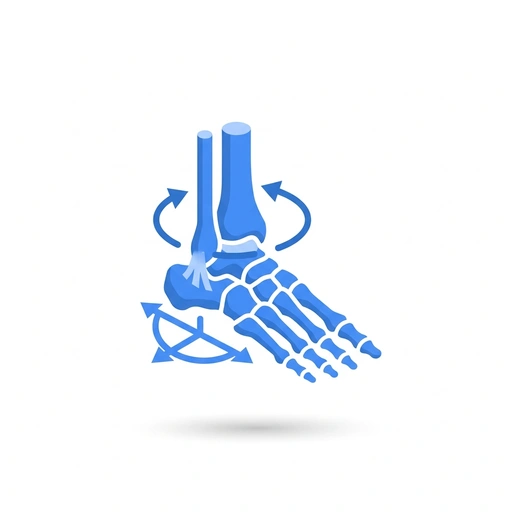
Ankle Mechanics and Stability
Like Duolingo, but for Ankle Mechanics and Stability. Tomo turns the whole topic into a game you play five minutes a day, until it actually sticks.
For the part of you with thirty open tabs that never became anything.
Free forever · No credit card · iPhone & Android

Key ideas in Ankle Mechanics and Stability
- The distal tibiofibular joint is a fibrous amphiarthrosis (syndesmosis) lacking a synovial capsule
- The anterior talar dome is wider than the posterior portion
- The joint is optimized for high-tension micro-motion rather than the low-friction fluid swing of diarthrodial joints
- Dorsiflexion wedges the wider talus into the mortise
- Ligamentous stiffness at this site is essential for maintaining the structural integrity of the ankle mortise under load
- The fibula must rotate externally and translate superiorly (ascend) to accommodate the talar width
- Distinguishing the functional classification and movement profile of the distal tibiofibular joint
- The mechanical sequence of the fibula during ankle dorsiflexion
- The ankle mortise requires precise millimetric alignment for force distribution
- The interosseous membrane acts as a tension-band that transfers load from the tibia to the fibula
- A 1mm lateral shift of the fibula reduces the effective contact area of the talus by approximately 40%
- The fibula is a weight-bearing bone, carrying a significant percentage of axial load via IOM shunting
- Syndesmotic widening leads to localized peak pressures that accelerate chondral wear
- IOM fiber orientation is optimized to resist the downward pull of muscles and upward thrust of the talus
- The impact of minor syndesmotic widening on joint contact mechanics
- The load-shunting role of the interosseous membrane
You've tried the other tabs
Thirty open tabs. Four facts you actually kept.
You watched. You nodded. By Sunday it was gone.
One answer, then back to scrolling.
Eight weeks. You meant to finish. You didn't.
Tomo gives Ankle Mechanics and Stability the Duolingo treatment: levels, streaks, and quick quizzes that test what you just learned. That game loop is what the tabs above never had, so it's the one you actually finish.
Here's what playing it feels like
A real question from this course. Take your best guess.
When looking at the talar dome from above, which section is wider?
Get it right to open this lesson and 11 more in the app.
Where Ankle Mechanics and Stability takes you
Go beyond basic joint names to master the complex biomechanics of the talocrural mortise and the neurological loops that prevent injury.
- 1
The Stability Architecture
- The Syndesmosis and High Ankle Dynamics
- The Lateral Complex and Proprioceptive Loops
- 2
Deep Arthrokinematics
- Talar Glide and the Subtalar Pivot
- The Medial Deltoid and Force Distribution
2 sections · 4 units · 12 levels. Built to play, not to enroll.
You pick the voice
Ankle Mechanics and Stability is taught in the The Professor style: clear, structured, thorough. Want a different feel? In the app you can spin up the same topic in any of Tomo's teaching styles. Same facts, totally different vibe.
More Science on Tomo

The Mechanics of the Cosmos
Master the mathematical laws and physical principles that govern everything from the motion of planets to the quantum behavior of starlight.
How Particle Accelerators Work
Look under the hood of the world's most powerful machines. Learn to identify the parts, steer the beams, and see how these 'atomic engines' power everything from cancer treatments to space-age materials.

The Living Factory: Biotech Basics
Discover how we use nature's own machinery to solve human problems, from curing diseases to growing sustainable food.

The Night Sky and Beyond
Journey from your backyard to the edge of the observable universe. Learn to navigate the constellations, understand the lives of stars, and explore the mysteries of black holes and dark energy.

Environmental Science: Our Changing Planet
Explore how Earth's natural systems function and how human activity reshapes our world. From biodiversity to renewable energy, learn to analyze the complex interactions that sustain life.
Molecular Architecture
Move beyond basic reactions to master the art of molecular design. Learn how to manipulate orbital symmetry, transition states, and non-covalent forces to engineer complex chemical outcomes.
Start Ankle Mechanics and Stability today.
Download Tomo, search Ankle Mechanics and Stability, and play your first lesson in under a minute.