
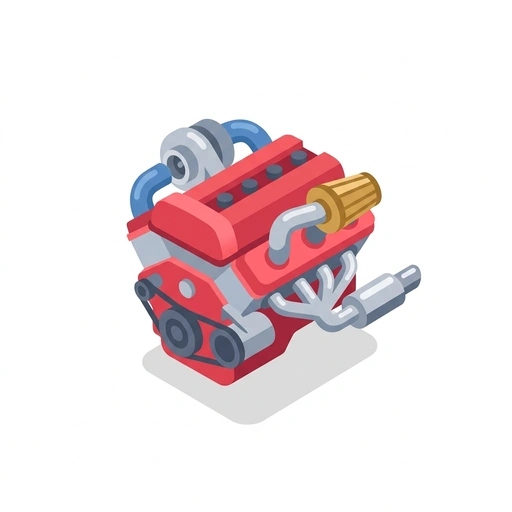
Car Mechanics and Everyday Upgrades
Understand how cars work from the engine bay to the wheels, and learn the essential logic behind modifying them for speed, sound, and handling.
Like Duolingo, but for Car Mechanics and Everyday Upgrades. Tomo turns the whole topic into a game you play five minutes a day, until it actually sticks.
A short one: 12 levels across 2 sections, about 24 minutes end to end, roughly 5 days at five minutes a day. It moves through How Cars Make Power and Speed and Grip, Stance, and Balanced Upgrades. It starts from scratch.
Free forever · No credit card · iPhone & Android

Key ideas in Car Mechanics and Everyday Upgrades
- Piston pulls fresh air and fuel into the cylinder during intake
- The mixture gets squeezed tight before a spark ignites it to push the piston down
- Spent exhaust gas is pushed out through the exhaust manifold
- The air intake loop starts at an open box with a pleated filter and leads directly to the engine
- Thick hoses run from the engine block to the radiator up front to shed heat
- The battery and alternator keep ignition, sensors, and accessories powered
- Engine oil points are marked on top of the engine for checking and refilling lubrication
- Torque is low-end twisting force that gives strong off-the-line launch feel
- Horsepower measures how quickly that work gets done at higher engine speeds
- A car can have high peak horsepower but feel sluggish from a dead stop if low-end torque is weak
- Forced induction rams extra air into the cylinder under pressure
- More air packed in allows the engine to burn more fuel per stroke, creating a bigger combustion kick
- A small 4-cylinder engine with a turbo can produce the power of a much larger naturally aspirated engine
- Fresh oil is amber and smooth, while dirty, broken-down oil turns black, gritty, and loses lubricating film
- Degraded coolant discolors to rusty brown and can no longer protect against overheating or corrosion
- Fresh brake fluid is light and clear; it absorbs moisture and darkens over time, lowering its boiling point
You've tried the other tabs
Thirty open tabs. Four facts you actually kept.
You watched. You nodded. By Sunday it was gone.
One answer, then back to scrolling.
Eight weeks. You meant to finish. You didn't.
Tomo gives Car Mechanics and Everyday Upgrades the Duolingo treatment: levels, streaks, and quick quizzes that test what you just learned. That game loop is what the tabs above never had, so it's the one you actually finish.
Here's what playing it feels like
A real question from this course. Take your best guess.
What happens to the air and fuel right before the spark ignites it?
Get it right to open this lesson and 11 more in the app.
Where Car Mechanics and Everyday Upgrades takes you
- 1
How Cars Make Power and Speed
- Inside the Engine Bay
- Unlocking Bolt-On Horsepower
- 2
Grip, Stance, and Balanced Upgrades
- Tires, Suspension, and Stopping
- Planning a Cohesive Build
2 sections · 4 units · 12 levels. Built to play, not to enroll.
You pick the voice
Car Mechanics and Everyday Upgrades is taught in the The Professor style: clear, structured, thorough. Want a different feel? In the app you can spin up the same topic in any of Tomo's teaching styles. Same facts, totally different vibe.
More Technology on Tomo
Everyday Car Mechanics
Demystify what happens under the hood. Learn to spot early warning signs, check vital fluids, and understand the core mechanical systems that keep your vehicle running safely.
The Anatomy of Your Car
Demystify the machine in your driveway by learning how parts work together to keep you moving and how to spot trouble before it starts.
Car Mechanics and Performance Tuning
Unpack the mechanical systems that turn fuel into fast, controlled lap times. Learn how airflow dynamics, ECU calibration, torque multiplication, and suspension geometry work together as an integrated performance machine.
How Cars Work
Demystify what happens beneath the hood and behind the dashboard. Learn how engines, transmissions, and brakes operate, how to spot warning signs before they become costly breakdowns, and how to make confident decisions as an owner.
Everyday Car Mechanics
Demystify what happens under your car's hood with practical, hands-on knowledge. Learn how to check vital fluids, diagnose weird noises, understand core engine systems, and deal honestly with mechanics.
The Mechanics of Modern Cars
Understand how modern cars translate mechanical forces into motion, handling, and control. Learn the physics of tire grip, power delivery, drivetrain layouts, and how to read the diagnostic cues your vehicle sends through the controls.
Start Car Mechanics and Everyday Upgrades today.
Download Tomo, search Car Mechanics and Everyday Upgrades, and play your first lesson in under a minute.