
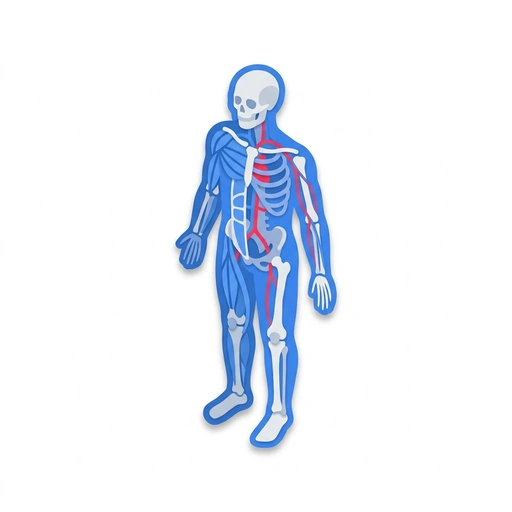
Comparative Anatomy and Linear Drawing
Construct believable animal forms through homologous skeletal mechanics, functional myology, and precise structural draftsmanship. Replace ambiguous rendering with definitive anatomical line weight, cross-contour rhythms, and kinematic force lines. Designed for experienced artists seeking to translate complex animal locomotion and surface anatomy into confident, economical line work.
Like Duolingo, but for Comparative Anatomy and Linear Drawing. Tomo turns the whole topic into a game you play five minutes a day, until it actually sticks.
20 levels across 3 sections, about 40 minutes end to end, roughly 8 days at five minutes a day. It moves through Translating Volume into Structural Line; Comparative Skeletal Architecture and Mechanics; and Myology, Wrapping Mass, and Surface Economy.
Free forever · No credit card · iPhone & Android
Key ideas in Comparative Anatomy and Linear Drawing
- Heavier line weight signals load-bearing bony points (like the olecranon process) and extreme fleshy compression against resistance (like seated gluteal mass)
- Stretched, tensioned contours and unloaded muscles are best described with thin, taut lines to read as pulled rather than bearing weight
- Modulating line weight based on compression versus skeletal proximity communicates gravity and volume faster than full value rendering
- In dynamic figure drawing, rhythmic force lines run through the fullness of active muscle masses using dominant convexities that capture outward muscular drive and tension
- The pinched side in lateral flexion creates an abrupt, folding concave transition where tissues crowd together, whereas the elongated, stretched side forms the continuous, structural convex sweep holding the torso's momentum
- Drawing the compressed side as the driving convex curve misidentifies where the structural energy and mechanical tension are being directed
- In a foreshortened reaching limb, the distal forearm extensors/brachioradialis wrap over the distal humerus and overlap the lower biceps form
- The biceps brachii nestles between the brachialis and passes underneath the anterior deltoid's embrace
- The pectoralis major tendon dives deep beneath the deltoid at the bicipital groove, placing it furthest back among the anterior torso-arm transitions
- Subcutaneous bony points like the tuber coxae and calcaneus force skin tight to bone, requiring an interruption of fluid contour to register skeletal rigidity
- Fascia seams—such as the division along the caudal edge of the tensor fasciae latae and the cranial margin of the biceps femoris—anchor skin and dictate clear directional shifts in surface plane
- Drawing unbroken, uninterrupted contours around fleshy muscle bellies ignores internal skeletal architecture, resulting in inflated, pneumatic-looking limbs
- In pronation, the radius crosses over the stationary ulna, causing superficial muscle masses like the brachioradialis and pronator teres to wrap obliquely around the skeletal cylinder
- Axial torsion is depicted in line art by bending cross-sectional ribbons along the helical muscle paths rather than drawing static transverse cross-sections
- Relying on perpendicular or uniform cross-contours flattens axial torsion into a static cylinder regardless of line weight
- Caliper lines break sharply or crease over subcutaneous bony landmarks because the skeleton offers immediate, rigid resistance under the skin
You've tried the other tabs
Thirty open tabs. Four facts you actually kept.
You watched. You nodded. By Sunday it was gone.
One answer, then back to scrolling.
Eight weeks. You meant to finish. You didn't.
Tomo gives Comparative Anatomy and Linear Drawing the Duolingo treatment: levels, streaks, and quick quizzes that test what you just learned. That game loop is what the tabs above never had, so it's the one you actually finish.
Here's what playing it feels like
A real question from this course. Take your best guess.
You are sketching a seated model leaning hard on one elbow. Where does your heaviest line weight belong?
Get it right to open this lesson and 19 more in the app.
How to learn Comparative Anatomy and Linear Drawing, step by step
Go in order. 20 short levels across 3 sections, about 40 minutes in all, five minutes a day.
- 1
Translating Volume into Structural Line
- Structural Line and Force Rhythms
- Cross-Contour Mapping and Form Torsion
- 2
Comparative Skeletal Architecture and Mechanics
- Homologous Chassis and Axial Mechanics
- Stance Typology: Plantigrade, Digitigrade, and Unguligrade
- Gaits, Suspensions, and Kinematic Lines
- 3
Myology, Wrapping Mass, and Surface Economy
- Comparative Myology and Muscular Slings
- Integument, Skin Folds, and Contour Economy
3 sections · 7 units · 20 levels. Built to play, not to enroll.
Questions about Comparative Anatomy and Linear Drawing
How do I learn Comparative Anatomy and Linear Drawing?
Go in order: start with Translating Volume into Structural Line, then Comparative Skeletal Architecture and Mechanics, then Myology, Wrapping Mass, and Surface Economy. On Tomo that's 20 short levels, about 40 minutes in all, played five minutes a day. Start free and play the first level in under a minute.
Is there a Duolingo-style app for Comparative Anatomy and Linear Drawing?
Yes. Tomo works like Duolingo: short daily lessons, streaks and quick quizzes. Comparative Anatomy and Linear Drawing is one of its free courses, and you can type any other topic to get a course of your own.
Is the Comparative Anatomy and Linear Drawing course free?
Yes. Comparative Anatomy and Linear Drawing is playable on Tomo's free plan, which doesn't expire. No credit card, no waitlist. Download the app and start your first lesson.
How long does it take to learn Comparative Anatomy and Linear Drawing?
20 levels across 3 sections, about 40 minutes of play in total. It's built for five minutes a day, so you finish it a little at a time instead of all at once.
Do I need any background to start Comparative Anatomy and Linear Drawing?
No. It's pitched at an advanced level, so it starts where you are and builds up. If you can tap a phone, you can start.
Tomo is in ChatGPT
Tomo is also a ChatGPT plugin: the same playable courses, built and played inside your chat.
Add Tomo to ChatGPT- What to ask
- “Make me a Tomo course on black holes.” “Turn this chat into a Tomo course.”
- What you get
- Quick questions with instant feedback, hearts and stars, ready to play in about a minute.
- Where it goes
- No sign-up to start. Connect your Tomo account and your streak carries on in the app.
You pick the voice
Comparative Anatomy and Linear Drawing is taught in the Professor style: clear, structured, thorough. Want a different feel? In the app you can spin up the same topic in any of Tomo's teaching styles. Same facts, totally different vibe.
More Arts on Tomo
Pattern Engineering and Advanced Construction
Transform flat textiles into complex three-dimensional forms through technical pattern drafting, kinetic balance, and internal garment architecture. Master advanced manipulation, turn-of-cloth compensation, and engineered structural assembly.
Reading Architecture Through Material
Learn to read buildings like an architect by looking at their materials. Discover how concrete, steel, titanium, and mass timber shaped the signature buildings of Le Corbusier, Mies, Gehry, and Zumthor.

Painting: Surface, Edge, and Space
Refine your painterly intelligence by mastering the physical behavior of paint and the perceptual dynamics of two-dimensional space. Move past basic rendering into edge hierarchies, rheological control, chromatic resonance, and decisive mark-making.
Drawing from Scratch
Learn to draw with confidence on paper or tablet. Build genuine skill step by step, from confident line work and 3D shading to drawing figures, fabric, and your own fashion sketches.

Elements of Art: The Visual Language
Move beyond basic definitions and learn how to use the elements of art as active tools for composition, mood, and visual storytelling in the classroom.

Drawing and Painting Essentials
Learn to translate what you see onto paper and canvas with accuracy, depth, and confidence. Explore core observational drawing, shading, color mixing, and rendering across dry and wet mediums.
Start Comparative Anatomy and Linear Drawing today.
Download Tomo, search Comparative Anatomy and Linear Drawing, and play your first lesson in under a minute.