
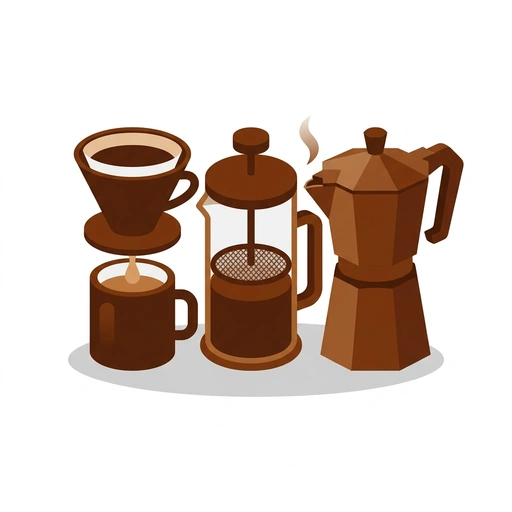
Comparing Coffee Brewing Methods
Evaluate how geometry, pressure, filter media, and fluid dynamics alter flavor clarity and tactile mouthfeel. Compare percolation, immersion, vapor, and hydraulic methods to control extraction with precision.
Like Duolingo, but for Comparing Coffee Brewing Methods. Tomo turns the whole topic into a game you play five minutes a day, until it actually sticks.
23 levels across 3 sections, about 46 minutes end to end, roughly 9 days at five minutes a day. It moves through Filtration Architecture and Tactile Dynamics; Pressure, Vapor, and Thermal Profiles; and Suspensions, Gravity Beds, and Ambient Dynamics.
Free forever · No credit card · iPhone & Android
Key ideas in Comparing Coffee Brewing Methods
- Dense bonded paper forms a tighter weave that strips out nearly all diterpenes (cafestol/kahweol) alongside micro-fines
- Removing insoluble oils and micro-fines drops perceived viscosity to an ultra-light, tea-like state
- Eliminating the lipid film allows delicate, volatile aromatic compounds to be perceived distinctly without palate coating
- Metal mesh allows insoluble micro-particulate and emulsified lipids to enter the brew freely
- Colloidal suspensions mute volatile aromatics like jasmine and bergamot through sensory masking
- Cloth acts as a selective barrier, blocking insoluble grit while permitting lipid droplets to slip through
- Cellulose fibers trap emulsified lipid droplets that would otherwise coat the tongue
- Mouthfeel perception shifts from velvety/buttery to clean and tea-like in direct proportion to lipid removal
- Cloth allows emulsified lipids through while completely trapping insoluble micro-fines
- The presence of oils without silt yields a heavy, syrupy, or glide-like mouthfeel entirely free of chalkiness
- Cloth brews possess greater body than paper brews while displaying cleaner finishing cups than metal brews
- Turbidity (suspended micro-fines and oil droplets) forms a physical film on lingual receptors
- This colloidal barrier dampens the immediate neural perception of malic, citric, and phosphoric acids
- Clean, low-turbidity cups deliver free organic acids directly to the palate without tactile interference
- Bed depth increases toward the cone's bottom apex, creating a path of least resistance through the deepest central column of coffee
- Water column height and hydraulic head pressure drive the fastest fluid velocities straight down the central axis rather than through the sloping perimeter walls
You've tried the other tabs
Thirty open tabs. Four facts you actually kept.
You watched. You nodded. By Sunday it was gone.
One answer, then back to scrolling.
Eight weeks. You meant to finish. You didn't.
Tomo gives Comparing Coffee Brewing Methods the Duolingo treatment: levels, streaks, and quick quizzes that test what you just learned. That game loop is what the tabs above never had, so it's the one you actually finish.
Here's what playing it feels like
A real question from this course. Take your best guess.
What happens to the thickness or body of your coffee when thick paper removes all oils and micro-fines?
Get it right to open this lesson and 22 more in the app.
Where Comparing Coffee Brewing Methods takes you
- 1
Filtration Architecture and Tactile Dynamics
- Filter Media and Tactile Weight
- Flat-Bottom vs. Conical Percolation
- Hybrid Immersion and Flow-Restricted Pour-Overs
- 2
Pressure, Vapor, and Thermal Profiles
- Hydraulic Extraction and Pressure Profiling
- Vapor-Pressure and Vacuum Extractions
- 3
Suspensions, Gravity Beds, and Ambient Dynamics
- Micro-Particulate Suspensions and Gravity Drippers
- Cold Percolation Kinetics vs. Cold Immersion
3 sections · 7 units · 23 levels. Built to play, not to enroll.
You pick the voice
Comparing Coffee Brewing Methods is taught in the Explain Like I'm 5 style: no big words. promise.. Want a different feel? In the app you can spin up the same topic in any of Tomo's teaching styles. Same facts, totally different vibe.
More Food & Drink on Tomo
Coffee Extraction Dynamics
Move past standard brew ratios and dial in coffee with physical and chemical precision. Master flow profiling, mineral buffer manipulation, and kinetic extraction to systematically unlock complex roasts.
Coffee Extraction Science
Examine the thermodynamics, fluid mechanics, and solubility kinetics behind brewing. Master profile shaping across immersion and percolation, control fine-particle migration, and engineer custom water chemistry for targeted cup profiles.
Precision Coffee Brewing
Move beyond the basics of the morning pot to master the physics of extraction, water chemistry, and the nuanced techniques of world-class pour-overs and espresso.
Brewing Better Coffee at Home
Move beyond basic brewing instructions to understand extraction, grind mechanics, and water chemistry. Diagnose problem cups and dial in pour-over, immersion, and espresso methods with confidence.
Precision Coffee Extraction and Chemistry
Explore the physical and chemical dynamics of specialty coffee brewing. Calibrate extractions using refractometry, manipulate mineral buffers in water, and decode fermentation and roast kinetics.
Coffee Craft and Extraction
Bridge the gap between pulling routine tickets and understanding true coffee craft. Master extraction mechanics, milk chemistry, sensory evaluation, roast profiles, and brew styles to elevate your daily bar workflow.
Start Comparing Coffee Brewing Methods today.
Download Tomo, search Comparing Coffee Brewing Methods, and play your first lesson in under a minute.