Connecting the Guitar Fretboard
Like Duolingo, but for Connecting the Guitar Fretboard. Tomo turns the whole topic into a game you play five minutes a day, until it actually sticks.
For the part of you with thirty open tabs that never became anything.
A short one: 12 levels across 2 sections, about 24 minutes end to end, roughly 5 days at five minutes a day. It moves through Break Out of the Open Neck and Play with Intent and Phrasing. It assumes you already know the basics.
Free forever · No credit card · iPhone & Android
Key ideas in Connecting the Guitar Fretboard
- Full barre chords crowd the low frequencies already occupied by the bass player.
- Upper-string triads isolate the chord tones that cut cleanly through a loud mix.
- Gripping three strings requires far less finger pressure than a full six-string barre.
- The 6th and 5th guitar strings provide reference coordinates for target root pitches.
- Movable chord shapes align directly above their root positions on the bass strings.
- Locking a root note onto the fretboard instantly transposes the shape to the desired key.
- Standard guitar strings are tuned in fourths except between the G and B strings.
- The G-to-B interval is a major third, four semitones instead of five.
- Fretboard shapes must shift up one fret on the top two strings to compensate for tuning.
- Root position places the chord's foundational root note on the lowest active string.
- First inversion raises the bass note to the chord's third, shifting the voicing upneck.
- Double-stops use two adjacent strings plucked together from an underlying triad shape.
- Sliding or hammering two notes within a triad creates rhythmic fills without muddying the groove.
- Leaving out one note of a triad opens up dynamic space for vocal melodies.
- Box 1's highest fretted notes double as Box 2's starting lower border notes.
- Sliding with your ring or index finger across boundary frets blends box shapes seamlessly.
You've tried the other tabs
Thirty open tabs. Four facts you actually kept.
You watched. You nodded. By Sunday it was gone.
One answer, then back to scrolling.
Eight weeks. You meant to finish. You didn't.
Tomo gives Connecting the Guitar Fretboard the Duolingo treatment: levels, streaks, and quick quizzes that test what you just learned. That game loop is what the tabs above never had, so it's the one you actually finish.
Here's what playing it feels like
A real question from this course. Take your best guess.
During a loud chorus with keys and bass, what helps your rhythm guitar cut cleanly through the mix?
Get it right to open this lesson and 11 more in the app.
Where Connecting the Guitar Fretboard takes you
Break free from open chords and the first pentatonic box. Learn how movable triad shapes, linked neck positions, and chord-tone targeting turn mechanical fretboard patterns into expressive, connected guitar playing.
- 1
Break Out of the Open Neck
- Movable Triads and Root Anchors
- Linking Pentatonic Boxes Across the Neck
- 2
Play with Intent and Phrasing
- Articulation and Touch
- Targeting Chord Tones
2 sections · 4 units · 12 levels. Built to play, not to enroll.
You pick the voice
Connecting the Guitar Fretboard is taught in the The Professor style: clear, structured, thorough. Want a different feel? In the app you can spin up the same topic in any of Tomo's teaching styles. Same facts, totally different vibe.
More Music on Tomo
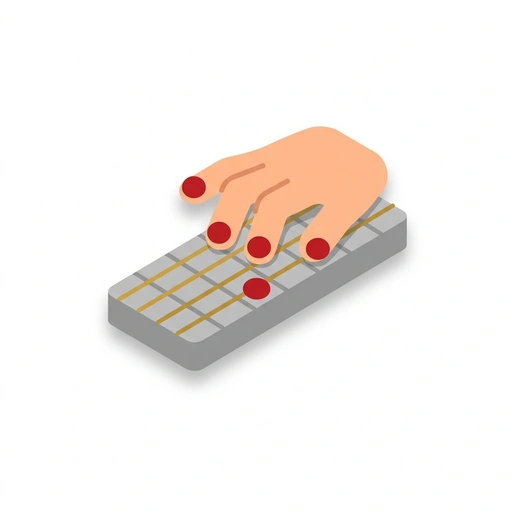
Guitar Chords by Shape
Stop memorizing hundreds of individual dots. Learn the 'master shapes' that unlock every chord on the guitar neck using simple, movable logic.

The Intermediate Guitarist's Toolkit
Move past basic open chords and simple scales to unlock the full fretboard. Learn to connect the neck, refine your tone, and play with professional expression.
Guitar Theory: From First Chords to Total Mastery
Stop memorizing shapes and start understanding the fretboard. Learn to play any song by ear, write your own riffs, and unlock the secrets of music theory directly on your guitar.
Guitar Rhythm and Chord Fluency
Break out of rigid beginner habits and master the fretboard with confident strumming, fluid syncopation, effortless barre chords, and rich voicings that groove in any style.

Impressionist Guitar: Voicing the Sublime
Transform your acoustic guitar into a lush orchestral canvas by mastering the harmonic language of Debussy and Ravel. Move beyond standard grips to explore ethereal extensions, open-string resonances, and the fluid textures of French Romanticism.
Singing at the Piano
Bridge the gap between your hands and your voice. This course teaches the coordination, arrangement, and expressive techniques needed to perform as a self-accompanied soloist.
Start Connecting the Guitar Fretboard today.
Download Tomo, search Connecting the Guitar Fretboard, and play your first lesson in under a minute.