
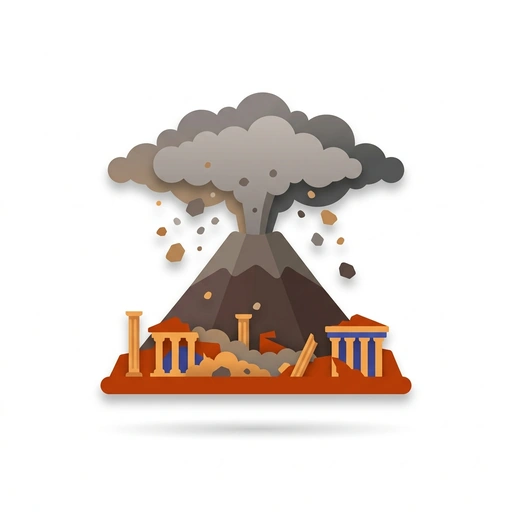
Destruction of Pompeii and Herculaneum
Deconstruct the physical and geological mechanics of the 79 AD eruption of Mount Vesuvius. Analyze the stratigraphy, lethal pyroclastic flows, and contrasting preservation taphonomy that froze two ancient cities in time.
Like Duolingo, but for Destruction of Pompeii and Herculaneum. Tomo turns the whole topic into a game you play five minutes a day, until it actually sticks.
83 levels across 8 sections, about 166 minutes end to end, roughly 33 days at five minutes a day. It moves through Field Forensics: Reading the Volcanic Deposits; The Eruption Timeline: Hour-by-Hour Reconstruction; Divergent Destinies: Pompeii vs. Herculaneum; The Physics and Lethality of Pyroclastic Density Currents; Forensic Bioarchaeology of the Victims; The Regional Arc: Beyond the Twin Cities; Magma, Pressure, and the Geochemical Engine; and Modern Archaeometry and Future Volcanic Hazard. It assumes you already know the basics.
Free forever · No credit card · iPhone & Android

Key ideas in Destruction of Pompeii and Herculaneum
- Airfall pumice blankets roofs, slopes, and open ground at a constant thickness
- Fall clasts are aerodynamically sorted in the eruption column into uniform lapilli sizes
- Airfall deposits lack ground-hugging momentum and drape terrain passively
- PDC flows behave like dense fluids, preferentially pooling inside rooms and street trenches
- PDCs deposit unsorted mixtures containing fine ash, pumice, and dense wall rock together
- Fall layers show crisp clast sorting because particles drop individually through air
- Passive vertical settling from the plume creates horizontal, planar layering
- Dilute turbulent surges push gas and ash horizontally, sculpting bedforms like river ripples
- Wavy dune beds and cross-lamination form only under high-velocity lateral shear
- Lithic bands represent fragmented wall rock blasted loose from Vesuvius's vent conduit
- Spikes in lithic abundance record explosive conduit collapse and rapid vent widening
- Dense lithics sink faster than frothy pumice, marking distinct explosive pulses
- Crisp, unweathered, razor-sharp contacts show continuous burial with no settling time
- Rill erosion channels carved into an ash top indicate rain runoff during an eruptive lull
- Fine, wind-blown reworked ash dust coats layer surfaces during temporary quiet phases
- Initial pumice fall concentrated extreme weight directly on pitched roofs
You've tried the other tabs
Thirty open tabs. Four facts you actually kept.
You watched. You nodded. By Sunday it was gone.
One answer, then back to scrolling.
Eight weeks. You meant to finish. You didn't.
Tomo gives Destruction of Pompeii and Herculaneum the Duolingo treatment: levels, streaks, and quick quizzes that test what you just learned. That game loop is what the tabs above never had, so it's the one you actually finish.
Here's what playing it feels like
A real question from this course. Take your best guess.
Imagine you dig into a pumice fall layer in Pompeii. Why are the lapilli pebbles all roughly the same size?
Get it right to open this lesson and 82 more in the app.
Where Destruction of Pompeii and Herculaneum takes you
- 1
Field Forensics: Reading the Volcanic Deposits
- Distinguishing Fall Deposits from Flow Deposits
- Reading Structural Failure Modes in Roman Architecture
- Stratigraphic Mapping of an Urban Dig
- 2
The Eruption Timeline: Hour-by-Hour Reconstruction
- The Opening Plinian Phase: The Pumice Rain
- Column Collapse and the First Pyroclastic Waves
- The Climactic Surges Across the Urban Plain
- 3
Divergent Destinies: Pompeii vs. Herculaneum
- Pompeii: The Mechanics of Pumice Trapping and Crush
- Herculaneum: Flash Incineration and Deep Mud Burial
- Taphonomic Contrasts: Preserved Wood vs. Plaster Voids
- 4
The Physics and Lethality of Pyroclastic Density Currents
- Fluid Mechanics of Concentrated Flows vs. Dilute Surges
- Thermal Dynamics and Biological Impact
- 5
Forensic Bioarchaeology of the Victims
- Decoding the Plaster Casts of Pompeii
- Forensic Osteology in the Herculaneum Boat Chambers
- 6
The Regional Arc: Beyond the Twin Cities
- Oplontis, Boscoreale, and the Suburban Agricultural Villas
- Stabiae and the Death of Pliny the Elder
- The Maritime Catastrophe Across the Bay of Naples
- 7
Magma, Pressure, and the Geochemical Engine
- Pre-Eruptive Magma Dynamics and Chamber Evolution
- Phreatomagmatic Explosions and External Water Interactions
- The Calendar Debate: Epigraphic, Botanical, and Coin Evidence
- 8
Modern Archaeometry and Future Volcanic Hazard
- Modern Archaeometry: Muons, Synchrotrons, and 3D Imaging
- Modern Hazard Modeling and Campania's Future Threat
8 sections · 21 units · 83 levels. Built to play, not to enroll.
Tomo is in ChatGPT
Tomo is also a ChatGPT plugin: the same playable courses, built and played inside your chat.
Add Tomo to ChatGPT- What to ask
- “Make me a Tomo course on black holes.” “Turn this chat into a Tomo course.”
- What you get
- Quick questions with instant feedback, hearts and stars, ready to play in about a minute.
- Where it goes
- No sign-up to start. Connect your Tomo account and your streak carries on in the app.
You pick the voice
Destruction of Pompeii and Herculaneum is taught in the Storyteller style: every lesson is a story. Want a different feel? In the app you can spin up the same topic in any of Tomo's teaching styles. Same facts, totally different vibe.
More History on Tomo
Historical Analysis and Method
Go beyond dates and chronologies to master the diagnostic tools of professional historians. Interrogate archival silences, model structural causation, and navigate deep historiographical debates.
Ancient Civilizations: Power and Connection
Move beyond the myths to understand how ancient empires actually functioned, from the logistics of their armies to the complex trade networks that linked the Mediterranean to the Far East.
The Betrayal of Charlie Kirk
An exhaustive forensic and psychological deep-dive into the 1891 murder of Charlie Kirk. Analyze the breakdown of trust, the mechanics of the ambush, and the legal precedents set by one of the era's most notorious acts of treachery.

The Great War: Beyond the Trenches
Move beyond basic dates to understand the human experience, the shifting maps of empires, and the technological leaps that changed warfare forever. Discover how a single spark ignited a global fire that still shapes our world today.
War, Water, and the Dutch City
Discover how 20th-century warfare, North Sea floods, and bold civil engineering shaped the modern urban landscapes of the Netherlands and its neighbors. Learn to read the hidden history in everyday streets, dikes, and city centers.
Patterns of World History
Unpack the structural forces that built our modern world. Trace how energy transitions, trade networks, ecological shocks, and institutional shifts steered the human journey from deep prehistory to globalized modernity.
Start Destruction of Pompeii and Herculaneum today.
Download Tomo, search Destruction of Pompeii and Herculaneum, and play your first lesson in under a minute.