
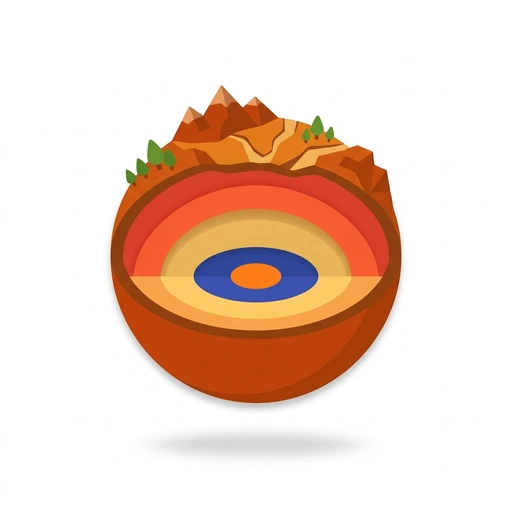
Geology: How the Earth Is Made
Learn to read the landscape like an open book, from identifying rocks beneath your feet to understanding volcanic eruptions and shifting continents. Discover how sediments harden into stone, how mountain ranges rise, and how the endless rock cycle shapes our planet.
Like Duolingo, but for Geology: How the Earth Is Made. Tomo turns the whole topic into a game you play five minutes a day, until it actually sticks.
25 levels across 3 sections, about 50 minutes end to end, roughly 10 days at five minutes a day. It moves through Reading the Rocks Beneath Your Feet, Landforms in Motion: Building and Carving, and The Engine Beneath: Plates and Deep Time. It starts from scratch.
Free forever · No credit card · iPhone & Android

Key ideas in Geology: How the Earth Is Made
- Igneous rocks form as liquid magma or lava cools, allowing minerals to grow directly against one another into interlocking crystals
- Interlocking crystals look like tight jigsaw pieces with no gaps, sand grains, or cement between them
- Sedimentary rocks are made of cemented particles, while metamorphic rocks show squished or aligned grains rather than a random crystalline mosaic
- Sedimentary rocks form from settled particles, often leaving distinct flat layers or gritty, sandy textures
- Fossils are almost exclusively preserved in sedimentary rocks because the heat that creates igneous and metamorphic rocks destroys organic remains
- Grains that rub off easily indicate cemented sediment rather than interlocking crystalline growth
- Metamorphic rocks undergo intense heat and pressure that squish, smear, and align mineral grains into wavy or banded patterns
- Sedimentary layers tend to settle flat and horizontal in water or wind, whereas metamorphic banding shows plastic distortion, folding, and wavy streaks
- Calcite is calcium carbonate, which fizzes and bubbles immediately when touched with weak acid (like vinegar or dilute acid)
- Quartz is very hard and will easily scratch common steel tools like pocketknives or nails without scratching itself
- Soft minerals like talc or gypsum can be visibly scratched using just a fingernail
- A rock's texture (such as interlocking crystals, cemented sand, or squished wavy ribbons) directly reveals how it was made
- Surface color in rocks often comes from trace amounts of elements (like iron turning rock red or pink) and varies widely even within the exact same rock type
- Deep underground, surrounding rock acts as an insulator, making magma cool over thousands of years
- Slow cooling gives atoms enough time to move together and build large, visible mineral crystals
- Granite is an intrusive igneous rock defined by its coarse, interlocking crystals
You've tried the other tabs
Thirty open tabs. Four facts you actually kept.
You watched. You nodded. By Sunday it was gone.
One answer, then back to scrolling.
Eight weeks. You meant to finish. You didn't.
Tomo gives Geology: How the Earth Is Made the Duolingo treatment: levels, streaks, and quick quizzes that test what you just learned. That game loop is what the tabs above never had, so it's the one you actually finish.
Here's what playing it feels like
A real question from this course. Take your best guess.
When you look closely at a rock with interlocking crystals, what pattern do you see?
Get it right to open this lesson and 24 more in the app.
Where Geology: How the Earth Is Made takes you
- 1
Reading the Rocks Beneath Your Feet
- Identifying the Three Rock Families
- Igneous Rocks: Cooled from Molten Fire
- Sedimentary Rocks: Archives of Ancient Worlds
- Metamorphic Rocks: Transformed by Heat and Pressure
- 2
Landforms in Motion: Building and Carving
- How Volcanoes Build and Destroy
- Weathering, Water, and Ice: Carving the Earth
- 3
The Engine Beneath: Plates and Deep Time
- Plate Tectonics: The Restless Crust
- The Endless Rock Cycle and Deep Time
3 sections · 8 units · 25 levels. Built to play, not to enroll.
Tomo is in ChatGPT
Tomo is also a ChatGPT plugin: the same playable courses, built and played inside your chat.
Add Tomo to ChatGPT- What to ask
- “Make me a Tomo course on black holes.” “Turn this chat into a Tomo course.”
- What you get
- Quick questions with instant feedback, hearts and stars, ready to play in about a minute.
- Where it goes
- No sign-up to start. Connect your Tomo account and your streak carries on in the app.
You pick the voice
Geology: How the Earth Is Made is taught in the Professor style: clear, structured, thorough. Want a different feel? In the app you can spin up the same topic in any of Tomo's teaching styles. Same facts, totally different vibe.
More Science on Tomo
Earth’s Cosmic Engine
Discover how our planet functions as a single, interconnected machine. From the deep ocean currents to the solar winds that shape our atmosphere, learn to read the signs of Earth's complex systems.
The Secret Life of Crystals
Go beyond the sparkle to understand how the Earth builds its most beautiful treasures. Learn to identify gems, understand their geometric secrets, and discover the extreme forces that forge diamonds.
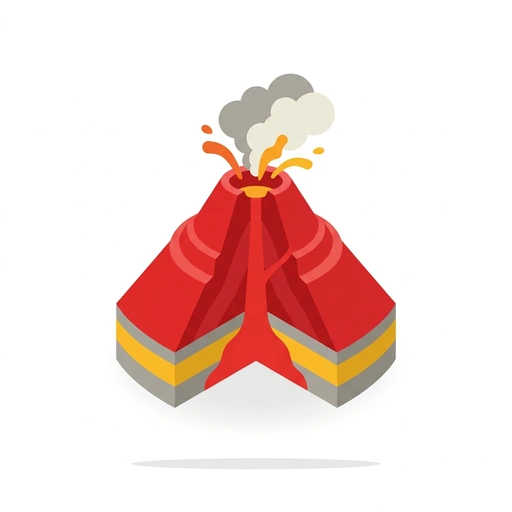
How Volcanoes Work
Discover why some volcanoes ooze gentle lava rivers while others blast mountains apart. Learn to read volcanic peaks, recognize the deadliest eruptive hazards, and see the subterranean engines driving our planet.
Living on a Giant Spaceship
Discover how our planet works as a perfectly balanced life-support system. Learn to read the landscape, predict the weather, and understand the massive forces moving beneath your feet.

The Thin Line: Moon, Earth, and Vacuum
Explore the physics of the boundaries where light meets shadow and atmosphere meets the void. Learn to read the Moon's geometry and understand the invisible pressure forces that define the edge of our world.

The Moving Earth
Discover why our planet is constantly shifting and shaking. Learn how deep heat and moving plates create giant mountains and powerful tremors.
Start Geology: How the Earth Is Made today.
Download Tomo, search Geology: How the Earth Is Made, and play your first lesson in under a minute.