
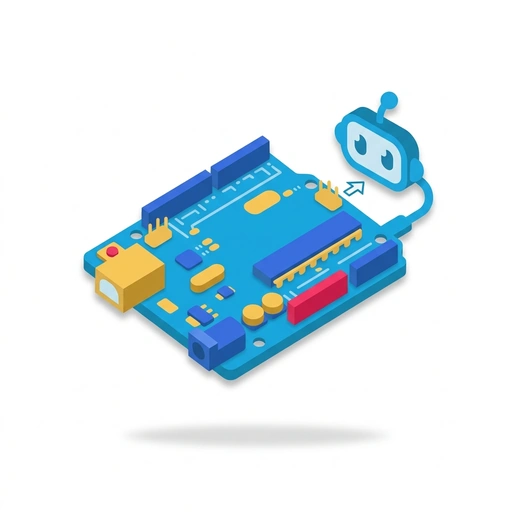
Hardware Control with Arduino and ESP32
Like Duolingo, but for Hardware Control with Arduino and ESP32. Tomo turns the whole topic into a game you play five minutes a day, until it actually sticks.
For the part of you with thirty open tabs that never became anything.
A short one: 12 levels across 2 sections, about 24 minutes end to end, roughly 5 days at five minutes a day. It moves through Responsive Logic and Safe Circuitry and Reliable Communication and Power Survival. It assumes you already know the basics.
Free forever · No credit card · iPhone & Android

Key ideas in Hardware Control with Arduino and ESP32
- delay() pauses microcontroller execution, halting sensor checks and input reads.
- Comparing current millis() to a past timestamp lets the loop run continuously.
- Timestamp subtraction avoids loop stalls and handles timer rollover naturally.
- ISRs must execute within microseconds to avoid starving other peripheral hardware.
- Serial prints and delay calls rely on interrupts and lock up inside an ISR.
- A well-behaved ISR simply toggles a volatile flag or updates a counter variable.
- Mechanical contacts generate multiple rapid voltage spikes over several milliseconds.
- An RC low-pass filter hardware circuit physically absorbs contact chatter.
- Software debouncing checks if sufficient time has passed since the last pin transition.
- Inputs and sensor thresholds are read non-blockingly at the start of the loop.
- A switch-case block checks the active state against the newly read inputs.
- State variables update before firing output actions to avoid conflicting states.
- An 8-bit AVR microcontroller reads 16-bit or 32-bit values across multiple clock cycles.
- An ISR firing mid-read corrupts data by modifying upper bytes before lower bytes finish.
- Disabling interrupts with noInterrupts() creates an atomic window for safe multi-byte reads.
- ESP32 GPIO pins are not 5V-tolerant unlike some older 8-bit microcontrollers.
You've tried the other tabs
Thirty open tabs. Four facts you actually kept.
You watched. You nodded. By Sunday it was gone.
One answer, then back to scrolling.
Eight weeks. You meant to finish. You didn't.
Tomo gives Hardware Control with Arduino and ESP32 the Duolingo treatment: levels, streaks, and quick quizzes that test what you just learned. That game loop is what the tabs above never had, so it's the one you actually finish.
Here's what playing it feels like
A real question from this course. Take your best guess.
How can your board wait without freezing its main loop?
Get it right to open this lesson and 11 more in the app.
Where Hardware Control with Arduino and ESP32 takes you
Level up from blinking LEDs to responsive, power-smart microcontroller systems. Learn to handle dual-voltage circuits, write non-blocking firmware, debug digital buses, and keep projects running on battery.
- 1
Responsive Logic and Safe Circuitry
- Non-Blocking Execution and Hardware Interrupts
- Bridging 5V Arduino and 3.3V ESP32 Circuits
- 2
Reliable Communication and Power Survival
- Debugging Bus Protocols: I2C and SPI
- ESP32 Power Optimization and Sleep Modes
2 sections · 4 units · 12 levels. Built to play, not to enroll.
You pick the voice
Hardware Control with Arduino and ESP32 is taught in the Explain Like I'm 5 style: no big words. promise.. Want a different feel? In the app you can spin up the same topic in any of Tomo's teaching styles. Same facts, totally different vibe.
More Technology on Tomo
Practical Circuit Design
Move past breadboard tutorials to build, analyze, and troubleshoot circuits that operate reliably in the real world. Learn how to control high-power loads, clean up noisy signals, select the right power architecture, and design durable printed circuit boards.
JavaScript Logic for Web and Mobile
Bridge the gap between basic syntax and professional application architecture. Master the logic patterns required to build responsive, high-performance apps that work seamlessly across every device.

ServiceNow: Building Better Workflows
Move beyond basic data entry and start designing intelligent, automated solutions. Learn to balance client-side responsiveness with robust server-side logic to create a seamless enterprise experience.

Advanced Automotive Diagnostics
Move beyond code-reading into deep system diagnostics. Master lab scopes, CAN-bus physical layer analysis, in-cylinder pressure profiling, and high-voltage electrified powertrain troubleshooting.
iPhone Efficiency and Power Habits
Move beyond the basics and transform your iPhone into a high-performance tool. Learn to automate repetitive tasks, master hidden navigation gestures, and secure your digital life with professional-grade settings.

Unreal Engine: Professional Workflows
Move beyond basic tutorials to build scalable, high-performance games. Master the architectural patterns, visual systems, and optimization tricks used by professional developers.
Start Hardware Control with Arduino and ESP32 today.
Download Tomo, search Hardware Control with Arduino and ESP32, and play your first lesson in under a minute.