
How Circuits Actually Work
Gain an intuitive grasp of voltage, current, and resistance by seeing how electricity actually moves through components. Learn to trace, design, and troubleshoot circuits from basic power loops to transistor-driven switches.
Like Duolingo, but for How Circuits Actually Work. Tomo turns the whole topic into a game you play five minutes a day, until it actually sticks.
A short one: 12 levels across 2 sections, about 24 minutes end to end, roughly 5 days at five minutes a day. It moves through Making Electricity Work and Control, Storage, and Logic. It starts from scratch.
Free forever · No credit card · iPhone & Android
Key ideas in How Circuits Actually Work
- Current only flows when there is an uninterrupted loop from higher potential back to lower potential
- Connecting to just one terminal of a power source cannot produce flow because there is nowhere for charges to return
- A load like a bulb must sit inside that continuous path to receive energy
- Voltage measures the electrical potential difference driving the flow
- Current measures how much charge passes through per second
- Electrical power depends on both pressure and flow simultaneously (Watts = Volts × Amps)
- A load provides resistance that converts electrical energy into useful output like light, sound, or mechanical motion
- Connecting power directly to ground without a load creates a short circuit, allowing massive current that rapidly overheats the wire and battery
- Every functioning circuit must have an intentional load to restrict and consume the electrical energy
- Ground in portable electronics is simply the common baseline reference from which all other voltages are measured
- Battery-powered devices do not need a connection to the literal Earth to have a functioning ground
- Voltages are always relative differences, so circuit designers pick one shared node to call 0V
- An open switch creates an air gap that breaks the continuous conductive path
- Current stops completely whenever an open break exists anywhere in a series path
- Closing a switch bridges the gap with a conductor, restoring the continuous circuit
- Resistance opposes current flow, so forcing more current through an unchanging resistance demands more electrical push (voltage)
You've tried the other tabs
Thirty open tabs. Four facts you actually kept.
You watched. You nodded. By Sunday it was gone.
One answer, then back to scrolling.
Eight weeks. You meant to finish. You didn't.
Tomo gives How Circuits Actually Work the Duolingo treatment: levels, streaks, and quick quizzes that test what you just learned. That game loop is what the tabs above never had, so it's the one you actually finish.
Here's what playing it feels like
A real question from this course. Take your best guess.
If you connect a wire to only one terminal of a battery, what happens?
Get it right to open this lesson and 11 more in the app.
Where How Circuits Actually Work takes you
- 1
Making Electricity Work
- The Complete Circuit: Harnessing Electron Flow
- Managing the Pressure: Resistance and Distribution
- 2
Control, Storage, and Logic
- Buffers and Valves: Capacitors and Diodes
- The Electric Valve: Transistors and Digital Signals
2 sections · 4 units · 12 levels. Built to play, not to enroll.
Tomo is in ChatGPT
Tomo is also a ChatGPT plugin: the same playable courses, built and played inside your chat.
Add Tomo to ChatGPT- What to ask
- “Make me a Tomo course on black holes.” “Turn this chat into a Tomo course.”
- What you get
- Quick questions with instant feedback, hearts and stars, ready to play in about a minute.
- Where it goes
- No sign-up to start. Connect your Tomo account and your streak carries on in the app.
You pick the voice
How Circuits Actually Work is taught in the Bestie style: your friend who just gets it. Want a different feel? In the app you can spin up the same topic in any of Tomo's teaching styles. Same facts, totally different vibe.
More Technology on Tomo
How Electric Circuits Work
Learn how electricity moves through everyday devices and gain the confidence to build your own circuits. From breadboarding components to debugging with a multimeter, discover the practical rules that bring hardware to life.
Electricity and Practical Circuits
Move beyond basic textbook formulas to build a working intuition for real circuits. Learn how components behave under load, diagnose tricky faults, and master the forces shaping electrical systems.
Hands-On Electronics
Demystify how everyday gadgets work by building and understanding circuits from the ground up. Learn to direct electrical currents, wire components safely, and read circuit behaviors.
How Electronics Work
Learn how electricity moves through circuits, powers components, and responds to controls. Build real intuition for voltage, resistance, and transistors through practical circuit design. Go from a bare battery to building responsive, sensor-driven hardware.
Electric Circuits
Build an intuitive and practical grasp of electrical circuits from the ground up. Master current, voltage, and circuit laws, simplify complex networks with proven theorems, and predict dynamic circuit behavior over time.
How Circuits Work
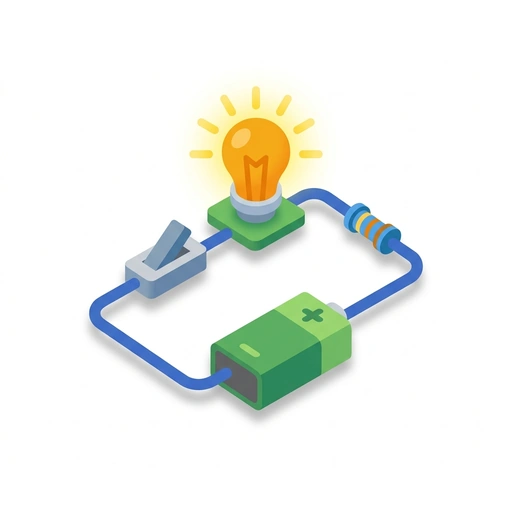
Understand the unseen flow of electricity by building real, working circuits. Learn to light components, route power on a breadboard, and automate behavior with switches and transistors.
Start How Circuits Actually Work today.
Download Tomo, search How Circuits Actually Work, and play your first lesson in under a minute.