
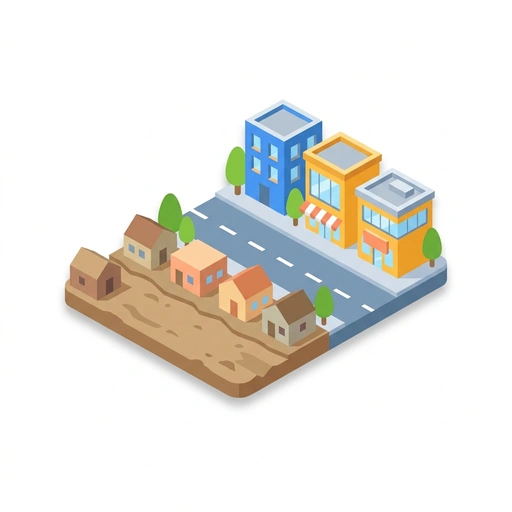
How Our Streets Got Their Shape
Discover the hidden history of the places you visit every day, from the surgical roots of the barbershop to why diners look like train cars.
Like Duolingo, but for How Our Streets Got Their Shape. Tomo turns the whole topic into a game you play five minutes a day, until it actually sticks.
88 levels across 8 sections, about 176 minutes end to end, roughly 35 days at five minutes a day. It moves through The Modern Main Street, The Evolution of Eating Out, Essential Services and Social Hubs, The Evolution of Shopping, Knowledge and Community, Travel and Lodging, Leisure and Play, and The Logic of the Street. It starts from scratch.
Free forever · No credit card · iPhone & Android

Key ideas in How Our Streets Got Their Shape
- Narrow footprints maximized street frontage when property taxes were based on width
- High ceilings and deep windows were essential for natural light before electric bulbs
- Building shapes were dictated by the need to display goods to foot traffic
- Daily needs like milk or bread historically required a 'corner' location near homes
- Comparison shopping (like clothing) works best when many similar shops are within a short walk
- The distance a person is willing to carry a bag determines where shops cluster
- Recognizing how building shapes reflect historical priorities
- Predicting establishment clustering based on walking distance
- Large plate glass is a relatively recent industrial invention
- Muntins (the wood strips between panes) were originally structural necessities for small glass pieces
- Modern shops often mimic these 'divided' looks to feel traditional or cozy
- Armrests in the middle of benches prevent people from lying down or staying too long
- Lack of shade or 'hostile' textures (like spikes) discourage loitering
- Awnings were first used to protect goods from sun damage while signaling a shop was open
- Muntins were originally structural necessities for small glass pieces
- Large windows evolved to turn the entire shop interior into a 'stage' for passersby
You've tried the other tabs
Thirty open tabs. Four facts you actually kept.
You watched. You nodded. By Sunday it was gone.
One answer, then back to scrolling.
Eight weeks. You meant to finish. You didn't.
Tomo gives How Our Streets Got Their Shape the Duolingo treatment: levels, streaks, and quick quizzes that test what you just learned. That game loop is what the tabs above never had, so it's the one you actually finish.
Here's what playing it feels like
A real question from this course. Take your best guess.
You step into an old shop with a soaring ceiling and windows that reach the floor. Why was this design so critical in the 1800s?
Get it right to open this lesson and 87 more in the app.
Where How Our Streets Got Their Shape takes you
- 1
The Modern Main Street
- Seeing Your Neighborhood Differently
- 2
The Evolution of Eating Out
- The Diner: From Wagons to Chrome
- Coffee Houses and the Third Place
- The Pub and the Tavern
- 3
Essential Services and Social Hubs
- The Post Office: The Original Network
- Barbershops and the History of Surgery
- Pharmacies and the Soda Fountain
- 4
The Evolution of Shopping
- From General Stores to Supermarkets
- The Department Store Experience
- Vending Machines and Automated Retail
- 5
Knowledge and Community
- Libraries: From Archives to Hubs
- The Schoolhouse and the Campus
- Parks and Public Squares
- 6
Travel and Lodging
- The Inn, the Hotel, and the Motel
- Gas Stations and the Roadside
- Train Stations and Commuting
- 7
Leisure and Play
- The Movie Palace and the Multiplex
- Gyms and Physical Culture
- Arcades and Play Spaces
- 8
The Logic of the Street
- Why Buildings Look the Way They Do
- Zoning and Clustering
- The Future of the Physical Store
8 sections · 22 units · 88 levels. Built to play, not to enroll.
You pick the voice
How Our Streets Got Their Shape is taught in the The Storyteller style: every lesson is a story. Want a different feel? In the app you can spin up the same topic in any of Tomo's teaching styles. Same facts, totally different vibe.
More History on Tomo

The History of Café Culture
Trace the evolution of the world's most vital social spaces, from Ottoman 'schools of the wise' to the modern digital nomad hubs that shape our daily lives.

Germany: Culture, History, and Language
Explore the heart of Europe by understanding the German mindset, the pivotal moments of its history, and the logic of its unique language.

The Japanese Social Fabric
Explore the intricate evolution of Japanese life, from the strategic architecture of samurai castles to the philosophical underpinnings of the tea ceremony and the daily rhythms of the Edo period.
Entertainment in the Renaissance
Step into the bustling taverns, gilded ballrooms, and rowdy open-air playhouses of Renaissance Europe. Discover how everyday folk and courtiers gambled, danced, feasted, and staged dazzling spectacles.

Explorers of Time and Place
Go beyond basic facts to discover how people shaped our world and how our surroundings shape us. Learn to piece together the past like a detective and read the secrets of the landscape.

The Historian's Lens
Move beyond memorizing dates and start questioning how the stories of our past are built. Learn to spot bias, compare conflicting accounts, and understand why the 'truth' of history changes over time.
Start How Our Streets Got Their Shape today.
Download Tomo, search How Our Streets Got Their Shape, and play your first lesson in under a minute.