

How the Mind Works
Discover how the human mind turns raw sensory input into thought, memory, and conscious decisions. Explore the hidden mental architecture that shapes how you perceive reality, solve problems, and communicate. Gain a clear, unified view of cognitive science without getting lost in academic jargon.
Like Duolingo, but for How the Mind Works. Tomo turns the whole topic into a game you play five minutes a day, until it actually sticks.
24 levels across 4 sections, about 48 minutes end to end, roughly 10 days at five minutes a day. It moves through Filtering and Interpreting Reality; Memory, Meaning, and Language; Reasoning and Problem-Solving; and The Architecture of Thought. It starts from scratch.
Free forever · No credit card · iPhone & Android
Key ideas in How the Mind Works
- Sensory organs continuously collect vast streams of physical information from the environment
- Conscious awareness acts as a narrow bottleneck that admits only a tiny fraction of incoming sensory signals
- Sensations not deemed immediately relevant are filtered out before reaching conscious perception
- Inattentional blindness occurs when high focus on one task prevents conscious awareness of an unexpected object
- Direct visual gaze alone does not equal visual perception; the brain's attention system must actively process the image
- Even visually prominent or brightly colored objects can go entirely unnoticed during focused attention
- The brain cannot consciously process two cognitively demanding, goal-directed tasks at the same exact time
- What feels like simultaneous multitasking is actually rapid task-switching
- Every switch between tasks carries an unavoidable cognitive cost in time, mental effort, and error rate
- Selective attention works both by boosting target sensory inputs and by actively suppressing distracting inputs
- Suppressing background noise is an active neural effort, not merely passive absence of hearing
- High-salience signals, like hearing one's own name, can punch through suppression filters
- Resisting tempting sensory cues requires active cognitive control that exhausts mental resources over time
- Removing distracting stimuli from the physical environment bypasses the need for continuous neural suppression
- Modifying environmental context preserves cognitive bandwidth far more reliably than effortful willpower
- The eye receives incomplete, noisy signals with blind spots and low peripheral resolution
You've tried the other tabs
Thirty open tabs. Four facts you actually kept.
You watched. You nodded. By Sunday it was gone.
One answer, then back to scrolling.
Eight weeks. You meant to finish. You didn't.
Tomo gives How the Mind Works the Duolingo treatment: levels, streaks, and quick quizzes that test what you just learned. That game loop is what the tabs above never had, so it's the one you actually finish.
Here's what playing it feels like
A real question from this course. Take your best guess.
Your senses grab lots of clues, but how much can you actually pay attention to at once?
Get it right to open this lesson and 23 more in the app.
How to learn How the Mind Works, step by step
Go in order. 24 short levels across 4 sections, about 48 minutes in all, five minutes a day.
- 1
Filtering and Interpreting Reality
- The Bottleneck of Attention
- Perception as an Educated Guess
- 2
Memory, Meaning, and Language
- How Memory Reconstructs the Past
- Concepts and Mental Shortcuts
- Language and Inner Thought
- 3
Reasoning and Problem-Solving
- Navigating Uncertainty and Decisions
- 4
The Architecture of Thought
- The Mind as an Information Engine
- Embodied and Extended Thinking
4 sections · 8 units · 24 levels. Built to play, not to enroll.
Questions about How the Mind Works
How do I learn How the Mind Works?
Go in order: start with Filtering and Interpreting Reality, then Memory, Meaning, and Language, then Reasoning and Problem-Solving, then The Architecture of Thought. On Tomo that's 24 short levels, about 48 minutes in all, played five minutes a day. Start free and play the first level in under a minute.
Is there a Duolingo-style app for How the Mind Works?
Yes. Tomo works like Duolingo: short daily lessons, streaks and quick quizzes. How the Mind Works is one of its free courses, and you can type any other topic to get a course of your own.
Is the How the Mind Works course free?
Yes. How the Mind Works is playable on Tomo's free plan, which doesn't expire. No credit card, no waitlist. Download the app and start your first lesson.
How long does it take to learn How the Mind Works?
24 levels across 4 sections, about 48 minutes of play in total. It's built for five minutes a day, so you finish it a little at a time instead of all at once.
Do I need any background to start How the Mind Works?
No. It's pitched at a beginner level, so it starts where you are and builds up. If you can tap a phone, you can start.
Tomo is in ChatGPT
Tomo is also a ChatGPT plugin: the same playable courses, built and played inside your chat.
Add Tomo to ChatGPT- What to ask
- “Make me a Tomo course on black holes.” “Turn this chat into a Tomo course.”
- What you get
- Quick questions with instant feedback, hearts and stars, ready to play in about a minute.
- Where it goes
- No sign-up to start. Connect your Tomo account and your streak carries on in the app.
You pick the voice
How the Mind Works is taught in the Explain Like I'm 5 style: no big words. promise.. Want a different feel? In the app you can spin up the same topic in any of Tomo's teaching styles. Same facts, totally different vibe.
More Science on Tomo
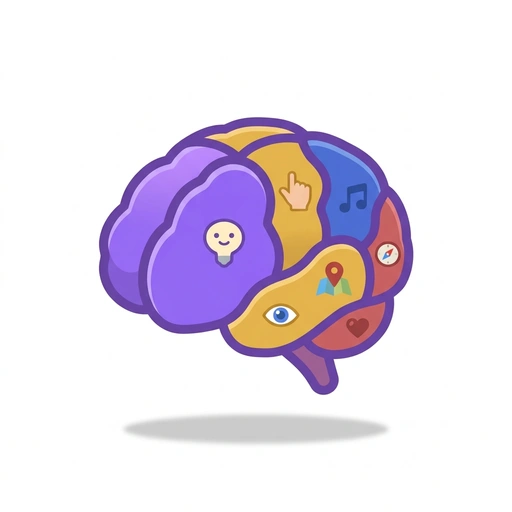
Mapping the Human Brain
Explore the architecture of the mind from the wrinkly outer cortex to the deep survival core. Learn where memories, senses, and motor habits live, and trace how distinct regions collaborate to produce everyday experience.
Quantum Mechanics and Reality
Move beyond pop-science metaphors to master the mathematical and physical reality of the subatomic world, from wavefunctions to quantum computing.
The Animal Mind in Action
Move beyond basic instincts to discover how animal brains solve problems, form social bonds, and navigate their worlds. Explore the fascinating mechanics of cognition and emotion across the animal kingdom.

How Quantum Physics Works
Explore the strange rules governing nature at its smallest scales. Discover why particles act like waves, how probability replaces certainty, and how quantum weirdness powers modern technology.
How Senses Construct Reality
Your conscious experience feels like a direct window onto the physical world, but it is actually a calibrated simulation built from ambiguous neural signals. Learn how your brain weighs top-down expectations against noisy sensory data across vision, hearing, and touch. Unpack the mechanics of perceptual thresholds, cross-modal integration, and sensory illusions.

Quantum Reality and Your Mind
Explore the surprising connection between subatomic physics and the power of intention. Learn how the science of possibility can change the way you view your daily life and future.
Start How the Mind Works today.
Download Tomo, search How the Mind Works, and play your first lesson in under a minute.