
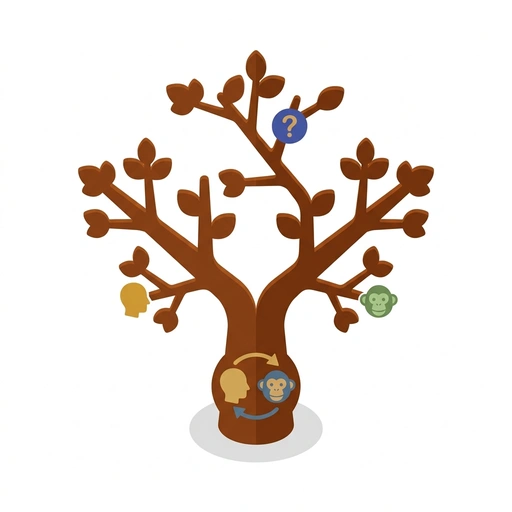
Humans and Monkeys: The Family Tree
Explore why we can't have 'human-monkey' babies and discover the fascinating truth about our shared history. Learn how DNA and evolution connect us to our primate cousins.
Like Duolingo, but for Humans and Monkeys: The Family Tree. Tomo turns the whole topic into a game you play five minutes a day, until it actually sticks.
A short one: 26 levels across 3 sections, about 52 minutes end to end, roughly 10 days at five minutes a day. It moves through Solving the Mystery of Reproduction, Spotting Our Shared Traits, and Tracing the Ancient Connection. It starts from scratch.
Free forever · No credit card · iPhone & Android
Key ideas in Humans and Monkeys: The Family Tree
- Species accumulate different genetic changes over millions of years
- Evolutionary distance creates physical and chemical barriers to fertilization
- Humans and monkeys have different numbers of chromosomes
- Fertilization requires specific protein-to-protein recognition
- Why shared ancestry doesn't ensure reproductive compatibility
- The primary biological barriers to DNA combination
- Small genetic percentages represent millions of structural differences
- Biological compatibility requires an exact match, not just a high percentage of similarity
- Chromosomes must exist in matching pairs to function as a complete set of instructions
- Each parent contributes half of the total instructions
- An odd or mismatched total number of chromosomes leaves 'chapters' without a partner, breaking the developmental blueprint
- The instructions from both parents must align perfectly to be 'read' by the growing embryo
- Chromosomes must pair up immediately after fertilization
- Unpaired chromosomes lead to a failure in the biological instructions, halting growth
- Why mismatched chromosome counts prevent a viable offspring
- The sequence of events when chromosomes fail to pair
You've tried the other tabs
Thirty open tabs. Four facts you actually kept.
You watched. You nodded. By Sunday it was gone.
One answer, then back to scrolling.
Eight weeks. You meant to finish. You didn't.
Tomo gives Humans and Monkeys: The Family Tree the Duolingo treatment: levels, streaks, and quick quizzes that test what you just learned. That game loop is what the tabs above never had, so it's the one you actually finish.
Here's what playing it feels like
A real question from this course. Take your best guess.
What is the primary result of a large 'evolutionary distance' between two species?
Get it right to open this lesson and 25 more in the app.
Where Humans and Monkeys: The Family Tree takes you
- 1
Solving the Mystery of Reproduction
- Why Humans and Monkeys Can't Reproduce
- How Chromosomes Act Like Instruction Manuals
- The Genetic Gap Between Species
- What Happens When DNA Doesn't Match
- 2
Spotting Our Shared Traits
- Looking at Our Hands and Feet
- How We Both Use Tools and Solve Problems
- Social Lives in the Jungle and the City
- Reading the Faces of Our Primate Relatives
- The Language of Gestures
- Why We Are Cousins, Not Descendants
- 3
Tracing the Ancient Connection
- Finding the Common Ancestor
- How One Path Split into Two
- The Fossil Clues Left Behind
3 sections · 13 units · 26 levels. Built to play, not to enroll.
You pick the voice
Humans and Monkeys: The Family Tree is taught in the The Bestie style: your friend who just gets it. Want a different feel? In the app you can spin up the same topic in any of Tomo's teaching styles. Same facts, totally different vibe.
More Science on Tomo

The Secret Life of Everything
Discover how the world works by solving real-life mysteries. From decoding hidden messages in stories to calculating the speed of a falling apple, you'll learn to see the math and science hiding in plain sight.
Mind-Bending Science: From Chaos to Cosmos
Explore the wildest ideas in the universe, from cats that are both dead and alive to the invisible forces shaping our planet and beyond. Master the mysteries that keep even the world's smartest scientists awake at night.

The Living Puzzle: Mastering Evolution
Move beyond basic survival of the fittest to understand the complex dance of life. Discover how genes shift, why weird traits persist, and how the history of the Earth is written in our own DNA.
Mastering Motion: The Physics of Moving Things
Stop just memorizing formulas and start predicting how the world moves. From launching projectiles to reading the hidden stories in graphs, you will master the language of motion used by NASA engineers and pro athletes alike.
Quantum Physics for the Curious
Ever wonder how a particle can be in two places at once? Discover the strange rules of the tiny world and how they power the technology in your pocket.

Quantum Physics in Your Pocket
Stop thinking about abstract equations and start seeing the quantum world in your everyday life. Discover how the strange rules of the tiny make your phone work, your toaster glow, and your cat (theoretically) immortal.
Start Humans and Monkeys: The Family Tree today.
Download Tomo, search Humans and Monkeys: The Family Tree, and play your first lesson in under a minute.