
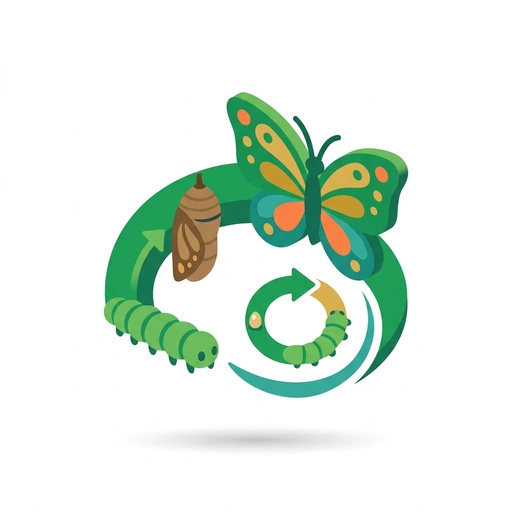
Insect Anatomy and Metamorphosis
Uncover how insects are built and how they pull off nature's most dramatic transformations. From specialized mouthparts to cocoons and cellular remodeling, explore the mechanics behind Earth's most successful creatures.
Like Duolingo, but for Insect Anatomy and Metamorphosis. Tomo turns the whole topic into a game you play five minutes a day, until it actually sticks.
24 levels across 4 sections, about 48 minutes end to end, roughly 10 days at five minutes a day. It moves through Reading the Living Insect, The Two Paths of Growth, Field Guide to Larvae and Pupae, and The Engine of Transformation. It starts from scratch.
Free forever · No credit card · iPhone & Android

Key ideas in Insect Anatomy and Metamorphosis
- Insects have exactly three distinct body segments
- The head sits at the front, followed by the middle thorax, ending with the rear abdomen
- All six legs always sprout from the middle segment (thorax)
- Wings, if present, also grow exclusively from the thorax
- The abdomen bears no true walking legs or flight wings
- The hard exoskeleton cannot stretch or expand once formed
- An insect must crack and shed its rigid outer shell to increase in size
- Antennae on the head detect smells, vibrations, and touch
- Compound eyes on the head provide vision
- Defensive stingers or abdominal organs are located at the opposite end of the body
- Insects uniquely have 6 legs and 3 body sections
- Spiders belong to arachnids with 8 legs and 2 main body parts
- Centipedes and isopods have far more leg pairs and body divisions than insects
- Chewing insects have hardened jaws called mandibles that move side-to-side
- Mandibles cut and crush solid plant tissue like scissors or teeth
- Chewing is the basic, ancestral mouthpart design found in insects like grasshoppers and beetles
You've tried the other tabs
Thirty open tabs. Four facts you actually kept.
You watched. You nodded. By Sunday it was gone.
One answer, then back to scrolling.
Eight weeks. You meant to finish. You didn't.
Tomo gives Insect Anatomy and Metamorphosis the Duolingo treatment: levels, streaks, and quick quizzes that test what you just learned. That game loop is what the tabs above never had, so it's the one you actually finish.
Here's what playing it feels like
A real question from this course. Take your best guess.
What is the correct order of an insect's three body parts, from front to back?
Get it right to open this lesson and 23 more in the app.
Where Insect Anatomy and Metamorphosis takes you
- 1
Reading the Living Insect
- Spotting the Insect Blueprint
- Decoding Insect Mouthparts
- 2
The Two Paths of Growth
- Incomplete Metamorphosis: The Gradual Path
- Complete Metamorphosis: The Radical Division
- 3
Field Guide to Larvae and Pupae
- Identifying the Five Larval Shapes
- Reading the Forms of Pupae
- 4
The Engine of Transformation
- Inside the Pupa: The Cellular Remodel
- Why Metamorphosis Conquered the Planet
4 sections · 8 units · 24 levels. Built to play, not to enroll.
You pick the voice
Insect Anatomy and Metamorphosis is taught in the Explain Like I'm 5 style: no big words. promise.. Want a different feel? In the app you can spin up the same topic in any of Tomo's teaching styles. Same facts, totally different vibe.
More Nature on Tomo

The Life of Trees
Go beyond basic identification to understand the complex hydraulics, social networks, and structural engineering of the world's oldest living organisms.

The Secret Life of Mushrooms
Discover how fungi are the hidden architects of our world, from the food on your plate to the vast networks beneath your feet. Learn to spot them, use them, and understand their vital role in nature's cycle.

Life Beneath the Surface
Discover the hidden neighborhoods of ponds, lakes, and rivers. Learn to read the water and understand the delicate balance that keeps aquatic worlds thriving.

Practical Arboriculture: Field and Certification Essentials
Develop the hands-on expertise required for field tree work and the ISA Certified Arborist exam. Master tree biology, safe rigging, pruning cuts, pest diagnosis, and cold-climate species identification from the ground up.

Norway Spruce: From Sapling to Giant
Master the art of cultivating the iconic Norway Spruce. From selecting the perfect site to managing decades of growth, learn the professional techniques to ensure your sapling thrives into a majestic forest anchor.

The Art of the Herbalist
Master the transition from kitchen enthusiast to skilled herbalist. Learn botanical identification, advanced extraction chemistry, and the professional logic of formulation and safety.
Start Insect Anatomy and Metamorphosis today.
Download Tomo, search Insect Anatomy and Metamorphosis, and play your first lesson in under a minute.