
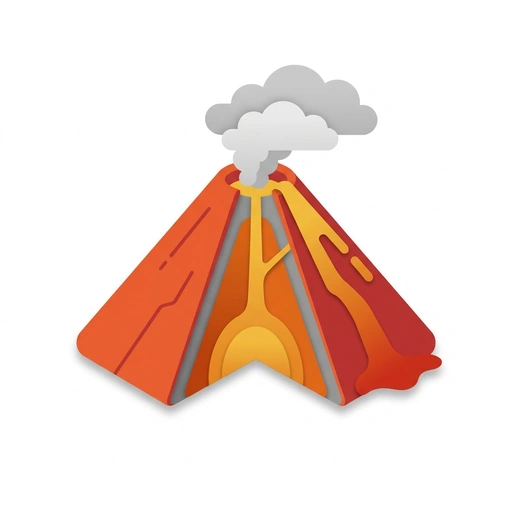
Inside Volcanoes: How Eruptions Happen
Discover why some volcanoes ooze gentle lava while others obliterate whole mountains. Learn to identify volcanic landscapes, recognize real-world hazards, and see how scientists forecast eruptions before disaster strikes.
Like Duolingo, but for Inside Volcanoes: How Eruptions Happen. Tomo turns the whole topic into a game you play five minutes a day, until it actually sticks.
A short one: 12 levels across 2 sections, about 24 minutes end to end, roughly 5 days at five minutes a day. It moves through Decoding the Eruption and Finding the Fire and Reading the Signs. It starts from scratch.
Free forever · No credit card · iPhone & Android

Key ideas in Inside Volcanoes: How Eruptions Happen
- Runny lava allows expanding gas bubbles to escape easily, producing gentle flows rather than blasts
- Thick, sticky magma traps gas bubbles and clogs volcanic vents, allowing pressure to build until it shatters violently
- Volcanic ash is made of tiny fragments of shattered rock and volcanic glass, not burned organic wood or soot
- When pressure suddenly drops, dissolved gases rapidly expand and shatter sticky magma into frothy pumice and microscopic ash
- Shield volcanoes have broad, low-angle slopes because their fluid basalt lava travels long distances before solidifying
- Eruptions on shield volcanoes are primarily effusive (oozing or fountaining) rather than massive ash-producing blasts
- Stratovolcanoes grow steep peaks because they alternate between explosive blasts that deposit ash/debris and slow flows of sticky lava
- Sticky lava cannot travel far from the vent, piling up around the rim alongside fallen ash to form steep sides
- Cinder cones are typically small, short-lived features formed when lava fountains freeze in mid-air and pile up around a single vent
- Shield volcanoes are enormous, gentle mounds built over thousands of years by runny basalt
- Stratovolcanoes are large, steep composite peaks built from alternating explosive and effusive layers
- Most lava flows advance at walking pace or slower, giving people ample time to walk out of their path
- Lava flows are devastating to buildings, roads, and land, but rarely catch mobile people by surprise
- Pyroclastic flows travel down slopes at highway speeds, making evacuation on foot impossible once they start
- The interior of a pyroclastic current reaches hundreds of degrees Celsius, destroying structures and burning anything organic instantly
- Volcanic ash is shattered rock and mineral glass, not soft organic soot
You've tried the other tabs
Thirty open tabs. Four facts you actually kept.
You watched. You nodded. By Sunday it was gone.
One answer, then back to scrolling.
Eight weeks. You meant to finish. You didn't.
Tomo gives Inside Volcanoes: How Eruptions Happen the Duolingo treatment: levels, streaks, and quick quizzes that test what you just learned. That game loop is what the tabs above never had, so it's the one you actually finish.
Here's what playing it feels like
A real question from this course. Take your best guess.
What happens when underground magma is thick and sticky?
Get it right to open this lesson and 11 more in the app.
Where Inside Volcanoes: How Eruptions Happen takes you
- 1
Decoding the Eruption
- Why Some Volcanoes Ooze and Others Explode
- Recognizing the Deadliest Volcanic Hazards
- 2
Finding the Fire and Reading the Signs
- Mapping Where Magma Breaks the Surface
- How Scientists Forecast the Next Blast
2 sections · 4 units · 12 levels. Built to play, not to enroll.
Tomo is in ChatGPT
Tomo is also a ChatGPT plugin: the same playable courses, built and played inside your chat.
Add Tomo to ChatGPT- What to ask
- “Make me a Tomo course on black holes.” “Turn this chat into a Tomo course.”
- What you get
- Quick questions with instant feedback, hearts and stars, ready to play in about a minute.
- Where it goes
- No sign-up to start. Connect your Tomo account and your streak carries on in the app.
You pick the voice
Inside Volcanoes: How Eruptions Happen is taught in the Bestie style: your friend who just gets it. Want a different feel? In the app you can spin up the same topic in any of Tomo's teaching styles. Same facts, totally different vibe.
More Science on Tomo
How Volcanoes Work
Discover why some volcanoes ooze gentle lava rivers while others blast mountains apart. Learn to read volcanic peaks, recognize the deadliest eruptive hazards, and see the subterranean engines driving our planet.

Living on a Giant Spaceship
Discover how our planet works as a perfectly balanced life-support system. Learn to read the landscape, predict the weather, and understand the massive forces moving beneath your feet.

The Moving Earth
Discover why our planet is constantly shifting and shaking. Learn how deep heat and moving plates create giant mountains and powerful tremors.

Reading the Night Sky
Transform an overwhelming canopy of stars into a legible cosmic map. Learn to navigate constellations, spot wandering planets, and read the secrets written in starlight using just your eyes.

Geography in the Real World
Notice the hidden forces shaping the places you live and visit. Learn why cities thrive where they do, how terrain secretly dictates climate, and how to spot map distortions.
The Ocean Deep
Dive beneath the waves to discover the mysterious world of the deep sea. Learn about strange glowing creatures, massive underwater mountains, and how life survives in the dark.
Start Inside Volcanoes: How Eruptions Happen today.
Download Tomo, search Inside Volcanoes: How Eruptions Happen, and play your first lesson in under a minute.