
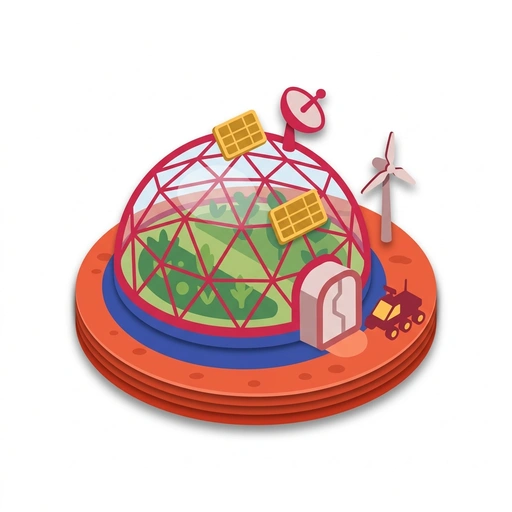
Living on the Red Planet
Ever wondered if you could actually survive on Mars? Discover how we'll find water, build homes in red dust, and search for signs of alien neighbors.
Like Duolingo, but for Living on the Red Planet. Tomo turns the whole topic into a game you play five minutes a day, until it actually sticks.
A short one: 26 levels across 3 sections, about 52 minutes end to end, roughly 10 days at five minutes a day. It moves through Your First Day on Mars, Exploring the Neighborhood, and The Science of Our Neighbor. It starts from scratch.
Free forever · No credit card · iPhone & Android
Key ideas in Living on the Red Planet
- Martian atmospheric pressure is less than 1% of Earth's
- Low pressure causes bodily fluids to boil and lungs to fail regardless of oxygen supply
- Pressurization is required to keep blood in a liquid state
- Thermal regulation is needed to survive extreme temperature swings
- A closed-loop oxygen supply is necessary because the atmosphere is 95% CO2
- Identifying the critical life-support components for immediate survival
- The Martian atmosphere is mostly CO2 and cannot be breathed
- The lack of pressure is as dangerous as the lack of oxygen
- Mapping Martian environmental hazards to gear
- The Martian atmosphere is primarily composed of carbon dioxide (CO2)
- Oxygen can be chemically separated from carbon dioxide molecules
- The process of making oxygen requires a constant input of power
- Splitting CO2 results in both oxygen and carbon monoxide waste
- Dust storms on Mars significantly reduce solar power efficiency
- Oxygen 'cracking' is an active process that fails without a power source
- Surface liquid water is non-existent due to low atmospheric pressure
You've tried the other tabs
Thirty open tabs. Four facts you actually kept.
You watched. You nodded. By Sunday it was gone.
One answer, then back to scrolling.
Eight weeks. You meant to finish. You didn't.
Tomo gives Living on the Red Planet the Duolingo treatment: levels, streaks, and quick quizzes that test what you just learned. That game loop is what the tabs above never had, so it's the one you actually finish.
Here's what playing it feels like
A real question from this course. Take your best guess.
If you had an oxygen mask but no pressurized suit on Mars, what would happen to your bodily fluids?
Get it right to open this lesson and 25 more in the app.
Where Living on the Red Planet takes you
- 1
Your First Day on Mars
- What to Pack for a New World
- How to Breathe When There is No Air
- Finding Water in the Red Dust
- Building a House Out of Martian Soil
- 2
Exploring the Neighborhood
- Hiking the Solar System's Tallest Volcano
- The Grand Canyon That Spans a Continent
- Why Everything Looks Red
- Surviving a Global Dust Storm
- Hunting for Ancient Alien Life
- The Mystery of the Disappearing Atmosphere
- 3
The Science of Our Neighbor
- Why Mars is Smaller Than Earth
- The Two Tiny Moons of Mars
- How a Day on Mars Compares to Earth
3 sections · 13 units · 26 levels. Built to play, not to enroll.
You pick the voice
Living on the Red Planet is taught in the The Bestie style: your friend who just gets it. Want a different feel? In the app you can spin up the same topic in any of Tomo's teaching styles. Same facts, totally different vibe.
More Science on Tomo
Environmental Science: Our Changing Planet
Explore how Earth's natural systems function and how human activity reshapes our world. From biodiversity to renewable energy, learn to analyze the complex interactions that sustain life.

The Secret Life of Energy
Discover how energy moves through everything from your morning snack to the stars in the sky. Learn to spot the invisible forces that make our world go round.
Exploring Our Solar System
Take a trip through space to meet our sun and the planets that circle it. Learn what makes each world special and how we explore the stars from Earth.
The Life Cycle of the Cosmos
Move beyond basic planet-spotting to understand the grand mechanisms of the universe, from the birth of stars in gas clouds to the dark matter holding galaxies together.
Secrets of the Solar Neighborhood
Go beyond basic planet names to discover the strange behaviors and extreme environments of our closest neighbors. Learn why some planets spin backward, where it rains diamonds, and how gravity reshapes the worlds around us.

Mastering the Building Blocks of the Universe
Stop memorizing names and start understanding how everything around you is built. From the air you breathe to the phone in your hand, discover how a few simple elements create our entire world.
Start Living on the Red Planet today.
Download Tomo, search Living on the Red Planet, and play your first lesson in under a minute.