
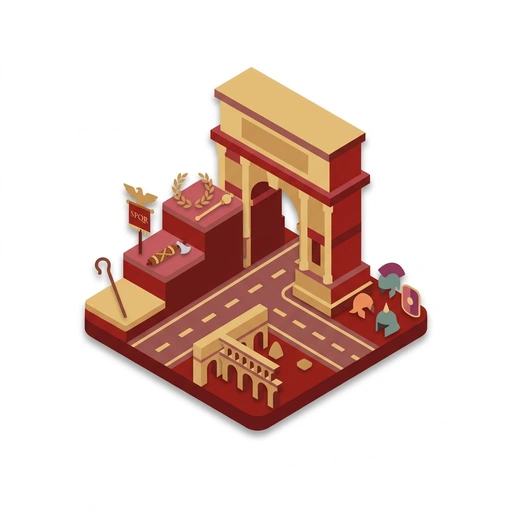
Rome: Power, Institutions, and Expansion
Uncover how a mud-brick settlement on the Tiber engineered a Mediterranean superpower. Examine the constitutional friction between Republic and Principate, the mechanics of provincial assimilation, and the structural stresses that transformed the classical world.
Like Duolingo, but for Rome: Power, Institutions, and Expansion. Tomo turns the whole topic into a game you play five minutes a day, until it actually sticks.
24 levels across 4 sections, about 48 minutes end to end, roughly 10 days at five minutes a day. It moves through Deconstructing the Pivot to Autocracy, Analyzing Mediterranean Mastery and Assimilation, Tracing the Institutional and Physical Foundations, and Diagnosing Late Imperial Crisis and Transformation. It assumes you already know the basics.
Free forever · No credit card · iPhone & Android
Key ideas in Rome: Power, Institutions, and Expansion
- Sulla led six Roman legions into Rome to reclaim command of the Mithridatic War.
- Marching armed legions across the sacred boundary (pomerium) broke an ancient taboo.
- Sulla's marches proved the Senate had no physical defense against a rogue commander.
- Tiberius Gracchus used the Concilium Plebis to pass land reforms without senatorial consent.
- Senators armed with broken benches murdered Tiberius during his reelection bid in 133 BCE.
- The Senate authorized lethal force against Gaius Gracchus via the Senatus Consultum Ultimum in 121 BCE.
- Marius enlisted the landless urban poor (capite censi) who owned no military equipment.
- The state did not provide retirement pensions, so veterans relied on generals to secure land.
- Soldiers swore personal oaths to commanders who promised plunder and post-war farms.
- Wealthy elites bought up neglected family farms while citizen-soldiers were overseas on long campaigns.
- Mass enslavement of conquered peoples provided cheap labor that peasant farmers could not compete against.
- Roman magistrates enjoyed legal immunity from prosecution only while holding imperium.
- Cato and senatorial rivals had prepared lawsuits against Caesar for his unconstitutional acts in 59 BCE.
- Relinquishing his proconsular army without running for consul in absentia meant political exile.
- Tribunicia potestas gave civil veto power and sacrosanctity without holding the plebeian office.
- Maius imperium proconsulare gave Augustus command that outranked all other provincial governors.
You've tried the other tabs
Thirty open tabs. Four facts you actually kept.
You watched. You nodded. By Sunday it was gone.
One answer, then back to scrolling.
Eight weeks. You meant to finish. You didn't.
Tomo gives Rome: Power, Institutions, and Expansion the Duolingo treatment: levels, streaks, and quick quizzes that test what you just learned. That game loop is what the tabs above never had, so it's the one you actually finish.
Here's what playing it feels like
A real question from this course. Take your best guess.
What ancient line did Sulla cross with his armed troops when entering the city?
Get it right to open this lesson and 23 more in the app.
Where Rome: Power, Institutions, and Expansion takes you
- 1
Deconstructing the Pivot to Autocracy
- Diagnosing the Fall of the Republic
- The Augustan Settlement and the Principate
- 2
Analyzing Mediterranean Mastery and Assimilation
- Assimilation, Alliances, and Roman Citizenship
- Confronting Great Rivals: Carthage, Greece, and the Frontiers
- 3
Tracing the Institutional and Physical Foundations
- Archaic Roots: Kings, Law, and the Republican Balance
- Engineering the Empire: Infrastructure and Logistics
- 4
Diagnosing Late Imperial Crisis and Transformation
- The Third-Century Crisis and the Tetrarchic Reset
- Constantine, Eastern Shift, and Western Fragmentation
4 sections · 8 units · 24 levels. Built to play, not to enroll.
Tomo is in ChatGPT
Tomo is also a ChatGPT plugin: the same playable courses, built and played inside your chat.
Add Tomo to ChatGPT- What to ask
- “Make me a Tomo course on black holes.” “Turn this chat into a Tomo course.”
- What you get
- Quick questions with instant feedback, hearts and stars, ready to play in about a minute.
- Where it goes
- No sign-up to start. Connect your Tomo account and your streak carries on in the app.
You pick the voice
Rome: Power, Institutions, and Expansion is taught in the The Professor style: clear, structured, thorough. Want a different feel? In the app you can spin up the same topic in any of Tomo's teaching styles. Same facts, totally different vibe.
More History on Tomo
Carthage: The Punic Empire
Go beyond the elephants and the salt. Explore the maritime engineering, political complexity, and enduring legacy of the Mediterranean's greatest merchant superpower.
How Rome Rose and Fell
Discover how a muddy Italian city-state conquered the Mediterranean, transformed from republic to empire, and left a blueprint that still shapes modern civilization.
Ancient Civilizations: Power and Connection
Move beyond the myths to understand how ancient empires actually functioned, from the logistics of their armies to the complex trade networks that linked the Mediterranean to the Far East.

Empires of the Sun and Sword
A master-level exploration of the Neo-Assyrian and Achaemenid Persian empires, focusing on the sophisticated administrative, military, and ideological frameworks that defined the first true global superpowers.
Eras That Shaped Human History
Trace how steam engines, ancient debates, trade caravans, and the first planted seeds built the modern world. Discover the defining eras that transformed human life without getting lost in dry dates. Walk away with a clear mental map of our shared journey.

Napoleon: The Rise and Fall
Follow the journey of a young outsider from Corsica who reshaped the map of Europe and became one of history's most powerful emperors.
Start Rome: Power, Institutions, and Expansion today.
Download Tomo, search Rome: Power, Institutions, and Expansion, and play your first lesson in under a minute.