
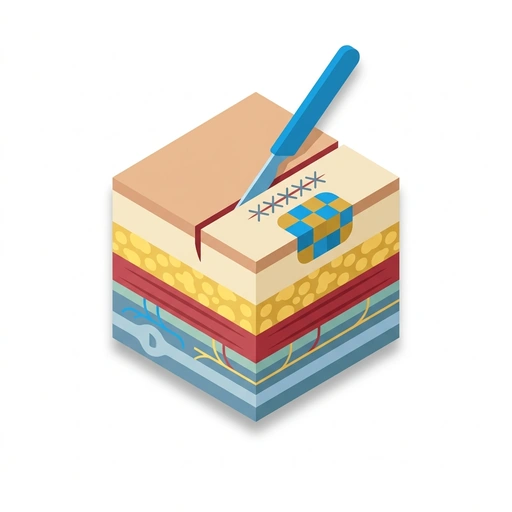
Surgical Anatomy and Tissue Reconstruction
Examine the structural planes, vascular territories, and tissue mechanics behind plastic and reconstructive surgery. Learn to identify critical anatomical landmarks and evaluate complex reconstructive procedures with precision.
Like Duolingo, but for Surgical Anatomy and Tissue Reconstruction. Tomo turns the whole topic into a game you play five minutes a day, until it actually sticks.
24 levels across 3 sections, about 48 minutes end to end, roughly 10 days at five minutes a day. It moves through Facial Architecture and Structural Landmarks, Flap Geometry and Vascular Principles, and Torso Planes and Body Contouring. It assumes you already know the basics.
Free forever · No credit card · iPhone & Android
Key ideas in Surgical Anatomy and Tissue Reconstruction
- Pitanguy line connects a point 0.5 cm below the tragus to 1.5 cm above the lateral brow
- The frontal branch transitions into a vulnerable, superficial plane along this line
- Dissection over the zygomatic arch along this vector requires staying deep to deep fascia
- Subcutaneous fat provides a cushion above the SMAS where motor branches do not travel
- Facial nerve branches run directly deep to or emerge through the deep surface of the SMAS
- Changing dissection depth across facial planes is the primary cause of inadvertent nerve injury
- Marginal mandibular nerve courses superficial to facial vessels at the mandibular notch
- The nerve dips 1 to 2 cm inferior to the inferior border of the mandible in many patients
- Vascular ligation without isolating the nerve superficial to the vessels risks lower lip paralysis
- The supraorbital, infraorbital, and mental foramina lie along a shared vertical pupillary line
- Supraorbital foramen exits highest in the superior orbital rim transmitting V1 sensory fibers
- Infraorbital foramen exits below the inferior orbital rim and mental foramen exits mid-mandible
- Crosses the inferior border of the mandible directly along the anterior border of the masseter
- Exhibits a tortuous, coiled path to accommodate tissue excursion during chewing and speech
- Gives off inferior labial, superior labial, and terminates as the angular artery
- Platysma transitions seamlessly into SMAS across the jawline
You've tried the other tabs
Thirty open tabs. Four facts you actually kept.
You watched. You nodded. By Sunday it was gone.
One answer, then back to scrolling.
Eight weeks. You meant to finish. You didn't.
Tomo gives Surgical Anatomy and Tissue Reconstruction the Duolingo treatment: levels, streaks, and quick quizzes that test what you just learned. That game loop is what the tabs above never had, so it's the one you actually finish.
Here's what playing it feels like
A real question from this course. Take your best guess.
Where does Pitanguy's line run to help you mark the course of the frontal branch?
Get it right to open this lesson and 23 more in the app.
Where Surgical Anatomy and Tissue Reconstruction takes you
- 1
Facial Architecture and Structural Landmarks
- Decoding Facial Danger Zones and Landmarks
- Navigating SMAS and Deep Plane Architecture
- Periorbital and Nasal Structural Frameworks
- 2
Flap Geometry and Vascular Principles
- Local Flap Mechanics and Tension Vectors
- Perforator Flaps and Vascular Territories
- Grafts and Structural Integration
- 3
Torso Planes and Body Contouring
- Breast Structural Planes and Pocket Design
- Abdominal Wall Anatomy and Lipo-Abdominoplasty
3 sections · 8 units · 24 levels. Built to play, not to enroll.
You pick the voice
Surgical Anatomy and Tissue Reconstruction is taught in the The Professor style: clear, structured, thorough. Want a different feel? In the app you can spin up the same topic in any of Tomo's teaching styles. Same facts, totally different vibe.
More Health on Tomo
Visual Anatomy for Plastic Surgery
Learn to interpret surgical photos, cross-sections, and anatomical diagrams like a surgeon. Recognize tissue planes, critical fascial layers, and vital danger zones across the face, abdomen, and breast.
Human Anatomy for Nursing
Learn to read the human body through the eyes of a bedside clinician. Connect structural landmarks, vital organ positions, and anatomical pathways directly to daily patient assessment.
Human Anatomy Foundations
Build the structural vocabulary and physiological concepts you need before walking into your first anatomy and physiology lab. Decode directional terms, master tissue architecture, and map major regulatory systems.
Clinical and Surgical Anatomy
Move beyond static textbook diagrams into dynamic, three-dimensional relational anatomy. Master fascial spread compartments, surgical dissection planes, neurovascular entrapments, and the developmental origins of anatomical variation.
Applied Surgical Anatomy
Bridge the gap between static textbook diagrams and dynamic surgical dissection. Learn to read living tissue planes, steer by fixed landmarks, and protect vulnerable neurovascular structures.
Maxillofacial Surgery Essentials
Learn the clinical techniques and decision-making behind minor oral surgery, facial trauma, deep neck infections, and jaw lesions as practiced in hospital and dental school clinics.
Start Surgical Anatomy and Tissue Reconstruction today.
Download Tomo, search Surgical Anatomy and Tissue Reconstruction, and play your first lesson in under a minute.