
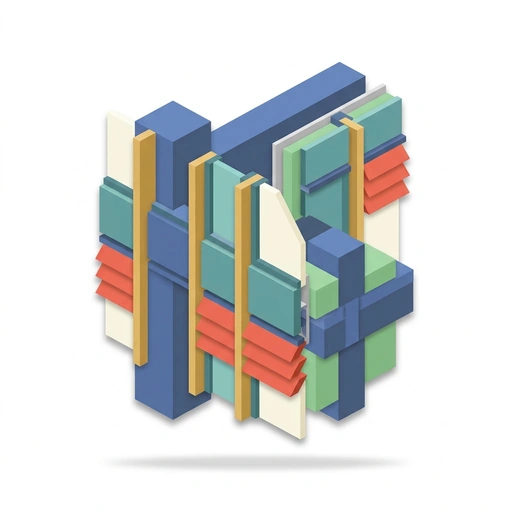
Tectonic Detailing and Envelope Design
Like Duolingo, but for Tectonic Detailing and Envelope Design. Tomo turns the whole topic into a game you play five minutes a day, until it actually sticks.
For the part of you with thirty open tabs that never became anything.
A short one: 11 levels across 2 sections, about 22 minutes end to end, roughly 4 days at five minutes a day. It moves through Resolving Joints and Load Paths and Envelope Physics and Spatial Interfaces.
Free forever · No credit card · iPhone & Android

Key ideas in Tectonic Detailing and Envelope Design
- A ceiling deflection reglet allows vertical slab movement independently of partition framing to prevent partition crushing
- A recessed reveal creates a deliberate shadowline that visually separates movement planes rather than attempting an impossible static flush condition
- Rigid top-track fastening or taped flush drywall joints across a deflection gap will shear or buckle under live loads
- Aluminum and zinc exhibit significantly higher thermal expansion coefficients than concrete and glass, requiring slip capability at every mechanical fixing
- Direct rigid bearing between materials with divergent expansion rates causes spalling, oil-canning, or glass shear rupture
- Volumetric continuity is preserved visually by concealing the compressible gaskets or sliding clips deep within a shadow gap
- Field construction tolerances for cast-in-place concrete (often ±6mm to ±12mm) inherently clash with precision millwork tolerances (±1mm)
- A recessed reveal or slip joint provides an optical and physical buffer where dimensional variances disappear into shadow rather than manifesting as proud edges or uneven seams
- Eliminating the reveal creates a rigid line vulnerable to seasonal moisture movement and uneven settling
- A deep horizontal kerf cut on the underside of a cantilevered precast soffit functions simultaneously as a capillary break and a crisp planar terminus
- Projecting reglet profiles with an undercut drip kick throw surface runoff clear while casting a dramatic, continuous horizontal shadow
- Surface tension allows water to cling and travel horizontally inward along a soffit unless interrupted by an air gap or downward drip projection of sufficient depth
- Tension elements achieve minimum cross-sectional profile through high-yield steel rods, reading visually as light, taut directional vectors
- Compression elements require significant cross-sectional bulk to resist buckling, typically manifesting as massive masonry, flaring piers, or thick-walled cast concrete
- A legible sectional equilibrium narrative directly mirrors internal stress diagrams by placing slender tension ties where moments cause elongation and massive members where compressive forces concentrate
- Outrigger systems stiffen high-aspect towers against lateral sway by mechanically coupling the shear core to perimeter mega-columns, mobilizing axial resistance across the whole footprint
You've tried the other tabs
Thirty open tabs. Four facts you actually kept.
You watched. You nodded. By Sunday it was gone.
One answer, then back to scrolling.
Eight weeks. You meant to finish. You didn't.
Tomo gives Tectonic Detailing and Envelope Design the Duolingo treatment: levels, streaks, and quick quizzes that test what you just learned. That game loop is what the tabs above never had, so it's the one you actually finish.
Here's what playing it feels like
A real question from this course. Take your best guess.
Why do architects detail a recessed reveal where a dynamic ceiling meets a static wall, rather than making the joint flush?
Get it right to open this lesson and 10 more in the app.
Where Tectonic Detailing and Envelope Design takes you
Bridge the divide between bold architectural concepts and real-world construction. Master advanced envelope assemblies, structural load articulation, and high-performance tectonic joints.
- 1
Resolving Joints and Load Paths
- Articulating the Tectonic Joint
- Expressive Sectional Load Paths
- 2
Envelope Physics and Spatial Interfaces
- High-Performance Thermal Envelopes
- Poché and Programmatic Friction
2 sections · 4 units · 11 levels. Built to play, not to enroll.
You pick the voice
Tectonic Detailing and Envelope Design is taught in the The Professor style: clear, structured, thorough. Want a different feel? In the app you can spin up the same topic in any of Tomo's teaching styles. Same facts, totally different vibe.
More Arts on Tomo
Reading Architectural Tectonics
Move beyond facade aesthetics by decoding the engineering and spatial logics that drive contemporary buildings. Analyze how load transfers, envelope detailing, and sectional cuts convert practical structural constraints into compelling spatial experiences. Develop an expert eye for structural joints, environmental envelopes, and material palimpsests.

Visual Tension in Photography
Move beyond technical correctness to command mood, subtext, and visual pressure in your images. Learn to harness highlight roll-off, edge friction, and chromatic discord to make frames that demand attention.
The Art of Shoemaking
Step into the world of cordwaining to understand how footwear is designed, constructed, and brought to market. From the geometry of the last to the economics of a small brand, you will learn what it takes to build shoes that last.

Salsa: Beyond the Basic Step
Move past the beginner patterns and unlock the fluid connection, complex musicality, and body isolations that define a confident social dancer.

Food Photography & Digital Presentation
Bridge the gap between the kitchen and the screen by mastering professional food styling, lighting, and the technical code required to showcase your culinary work online.

The Architect's Eye
Stop just looking at buildings and start reading them. Learn to decode the hidden logic of facades, sections, and structural choices that define our built world.
Start Tectonic Detailing and Envelope Design today.
Download Tomo, search Tectonic Detailing and Envelope Design, and play your first lesson in under a minute.