
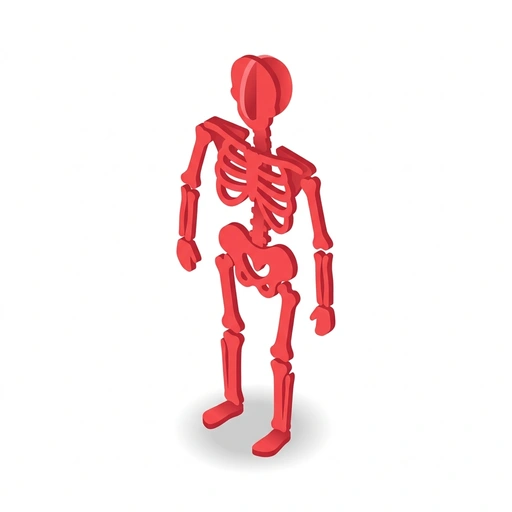
The Human Body: How We're Built
Like Duolingo, but for The Human Body: How We're Built. Tomo turns the whole topic into a game you play five minutes a day, until it actually sticks.
For the part of you with thirty open tabs that never became anything.
Free forever · No credit card · iPhone & Android
Key ideas in The Human Body: How We're Built
- Bones are rigid and don't shift like fat or muscle
- The body is built with a left-right mirror design
- Bony protrusions can be felt even through layers of skin
- Comparing a 'normal' side to a 'suspect' side reveals subtle changes
- Landmarks provide a fixed starting point to measure distance to other parts
- Individual bodies vary, so the person's own other side is the best baseline
- Using bony landmarks as reliable reference points for navigation
- Using symmetry to detect anatomical abnormalities
- Joints are the specific gaps between bones where movement occurs
- Creases form where the skin is frequently compressed or folded
- Mechanical action is localized to these pivot points
- The depth and number of folds indicate the primary direction of movement
- Identifying joints as the mechanical pivot points of the body
- Pulses are felt where an artery is squeezed against a hard bone
- Common accessible points include the thumb-side of the wrist and the side of the neck
- Relating skin surface features to underlying range of motion
You've tried the other tabs
Thirty open tabs. Four facts you actually kept.
You watched. You nodded. By Sunday it was gone.
One answer, then back to scrolling.
Eight weeks. You meant to finish. You didn't.
Tomo gives The Human Body: How We're Built the Duolingo treatment: levels, streaks, and quick quizzes that test what you just learned. That game loop is what the tabs above never had, so it's the one you actually finish.
Here's what playing it feels like
A real question from this course. Take your best guess.
What fundamental design principle allows us to use one side of the body to understand the other?
Get it right to open this lesson and 20 more in the app.
Where The Human Body: How We're Built takes you
Discover the incredible machinery inside you. Learn to identify your own landmarks, understand how your systems work together, and see the human form in a whole new way.
- 1
The Outer Shell and Movement
- Finding Your Landmarks
- The Framework of Bone
- The Engines of Motion
- 2
The Inner Workings
- The Pump and the Pipes
- Fueling and Breathing
- The Control Center
- 3
Maintenance and Protection
- The Body's Shield
3 sections · 7 units · 21 levels. Built to play, not to enroll.
You pick the voice
The Human Body: How We're Built is taught in the The Professor style: clear, structured, thorough. Want a different feel? In the app you can spin up the same topic in any of Tomo's teaching styles. Same facts, totally different vibe.
More Science on Tomo
The Mechanics of the Cosmos
Master the mathematical laws and physical principles that govern everything from the motion of planets to the quantum behavior of starlight.

The Night Sky and Beyond
Journey from your backyard to the edge of the observable universe. Learn to navigate the constellations, understand the lives of stars, and explore the mysteries of black holes and dark energy.
Environmental Science: Our Changing Planet
Explore how Earth's natural systems function and how human activity reshapes our world. From biodiversity to renewable energy, learn to analyze the complex interactions that sustain life.
Molecular Architecture
Move beyond basic reactions to master the art of molecular design. Learn how to manipulate orbital symmetry, transition states, and non-covalent forces to engineer complex chemical outcomes.
Ocean Worlds of the Solar System
Journey beyond Earth to discover the hidden, liquid-water oceans locked beneath the icy shells of moons and dwarf planets. Explore the chemistry, gravity, and extreme environments that make these distant worlds the best places to search for alien life.
Time Travel in the Real World
Discover how time travel isn't just for movies. Explore the real physics of time dilation, the logic of paradoxes, and why your GPS depends on time travel to work.
Start The Human Body: How We're Built today.
Download Tomo, search The Human Body: How We're Built, and play your first lesson in under a minute.