
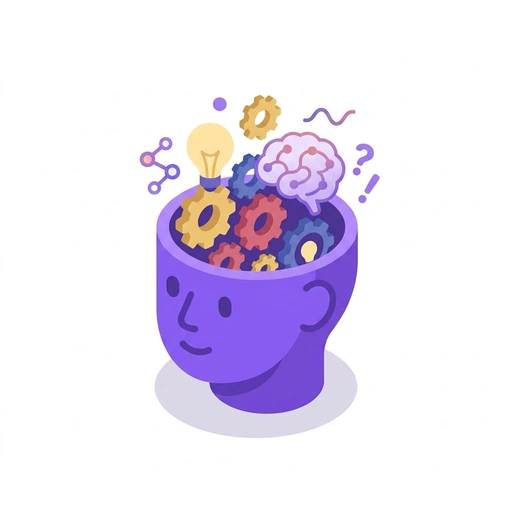
The Mechanics of the Mind
Go beyond basic definitions to understand the hidden drivers of human behavior, from the neurochemistry of habits to the social forces that shape our identity.
Like Duolingo, but for The Mechanics of the Mind. Tomo turns the whole topic into a game you play five minutes a day, until it actually sticks.
18 levels across 3 sections, about 36 minutes end to end, roughly 7 days at five minutes a day. It moves through The Mind in Action, Navigating the Social World, and The Internal Engine. It assumes you already know the basics.
Free forever · No credit card · iPhone & Android

Key ideas in The Mechanics of the Mind
- Heuristics minimize cognitive load to allow for immediate action in high-stakes environments
- The availability heuristic causes people to judge frequency based on ease of recall
- Systematic processing is too slow for survival threats where a false positive is safer than a miss
- Repeated media exposure creates a feedback loop that amplifies the perceived probability of an event
- The evolutionary tradeoff between speed and accuracy in heuristics
- The mechanism of an Availability Cascade in public perception
- Confirmation bias operates subconsciously to avoid the mental strain of cognitive dissonance
- The skills required to be competent are the same skills needed to recognize competence
- The brain prefers information that fits existing schemas because it requires less metabolic energy to process
- Metacognition is the ability to monitor and evaluate one's own thought processes and performance
- Dunning-Kruger as a metacognitive deficit
- Large choice sets increase the opportunity cost of the 'path not taken', leading to regret
- Confirmation bias as a tool for maintaining cognitive ease
- Decision paralysis occurs when the cognitive effort of comparing options exceeds the benefit of the choice
- The psychological consequences of choice overload
- The basal ganglia stores habits to offload work from the prefrontal cortex
You've tried the other tabs
Thirty open tabs. Four facts you actually kept.
You watched. You nodded. By Sunday it was gone.
One answer, then back to scrolling.
Eight weeks. You meant to finish. You didn't.
Tomo gives The Mechanics of the Mind the Duolingo treatment: levels, streaks, and quick quizzes that test what you just learned. That game loop is what the tabs above never had, so it's the one you actually finish.
Here's what playing it feels like
A real question from this course. Take your best guess.
Picture a friend who is suddenly terrified of sharks after watching a movie. Why does their brain now think shark attacks are common?
Get it right to open this lesson and 17 more in the app.
How to learn The Mechanics of the Mind, step by step
Go in order. 18 short levels across 3 sections, about 36 minutes in all, five minutes a day.
- 1
The Mind in Action
- Cognitive Shortcuts and Pitfalls
- The Architecture of Habits
- 2
Navigating the Social World
- Influence and Persuasion
- Group Dynamics and Identity
- 3
The Internal Engine
- Stress and Resilience Mechanisms
- Personality and Belief Formation
3 sections · 6 units · 18 levels. Built to play, not to enroll.
Questions about The Mechanics of the Mind
How do I learn The Mechanics of the Mind?
Go in order: start with The Mind in Action, then Navigating the Social World, then The Internal Engine. On Tomo that's 18 short levels, about 36 minutes in all, played five minutes a day. Start free and play the first level in under a minute.
Is there a Duolingo-style app for The Mechanics of the Mind?
Yes. Tomo works like Duolingo: short daily lessons, streaks and quick quizzes. The Mechanics of the Mind is one of its free courses, and you can type any other topic to get a course of your own.
Is The Mechanics of the Mind free?
Yes. The Mechanics of the Mind is playable on Tomo's free plan, which doesn't expire. No credit card, no waitlist. Download the app and start your first lesson.
How long does it take to learn The Mechanics of the Mind?
18 levels across 3 sections, about 36 minutes of play in total. It's built for five minutes a day, so you finish it a little at a time instead of all at once.
Do I need any background to start The Mechanics of the Mind?
No. It's pitched at an intermediate level, so it starts where you are and builds up. If you can tap a phone, you can start.
Tomo is in ChatGPT
Tomo is also a ChatGPT plugin: the same playable courses, built and played inside your chat.
Add Tomo to ChatGPT- What to ask
- “Make me a Tomo course on black holes.” “Turn this chat into a Tomo course.”
- What you get
- Quick questions with instant feedback, hearts and stars, ready to play in about a minute.
- Where it goes
- No sign-up to start. Connect your Tomo account and your streak carries on in the app.
You pick the voice
The Mechanics of the Mind is taught in the Storyteller style: every lesson is a story. Want a different feel? In the app you can spin up the same topic in any of Tomo's teaching styles. Same facts, totally different vibe.
More Psychology on Tomo
The Mechanics of Human Behavior
Move beyond introductory psychology terms to understand the hidden mechanisms driving choices, social dynamics, and emotions. Learn how the brain constructs reality and how to critically evaluate behavioral claims.
Psychology for Everyday Life
Discover how your mind actually works and apply proven psychological principles to build better habits, read social dynamics, and make sharper decisions.

Psychology for Everyday Life
Discover why people think, act, and feel the way they do through classic experiments and modern behavioral science. Turn abstract theories into practical tools for understanding yourself and navigating everyday interactions.
The Psychology of Everyday Life
Discover why you think, feel, and act the way you do. This course turns the lens on your own mind to reveal the hidden patterns that drive your daily decisions and social interactions.
Psychology: How Minds Actually Work
Discover the hidden forces shaping your thoughts, choices, and relationships. Learn why your mind relies on cognitive shortcuts, how emotions and habits really operate, and how your brain constructs everyday reality.

The Psychology of Everyday Behavior
Discover why you think, react, and decide the way you do. Learn the core principles of cognitive and social psychology to read human behavior with clarity.
Start The Mechanics of the Mind today.
Download Tomo, search The Mechanics of the Mind, and play your first lesson in under a minute.