
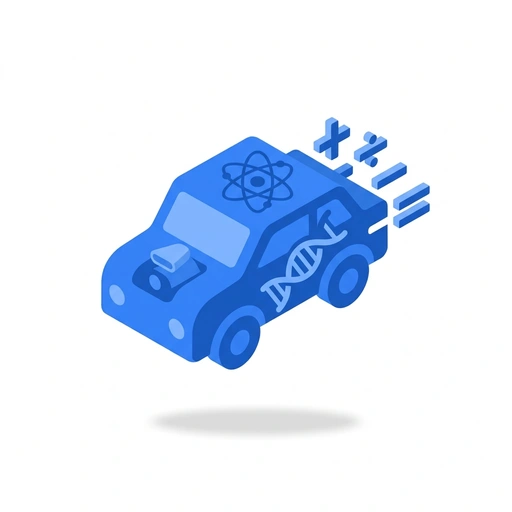
The Physics of Driving
Discover the hidden math and mechanical forces that govern every second behind the wheel. Learn how kinetic energy, traction limits, and aerodynamic drag dictate how cars accelerate, turn, and stop.
Like Duolingo, but for The Physics of Driving. Tomo turns the whole topic into a game you play five minutes a day, until it actually sticks.
A short one: 12 levels across 2 sections, about 24 minutes end to end, roughly 5 days at five minutes a day. It moves through Forces on the Road and Power and Resistance. It starts from scratch.
Free forever · No credit card · iPhone & Android

Key ideas in The Physics of Driving
- Stopping distance splits into reaction distance (distance covered while thinking and moving your foot) followed by physical braking distance
- Physical braking only begins once the pedal is physically pressed and the brake pads grab the wheels
- Reaction distance grows in direct proportion to speed because the car continues rolling freely during human reaction lag
- A moving car's kinetic energy scales with speed multiplied by itself (the square of speed)
- Because braking work removes this energy at a steady rate, doubling speed requires 4 times the distance to stop
- At 60 mph (2x speed), braking distance multiplies by 4 (45 ft x 4 = 180 ft)
- Brake pads and rotors only halt the rotation of the wheels
- The physical friction between the tire tread and the road surface is what actually stops the vehicle
- If tires lose traction with the surface (such as on smooth ice), the car keeps sliding no matter how hard the brakes pinch
- Extra vehicle weight requires more braking force to stop because of its greater momentum
- Extra weight simultaneously presses the rubber tires harder into the dry pavement, creating proportionally more friction grip
- A rolling tire maintains static friction with the road, which has noticeably higher grip than a sliding tire
- Once a locked wheel skids, it experiences sliding (kinetic) friction, lengthening the stopping distance
- Locked, skidding front wheels cannot steer; pulsing the brakes keeps the wheels rotating enough to maintain steering control
- These two effects largely cancel each other out on dry pavement, giving light and heavy vehicles similar stopping distances
- A tire has a single, finite traction limit often visualized as a circle
You've tried the other tabs
Thirty open tabs. Four facts you actually kept.
You watched. You nodded. By Sunday it was gone.
One answer, then back to scrolling.
Eight weeks. You meant to finish. You didn't.
Tomo gives The Physics of Driving the Duolingo treatment: levels, streaks, and quick quizzes that test what you just learned. That game loop is what the tabs above never had, so it's the one you actually finish.
Here's what playing it feels like
A real question from this course. Take your best guess.
When does a car actually begin to slow down physically during a sudden stop?
Get it right to open this lesson and 11 more in the app.
How to learn The Physics of Driving, step by step
Go in order. 12 short levels across 2 sections, about 24 minutes in all, five minutes a day.
- 1
Forces on the Road
- The Math of Stopping Distance
- Cornering and the Friction Circle
- 2
Power and Resistance
- Gears, Torque, and Engine Power
- Aerodynamic Drag and Fuel Economy
2 sections · 4 units · 12 levels. Built to play, not to enroll.
Questions about The Physics of Driving
How do I learn The Physics of Driving?
Go in order: start with Forces on the Road, then Power and Resistance. On Tomo that's 12 short levels, about 24 minutes in all, played five minutes a day. Start free and play the first level in under a minute.
Is there a Duolingo-style app for The Physics of Driving?
Yes. Tomo works like Duolingo: short daily lessons, streaks and quick quizzes. The Physics of Driving is one of its free courses, and you can type any other topic to get a course of your own.
Is The Physics of Driving free?
Yes. The Physics of Driving is playable on Tomo's free plan, which doesn't expire. No credit card, no waitlist. Download the app and start your first lesson.
How long does it take to learn The Physics of Driving?
12 levels across 2 sections, about 24 minutes of play in total. It's built for five minutes a day, so you finish it a little at a time instead of all at once.
Do I need any background to start The Physics of Driving?
No. It's pitched at a beginner level, so it starts where you are and builds up. If you can tap a phone, you can start.
Tomo is in ChatGPT
Tomo is also a ChatGPT plugin: the same playable courses, built and played inside your chat.
Add Tomo to ChatGPT- What to ask
- “Make me a Tomo course on black holes.” “Turn this chat into a Tomo course.”
- What you get
- Quick questions with instant feedback, hearts and stars, ready to play in about a minute.
- Where it goes
- No sign-up to start. Connect your Tomo account and your streak carries on in the app.
You pick the voice
The Physics of Driving is taught in the Professor style: clear, structured, thorough. Want a different feel? In the app you can spin up the same topic in any of Tomo's teaching styles. Same facts, totally different vibe.
More Science on Tomo

The Physics of Everyday Motion
Discover the invisible forces that govern how you move, drive, and play. Learn to see the world through the lens of momentum, energy, and the laws that keep everything in its place.

Physics Through Simulation
Discover how computers solve the mysteries of the universe using simple logic instead of complex equations. Rebuild your confidence in science by learning to think like a digital physicist.
The Quantum World
Discover the strange rules that govern the universe at its smallest scale. Learn why particles can be in two places at once and how this 'weird' science powers your smartphone.

The Language of Physics
Bridge the gap between everyday English and scientific precision. Learn to describe the laws of the universe using the specific vocabulary and phrasing of a physicist.
How Electricity Works
Demystify the invisible force that powers modern life. Learn how circuits operate, what voltage and wattage actually measure, and how electricity safely runs your home.
The Body Electric: Signals and Systems
Discover how your body uses the laws of physics to move, think, and sense the world. Explore the hidden electrical circuits and wave patterns that keep your biological systems in sync.
Start The Physics of Driving today.
Download Tomo, search The Physics of Driving, and play your first lesson in under a minute.