
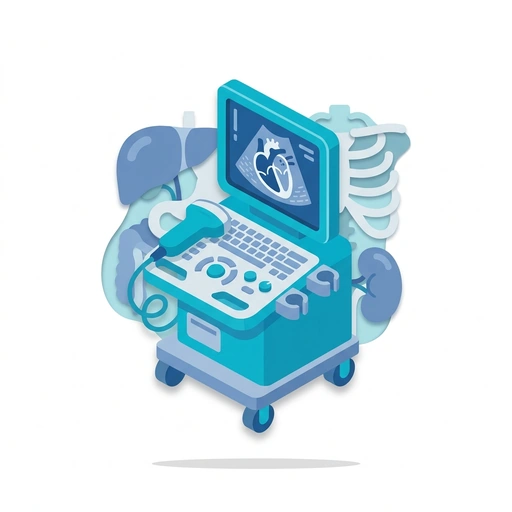
Core Sonography and Acoustic Anatomy
Bridge gross anatomy, acoustic physics, and diagnostic scanning to build practical sonography skills. Learn to operate machine controls, translate cross-sectional anatomy into standard planes, and evaluate tissue signatures with precision.
Like Duolingo, but for Core Sonography and Acoustic Anatomy. Tomo turns the whole topic into a game you play five minutes a day, until it actually sticks.
24 levels across 4 sections, about 48 minutes end to end, roughly 10 days at five minutes a day. It moves through Generating and Orienting the Image, Mapping Anatomy in Acoustic Cross-Sections, Hemodynamics and Artifact Recognition, and Acoustic Foundations and Clinical Practice. It assumes you already know the basics.
Free forever · No credit card · iPhone & Android
Key ideas in Core Sonography and Acoustic Anatomy
- The transducer orientation marker correlates directly to the indicator mark on the left side of the monitor screen.
- In standard transverse abdominal scanning, the transducer marker points toward the patient's anatomical right side.
- Pointing the transducer marker to the patient's right displays anatomical right structures on the screen's left.
- Simple fluid produces no internal acoustic echoes, displaying as anechoic or completely black on the monitor.
- Normal liver parenchyma displays medium-level gray echoes, providing a baseline isoechoic reference.
- Sinus fat and fibrous tissue interfaces reflect sound strongly, presenting as intensely hyperechoic white echoes.
- Fluid-filled lumens like a full bladder transmit sound freely without scatter, illuminating posterior structures.
- Homogeneous parenchymal organs like the liver act as natural windows to view deeper organs like the right kidney.
- Bowel gas scatters sound waves and bone reflects sound almost entirely, casting acoustic shadows that obscure deep organs.
- Sliding translates the transducer across the patient's body surface to change the physical point of insonation.
- Tilting (fanning) points the beam obliquely across the short axis to sweep through an entire organ volume.
- Orthogonal views require imaging every target in two perpendicular anatomical planes, usually longitudinal and transverse.
- Partial volume averaging or overlapping normal structures can mimic true pathology in a single viewing plane.
- A genuine anatomical lesion must be reproducible and demonstrate discrete margins in both perpendicular orthogonal planes.
- Rotating spins the probe around its vertical axis to transition between sagittal, transverse, and coronal views.
- Sound attenuates exponentially as it travels deeper into body tissues
You've tried the other tabs
Thirty open tabs. Four facts you actually kept.
You watched. You nodded. By Sunday it was gone.
One answer, then back to scrolling.
Eight weeks. You meant to finish. You didn't.
Tomo gives Core Sonography and Acoustic Anatomy the Duolingo treatment: levels, streaks, and quick quizzes that test what you just learned. That game loop is what the tabs above never had, so it's the one you actually finish.
Here's what playing it feels like
A real question from this course. Take your best guess.
When you perform a standard transverse scan of the abdomen, where should the transducer marker point?
Get it right to open this lesson and 23 more in the app.
Where Core Sonography and Acoustic Anatomy takes you
- 1
Generating and Orienting the Image
- Sonographic Orientation and Terminology
- Knobology and Image Optimization
- 2
Mapping Anatomy in Acoustic Cross-Sections
- Relational Abdominal Anatomy and Vascular Landmarks
- Differentiating Tissue Echo Textures
- 3
Hemodynamics and Artifact Recognition
- Doppler Hemodynamics and Waveform Analysis
- Interpreting and Using Acoustic Artifacts
- 4
Acoustic Foundations and Clinical Practice
- Acoustic Physics and Ultrasound Bioeffects
- Clinical Protocols, Ergonomics, and Image Metrics
4 sections · 8 units · 24 levels. Built to play, not to enroll.
Tomo is in ChatGPT
Tomo is also a ChatGPT plugin: the same playable courses, built and played inside your chat.
Add Tomo to ChatGPT- What to ask
- “Make me a Tomo course on black holes.” “Turn this chat into a Tomo course.”
- What you get
- Quick questions with instant feedback, hearts and stars, ready to play in about a minute.
- Where it goes
- No sign-up to start. Connect your Tomo account and your streak carries on in the app.
You pick the voice
Core Sonography and Acoustic Anatomy is taught in the Bestie style: your friend who just gets it. Want a different feel? In the app you can spin up the same topic in any of Tomo's teaching styles. Same facts, totally different vibe.
More Health on Tomo
Clinical Anatomy and Physiology
Bridge foundational human biology and medical practice. Connect gross anatomical architecture and systemic physiology directly to bedside physical diagnosis and clinical signs.
Human Anatomy for Nursing
Learn to read the human body through the eyes of a bedside clinician. Connect structural landmarks, vital organ positions, and anatomical pathways directly to daily patient assessment.
Visual Anatomy for Plastic Surgery
Learn to interpret surgical photos, cross-sections, and anatomical diagrams like a surgeon. Recognize tissue planes, critical fascial layers, and vital danger zones across the face, abdomen, and breast.
Mapping the Human Body
Learn to read your own body like a clinical map. Discover how surface landmarks reveal internal organs, how your chest and abdomen are organized, and how spinal nerve highways route sensation.
Clinical Laboratory Medicine
Bridge the gap between raw biological samples and diagnostic decisions. Learn to catch hidden specimen artifacts, interpret complex panel patterns, and navigate assay interferences.
Surgical Anatomy and Tissue Reconstruction
Examine the structural planes, vascular territories, and tissue mechanics behind plastic and reconstructive surgery. Learn to identify critical anatomical landmarks and evaluate complex reconstructive procedures with precision.
Start Core Sonography and Acoustic Anatomy today.
Download Tomo, search Core Sonography and Acoustic Anatomy, and play your first lesson in under a minute.