
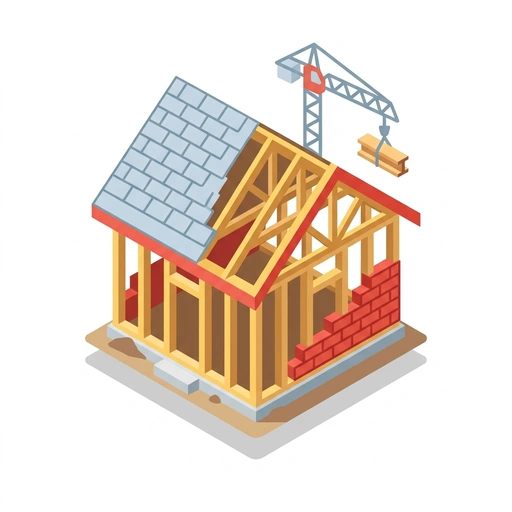
How a House Is Built
Learn how raw ground turns into a standing home. Discover how foundations, framing, weatherproofing, and mechanical systems work together to keep a house dry, warm, and standing strong.
Like Duolingo, but for How a House Is Built. Tomo turns the whole topic into a game you play five minutes a day, until it actually sticks.
A short one: 12 levels across 2 sections, about 24 minutes end to end, roughly 5 days at five minutes a day. It moves through Laying the Bones and Sealing and Servicing the Shell. It starts from scratch.
Free forever · No credit card · iPhone & Android

Key ideas in How a House Is Built
- A house concentrates tremendous weight onto narrow perimeter walls
- Poured concrete footings act like snowshoes, spreading that concentrated weight over a wide footprint of dirt
- Without wide footings, narrow foundation walls would sink unevenly into soft or shifting ground
- Groundwater expands when it freezes, exerting massive upward pressure known as frost heave
- The frost line is the maximum depth ground freezes in a specific geographic area
- Placing footings below the local frost line keeps the foundation resting on unfrozen, stable earth year-round
- Water accumulating in the ground exerts hydrostatic pressure that cracks concrete and forces moisture into basements
- Grading the surrounding soil downward away from the foundation sheds surface runoff before it sinks in
- Perforated drain pipes (drain tile) wrapped in gravel beside the footings collect rising groundwater and channel it away
- A wooden house does not stay on a concrete foundation by gravity alone
- Anchor bolts are embedded directly into wet concrete along the top perimeter
- A slab-on-grade pours the floor and edge support directly on the ground, ideal for flat lots in regions without deep ground freezing
- Basements make economic sense in freezing climates because excavators already have to dig deep below the frost line
- Crawlspaces elevate the wood floor framing above damp or uneven ground, accommodating slopes while leaving an accessible utility space
- The wooden base plate (sill plate) of the frame is bolted securely to these anchors to resist wind uplift and lateral ground shaking
- Modern platform framing uses relatively light dimensional lumber repeated at regular intervals (commonly 16 inches on center)
You've tried the other tabs
Thirty open tabs. Four facts you actually kept.
You watched. You nodded. By Sunday it was gone.
One answer, then back to scrolling.
Eight weeks. You meant to finish. You didn't.
Tomo gives How a House Is Built the Duolingo treatment: levels, streaks, and quick quizzes that test what you just learned. That game loop is what the tabs above never had, so it's the one you actually finish.
Here's what playing it feels like
A real question from this course. Take your best guess.
Why do builders pour wide concrete footings under the foundation walls?
Get it right to open this lesson and 11 more in the app.
Where How a House Is Built takes you
- 1
Laying the Bones
- Groundwork and Foundations
- Framing the Structural Skeleton
- 2
Sealing and Servicing the Shell
- Weatherproofing and the Thermal Envelope
- Mechanical Rough-Ins and Systems
2 sections · 4 units · 12 levels. Built to play, not to enroll.
Tomo is in ChatGPT
Tomo is also a ChatGPT plugin: the same playable courses, built and played inside your chat.
Add Tomo to ChatGPT- What to ask
- “Make me a Tomo course on black holes.” “Turn this chat into a Tomo course.”
- What you get
- Quick questions with instant feedback, hearts and stars, ready to play in about a minute.
- Where it goes
- No sign-up to start. Connect your Tomo account and your streak carries on in the app.
You pick the voice
How a House Is Built is taught in the Bestie style: your friend who just gets it. Want a different feel? In the app you can spin up the same topic in any of Tomo's teaching styles. Same facts, totally different vibe.
More Technology on Tomo

Hands-On Auto Mechanics
Move beyond routine fluid changes into real-world diagnostic and mechanical repair. Learn to track down electrical gremlins, interpret live sensor data, and pinpoint chassis and engine faults before unbolting parts.

Advanced Aircraft Flight Dynamics
Examine the high-speed boundaries of modern flight, from transonic shock dynamics and swept-wing pitch-up to fly-by-wire control laws and aeroelastic flutter. Master the engineering trade-offs that keep high-performance aircraft controllable at the aerodynamic edge.
Practical Home and Vehicle Maintenance
Gain the hands-on skills to troubleshoot and repair the systems you rely on every day. From fixing running toilets and resetting breakers to keeping bicycle chains and car engines running smoothly, this course gives you practical autonomy around the house and on the road.

Thinking Like an Engineer
Discover how engineers tackle chaotic, complex problems with clarity and precision. Learn to deconstruct systems, navigate tough trade-offs, and turn real-world failures into durable designs.
Car Engines and Diesel Power
Start from zero and discover how internal combustion engines actually turn fuel into movement. Learn the physics behind heavy diesel machinery and build the foundational diagnostic mindset of a professional mechanic.

Practical Mechanical Design
Bridge the gap between textbook mechanics and hardware that actually works. Learn how to prevent binding, design joints that resist fatigue, and tame thermal expansion in real mechanisms.
Start How a House Is Built today.
Download Tomo, search How a House Is Built, and play your first lesson in under a minute.