
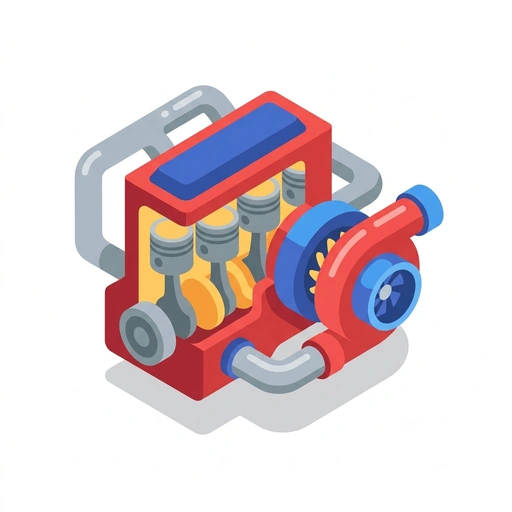
How Car Engines and Turbos Work
Trace the path of power from a drop of fuel to rotating tires. Master the four-stroke cycle, mechanical drivetrain connections, and how turbos harness exhaust to unlock massive power.
Like Duolingo, but for How Car Engines and Turbos Work. Tomo turns the whole topic into a game you play five minutes a day, until it actually sticks.
A short one: 10 levels across 2 sections, about 20 minutes end to end, roughly 4 days at five minutes a day. It moves through The Mechanical Chain: From Combustion to Tires and Forced Induction: The Turbo Loop. It starts from scratch.
Free forever · No credit card · iPhone & Android

Key ideas in How Car Engines and Turbos Work
- Igniting the trapped air and fuel produces sudden, extreme heat and pressure
- The expanding hot gas has nowhere to escape, forcing the movable piston down the cylinder
- The downward shove on the piston turns the crankshaft into rotational wheel motion
- The engine must suck in fresh air and fuel before doing anything else
- The mixture is squished tightly before the spark plug ignites it
- The burned waste gas must be pushed out before fresh mixture can enter again
- Only the power stroke generates usable energy from burning fuel
- Drawing in air, compressing it, and pushing out burnt gas all take physical effort from the spinning engine
- Three out of four strokes are purely preparation and waste-clearing
- Packing fuel molecules tightly together allows the flame to burn them faster and hotter
- High starting density creates vastly higher peak pressure when ignited
- Uncompressed fuel burns slowly like an open campfire rather than delivering a forceful shove
- The engine only pushes on the crankshaft during one out of every four strokes
- A heavy rotating mass carries momentum to coast through the three dead strokes without stalling or jerking
- Without stored rotational momentum, the piston would halt during compression
- Pistons only move straight up and down inside the cylinder
You've tried the other tabs
Thirty open tabs. Four facts you actually kept.
You watched. You nodded. By Sunday it was gone.
One answer, then back to scrolling.
Eight weeks. You meant to finish. You didn't.
Tomo gives How Car Engines and Turbos Work the Duolingo treatment: levels, streaks, and quick quizzes that test what you just learned. That game loop is what the tabs above never had, so it's the one you actually finish.
Here's what playing it feels like
A real question from this course. Take your best guess.
When burning gas expands inside a closed cylinder, what does it push against?
Get it right to open this lesson and 9 more in the app.
Where How Car Engines and Turbos Work takes you
- 1
The Mechanical Chain: From Combustion to Tires
- The Four-Stroke Cycle
- Converting Pushes into Wheel Rotation
- 2
Forced Induction: The Turbo Loop
- Harnessing Exhaust to Pack More Air
- Boost Dynamics and Turbo Lag
2 sections · 4 units · 10 levels. Built to play, not to enroll.
Tomo is in ChatGPT
Tomo is also a ChatGPT plugin: the same playable courses, built and played inside your chat.
Add Tomo to ChatGPT- What to ask
- “Make me a Tomo course on black holes.” “Turn this chat into a Tomo course.”
- What you get
- Quick questions with instant feedback, hearts and stars, ready to play in about a minute.
- Where it goes
- No sign-up to start. Connect your Tomo account and your streak carries on in the app.
You pick the voice
How Car Engines and Turbos Work is taught in the The Bestie style: your friend who just gets it. Want a different feel? In the app you can spin up the same topic in any of Tomo's teaching styles. Same facts, totally different vibe.
More Technology on Tomo
How Car Engines and Turbos Work
Discover how tiny drops of gasoline create explosive forward motion. Trace the path from piston stroke to crankshaft spin, then see how a turbocharger harvests exhaust to unlock effortless speed.
How Engines and Turbos Work
Discover how cars turn droplets of fuel and gulps of air into rotational wheel power. Follow the path of combustion through pistons and crankshafts, then see how turbochargers harvest waste exhaust to create effortless boost.
How Engines and Turbos Work
Understand the mechanical magic under the hood. Follow the path of fuel and air as it transforms into wheel-turning power, and see how turbos capture waste exhaust to deliver massive performance.
Turbos, Superchargers, and Boost
Understand the mechanics, fluid dynamics, and thermodynamics of forced induction. Learn how compressors, intercoolers, and wastegates manipulate air density and exhaust gas energy to produce reliable engine power.
How Diesel Engines Work
Discover the rugged engineering behind the world's hardest-working engines. Learn how extreme compression replaces spark plugs, how heavy-duty parts handle violent force, and how fuel and air create legendary pulling power.
High-Performance Car Mechanics
Examine the advanced engineering that governs vehicle dynamics, forced induction, and powertrain control. Learn how acoustic resonance, transient boost, differential ramps, and thermal limits dictate real-world mechanical performance.
Start How Car Engines and Turbos Work today.
Download Tomo, search How Car Engines and Turbos Work, and play your first lesson in under a minute.