
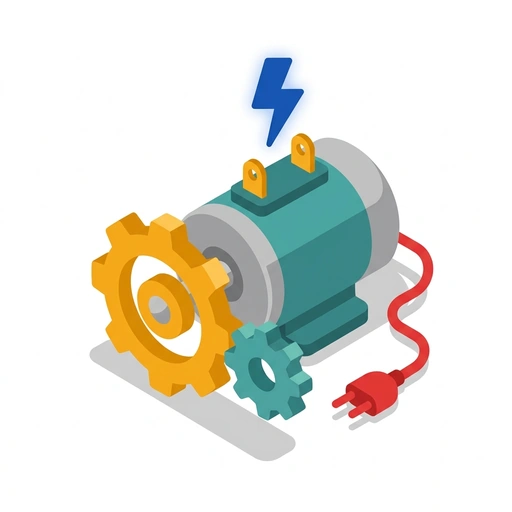
How Electricity Powers Machines
Like Duolingo, but for How Electricity Powers Machines. Tomo turns the whole topic into a game you play five minutes a day, until it actually sticks.
For the part of you with thirty open tabs that never became anything.
24 levels across 4 sections, about 48 minutes end to end, roughly 10 days at five minutes a day. It moves through Making Physical Things Move; Trading Speed for Strength; Controlling Motion with Signals; and Limits, Heat, and Electromechanical Physics. It starts from scratch.
Free forever · No credit card · iPhone & Android

Key ideas in How Electricity Powers Machines
- Current flowing through internal coils creates an electromagnet
- Opposing magnetic poles push and attract to twist the shaft
- Internal contacts switch the magnetic orientation as it spins so it never gets stuck aligned
- Reversing wire polarity flips the direction of current flowing through the motor coils
- Flipping current reverses the magnetic push, reversing the shaft rotation
- Higher voltage drives a DC motor to spin faster
- Higher current provides the torque or twisting strength needed to overcome resistance
- A stationary motor has very little electrical resistance to current before it starts moving
- How swapping electrical polarity alters motor direction
- Starting from zero speed pulls a momentary burst of high current
- Once spinning freely, the motor's current drops down to a modest, steady level
- How magnetic forces inside a DC motor convert electricity into continuous rotation
- A motor spins at its fastest when nothing resists its shaft
- Physical friction or load drags the shaft speed down
- As a loaded motor slows down, it pulls more electrical current trying to push through the resistance
- A solenoid uses a coiled wire to create an electromagnet
You've tried the other tabs
Thirty open tabs. Four facts you actually kept.
You watched. You nodded. By Sunday it was gone.
One answer, then back to scrolling.
Eight weeks. You meant to finish. You didn't.
Tomo gives How Electricity Powers Machines the Duolingo treatment: levels, streaks, and quick quizzes that test what you just learned. That game loop is what the tabs above never had, so it's the one you actually finish.
Here's what playing it feels like
A real question from this course. Take your best guess.
What happens inside a DC motor when electricity flows through its internal coils of wire?
Get it right to open this lesson and 23 more in the app.
Where How Electricity Powers Machines takes you
Discover how electricity transforms into mechanical motion, force, and precision. Learn to pick motors, balance speed and torque with gears, and control physical mechanisms safely.
- 1
Making Physical Things Move
- Spinning a Motor on Demand
- Pushing and Pulling with Solenoids and Screws
- 2
Trading Speed for Strength
- Gearing and Mechanical Advantage
- Choosing the Right Motor Architecture
- 3
Controlling Motion with Signals
- Switching High Power with Small Signals
- Sensing Position and Managing Feedback
- 4
Limits, Heat, and Electromechanical Physics
- Electromagnetic Forces and Back EMF
- Heat Buildup, Stall Current, and System Safety
4 sections · 8 units · 24 levels. Built to play, not to enroll.
You pick the voice
How Electricity Powers Machines is taught in the The Professor style: clear, structured, thorough. Want a different feel? In the app you can spin up the same topic in any of Tomo's teaching styles. Same facts, totally different vibe.
More Technology on Tomo
Mastering the Flow: Practical Electronics
Move beyond simple batteries and bulbs to design circuits that solve real problems. Master the math of power, troubleshoot like a pro, and understand how modern gadgets actually think.

The Flow of Power: Basic Circuits
Stop guessing and start building. Learn to direct the invisible force of electricity to power lights, motors, and your own inventions.
How Everyday Machines Work
Uncover the mechanical and electrical principles powering the machines in your living room. From CRT televisions to electric fans and cooling systems, learn how engineers turn physics into functional household hardware.
How Robots Work
Discover how machines sense the physical world, make real-time decisions, and move with precision. Learn the core principles behind autonomous navigation, mechanical manipulation, and feedback control.
Real-World Circuit Design
Move past idealized textbook schematics into the physics of high-speed signals, control loop stability, and electromagnetic compliance. Master parasitic management, noise reduction, and robust power delivery.

Build Your First Smart Gadget
Stop just looking at gadgets and start building them. Learn how to control electricity with code and sensors to create your own interactive inventions.
Start How Electricity Powers Machines today.
Download Tomo, search How Electricity Powers Machines, and play your first lesson in under a minute.