
How Everyday Electronics Work
Learn how the hidden circuitry inside your daily gadgets actually functions. Build a practical understanding of voltage, current, components, and sensors to demystify, troubleshoot, and safely handle modern electronics.
Like Duolingo, but for How Everyday Electronics Work. Tomo turns the whole topic into a game you play five minutes a day, until it actually sticks.
23 levels across 4 sections, about 46 minutes end to end, roughly 9 days at five minutes a day. It moves through Making Current Flow, Taming Household Power, How Circuits Think and Sense, and Diagnosing and Maintaining Gadgets. It starts from scratch.
Free forever · No credit card · iPhone & Android
Key ideas in How Everyday Electronics Work
- Electrical current cannot flow unless there is an unbroken circular path from the power source through the device and back
- Connecting only one terminal leaves the circuit incomplete, so no energy transfers to the device
- Voltage is the driving pressure or potential difference that pushes charges through a circuit
- Current measures the rate or volume of charges physically flowing through the path
- A conductor is the physical pathway (like copper wire) that lets charges pass through easily
- An open circuit is an intentional gap in the loop that stops current everywhere in that line instantly
- Mechanical switches work simply by physically separating two metal contacts
- Batteries store energy chemically, not as loose static charges sitting in a tank
- Internal chemical reactions push electrons toward one terminal, sustaining a steady voltage difference across the circuit
- LEDs are polarized and only allow electric current to pass through in one direction
- The longer lead of an LED is typically the positive side (anode) and must point toward positive voltage to light
- Reversing an LED in a simple low-voltage circuit harmlessly blocks current flow rather than lighting up
- Electricity does not choose a single 'easiest' path to the exclusion of others
- Current divides across all available closed pathways simultaneously
- A path with lower resistance carries more current, but higher-resistance paths still carry a proportional share
- A short circuit occurs when current bypasses the intended component through an almost zero-resistance connection
You've tried the other tabs
Thirty open tabs. Four facts you actually kept.
You watched. You nodded. By Sunday it was gone.
One answer, then back to scrolling.
Eight weeks. You meant to finish. You didn't.
Tomo gives How Everyday Electronics Work the Duolingo treatment: levels, streaks, and quick quizzes that test what you just learned. That game loop is what the tabs above never had, so it's the one you actually finish.
Here's what playing it feels like
A real question from this course. Take your best guess.
You run a wire from just one side of a battery to a small bulb. What happens?
Get it right to open this lesson and 22 more in the app.
How to learn How Everyday Electronics Work, step by step
Go in order. 23 short levels across 4 sections, about 46 minutes in all, five minutes a day.
- 1
Making Current Flow
- Closed Loops and Power Sources
- Guiding Pathways and Polarity
- 2
Taming Household Power
- Restricting and Smoothing Flow
- From Wall Power to Batteries
- 3
How Circuits Think and Sense
- Active Switching with Semiconductors
- Sensors and Everyday Inputs
- 4
Diagnosing and Maintaining Gadgets
- Tracking Signals with a Multimeter
- Why Electronic Devices Fail
4 sections · 8 units · 23 levels. Built to play, not to enroll.
Questions about How Everyday Electronics Work
How do I learn How Everyday Electronics Work?
Go in order: start with Making Current Flow, then Taming Household Power, then How Circuits Think and Sense, then Diagnosing and Maintaining Gadgets. On Tomo that's 23 short levels, about 46 minutes in all, played five minutes a day. Start free and play the first level in under a minute.
Is there a Duolingo-style app for How Everyday Electronics Work?
Yes. Tomo works like Duolingo: short daily lessons, streaks and quick quizzes. How Everyday Electronics Work is one of its free courses, and you can type any other topic to get a course of your own.
Is the How Everyday Electronics Work course free?
Yes. How Everyday Electronics Work is playable on Tomo's free plan, which doesn't expire. No credit card, no waitlist. Download the app and start your first lesson.
How long does it take to learn How Everyday Electronics Work?
23 levels across 4 sections, about 46 minutes of play in total. It's built for five minutes a day, so you finish it a little at a time instead of all at once.
Do I need any background to start How Everyday Electronics Work?
No. It's pitched at a beginner level, so it starts where you are and builds up. If you can tap a phone, you can start.
Tomo is in ChatGPT
Tomo is also a ChatGPT plugin: the same playable courses, built and played inside your chat.
Add Tomo to ChatGPT- What to ask
- “Make me a Tomo course on black holes.” “Turn this chat into a Tomo course.”
- What you get
- Quick questions with instant feedback, hearts and stars, ready to play in about a minute.
- Where it goes
- No sign-up to start. Connect your Tomo account and your streak carries on in the app.
You pick the voice
How Everyday Electronics Work is taught in the Professor style: clear, structured, thorough. Want a different feel? In the app you can spin up the same topic in any of Tomo's teaching styles. Same facts, totally different vibe.
More Technology on Tomo
Everyday Electronics in Action
Discover how everyday gadgets really work by tracing the path of electricity through loops, resistors, capacitors, and switches. Build a practical mental model of basic circuits using real-world examples.
How Electronics Work
Learn how electricity moves through circuits, powers components, and responds to controls. Build real intuition for voltage, resistance, and transistors through practical circuit design. Go from a bare battery to building responsive, sensor-driven hardware.
Electronics: Making Real Circuits Work
Bridge the gap between theoretical schematics and physical hardware that actually functions as intended. Learn to tame power supply sag, drive heavy loads without damaging components, condition noisy signals, and isolate elusive circuit faults.
Practical Electronics: From Circuits to Chips
Learn how electricity is harnessed, amplified, and programmed to power modern hardware. Explore real-world circuits from basic LEDs and transistors up to microcontrollers, op-amps, and commercial silicon chips.
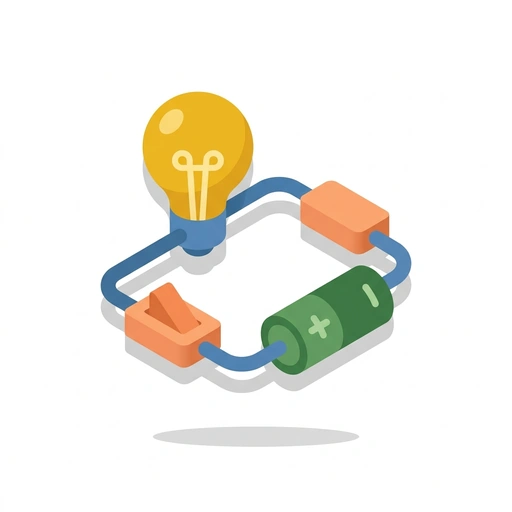
How Electric Circuits Work
Learn how electricity moves through everyday devices and gain the confidence to build your own circuits. From breadboarding components to debugging with a multimeter, discover the practical rules that bring hardware to life.
Hands-On Electronics
Demystify how everyday gadgets work by building and understanding circuits from the ground up. Learn to direct electrical currents, wire components safely, and read circuit behaviors.
Start How Everyday Electronics Work today.
Download Tomo, search How Everyday Electronics Work, and play your first lesson in under a minute.