
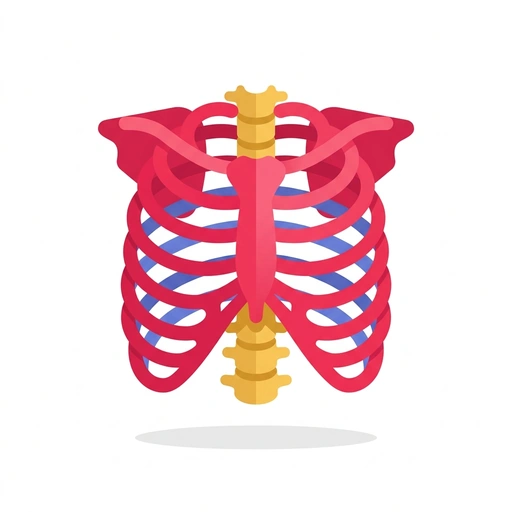
How the Human Body Is Built
Decode the architecture beneath your skin. Learn to identify major skeletal landmarks, trace how muscles pull against joints, and understand how internal organs are organized into working compartments.
Like Duolingo, but for How the Human Body Is Built. Tomo turns the whole topic into a game you play five minutes a day, until it actually sticks.
A short one: 11 levels across 2 sections, about 22 minutes end to end, roughly 4 days at five minutes a day. It moves through The Moving Frame and The Living Core. It starts from scratch.
Free forever · No credit card · iPhone & Android
Key ideas in How the Human Body Is Built
- Bones sit directly beneath the skin in certain spots with virtually no muscle or fat covering them
- Soft tissues like fat and muscle shift, stretch, or change size over time, while skeletal landmarks remain fixed
- Bones operate as rigid levers pivoting around joints
- A small pull near the joint pivot creates a wide, sweeping arc at the far tip of the limb
- Hinge joints interlock closely to allow movement in only one flat direction
- Ball-and-socket joints fit a rounded bone head into a cup, allowing full circles but dislocating more easily
- Bone-on-bone contact causes severe wear and friction
- Cartilage caps act as slick shock absorbers, nourished and lubricated by enclosed fluid
- Muscles can only pull and shorten; they have no mechanism to push back out
- Every joint requires opposing muscle pairs working on opposite sides to reverse any motion
- Tendons act like remote pull-cables crossing joints so bulky muscle bellies can sit higher up the limb
- Placing muscle bellies in fingers or toes would make joints too bulky and clumsy to move
- The nervous system activates only the fraction of muscle fibers needed for the specific weight
- Lighter objects require only a few fibers to fire, while maximum efforts recruit nearly all available fibers
- Muscles can contract and generate steady pulling tension without changing their overall length
- Posture depends on continuous holding tension rather than active joint movement
You've tried the other tabs
Thirty open tabs. Four facts you actually kept.
You watched. You nodded. By Sunday it was gone.
One answer, then back to scrolling.
Eight weeks. You meant to finish. You didn't.
Tomo gives How the Human Body Is Built the Duolingo treatment: levels, streaks, and quick quizzes that test what you just learned. That game loop is what the tabs above never had, so it's the one you actually finish.
Here's what playing it feels like
A real question from this course. Take your best guess.
Why do doctors and artists rely on bony landmarks instead of muscle folds to measure body proportions?
Get it right to open this lesson and 10 more in the app.
Where How the Human Body Is Built takes you
- 1
The Moving Frame
- Bones as Levers and Surface Landmarks
- Muscles, Tendons, and Antagonist Pairs
- 2
The Living Core
- Body Cavities and Organ Architecture
- The Distribution Grid: Vessels and Nerves
2 sections · 4 units · 11 levels. Built to play, not to enroll.
You pick the voice
How the Human Body Is Built is taught in the The Professor style: clear, structured, thorough. Want a different feel? In the app you can spin up the same topic in any of Tomo's teaching styles. Same facts, totally different vibe.
More Science on Tomo
How the Human Body Fits Together
Explore the elegant architecture of your own body from the inside out. Learn how your skeleton, muscles, circulation, and vital organs coordinate to keep you upright, moving, and alive.
Human Anatomy: Built to Move
Discover the mechanical genius beneath your skin. Learn how your bones, muscles, lungs, and heart coordinate to move you through the world.
Human Anatomy: Bones and Muscle
Move beyond memorizing muscle and bone names to understand how the human musculoskeletal system functions as an integrated mechanical machine. Learn how joints dictate movement, why muscles operate in coupled pairs, and how living tissue remodels under load.
Your Body's Blueprint
Discover the incredible engineering of the human body, from the electrical signals in your brain to the living architecture of your bones.
How the Human Body Works
Discover how your senses, muscles, brain, and heart collaborate as an extraordinary living machine. Learn how your body translates the world outside into thought, movement, and life on the inside.
How the Human Body Works
Discover how your body coordinates movement, fuels your cells, and keeps you alive. Learn the mechanics behind everyday sensations from your heartbeat to muscle fatigue.
Start How the Human Body Is Built today.
Download Tomo, search How the Human Body Is Built, and play your first lesson in under a minute.