
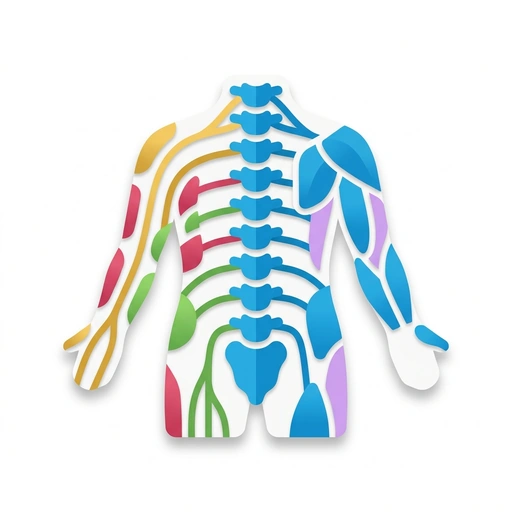
Mapping Dermatomes and Myotomes
Learn the body's hidden electrical blueprint. Decode numbness, tingling, and weakness by tracing nerve roots straight to the spine.
Like Duolingo, but for Mapping Dermatomes and Myotomes. Tomo turns the whole topic into a game you play five minutes a day, until it actually sticks.
A short one: 12 levels across 2 sections, about 24 minutes end to end, roughly 5 days at five minutes a day. It moves through Reading the Body's Neurological Map and Troubleshooting Nerve Root Puzzles. It starts from scratch.
Free forever · No credit card · iPhone & Android
Key ideas in Mapping Dermatomes and Myotomes
- Each section of skin is wired back to one individual spinal nerve root
- The dedicated skin zone wired to a single nerve is called a dermatome
- T4 lines up directly across the nipples
- T10 forms a belt right around the navel
- L1 marks the crease where the thigh meets the lower abdomen
- C6 supplies the thumb and outer forearm
- C7 supplies the middle finger
- C8 supplies the pinky finger and inner palm
- Neighboring dermatomes overlap along their borders like roofing shingles
- Losing one nerve root typically creates partial numbness or dulled feeling, not complete sensory loss
- Dermatome testing relies on comparing light touch or a pinprick against the matching spot on the opposite side
- A true nerve-root issue shows an asymmetry with a recognizable line or band of reduced feeling, rather than patchy all-over numbness
- C6 supplies the thumb and outer forearm, C7 supplies the middle finger, and C8 supplies the pinky finger and inner palm
- Neighboring dermatomes overlap along their borders like roofing shingles, so losing one nerve root typically creates partial numbness or dulled feeling, not complete sensory loss
- Dermatomes provide sensory feedback from skin patches
- Myotomes control motor movements in specific muscle groups
You've tried the other tabs
Thirty open tabs. Four facts you actually kept.
You watched. You nodded. By Sunday it was gone.
One answer, then back to scrolling.
Eight weeks. You meant to finish. You didn't.
Tomo gives Mapping Dermatomes and Myotomes the Duolingo treatment: levels, streaks, and quick quizzes that test what you just learned. That game loop is what the tabs above never had, so it's the one you actually finish.
Here's what playing it feels like
A real question from this course. Take your best guess.
Which spinal level lines up directly across your nipples?
Get it right to open this lesson and 11 more in the app.
Where Mapping Dermatomes and Myotomes takes you
- 1
Reading the Body's Neurological Map
- Sensory Landmarks: Reading the Skin Map
- Movement Checks: Testing Muscle Groups
- 2
Troubleshooting Nerve Root Puzzles
- The Electrician's Dilemma: Root vs. Peripheral Nerve
- Clinical Red Flags: From Sciatica to Spinal Alarms
2 sections · 4 units · 12 levels. Built to play, not to enroll.
You pick the voice
Mapping Dermatomes and Myotomes is taught in the Explain Like I'm 5 style: no big words. promise.. Want a different feel? In the app you can spin up the same topic in any of Tomo's teaching styles. Same facts, totally different vibe.
More Health on Tomo
Mapping the Human Body
Learn to read human anatomy like a clinical map. Master universal body orientation, follow major blood and nerve pathways, and understand how internal structures interact in health and disease.
Visual Anatomy for Plastic Surgery
Learn to interpret surgical photos, cross-sections, and anatomical diagrams like a surgeon. Recognize tissue planes, critical fascial layers, and vital danger zones across the face, abdomen, and breast.

Medical Terminology: The Clinical Code
Crack the universal code behind complex medical words. Learn how prefixes, roots, and suffixes snap together so you can read health records, diagnoses, and clinical notes with confidence.
Clinical Musculoskeletal Anatomy
Build a working knowledge of functional musculoskeletal anatomy for movement assessment and rehabilitation. Learn how muscle lines of pull, force couples, and kinetic chains drive human motion and clinical decision-making.
Clinical Anatomy: The Body in Action
Master the structural logic of the human body through the lens of clinical practice. Learn to visualize internal systems and speak the precise language used by medical professionals to describe health and injury.

GLP-1 Peptides and Weight Loss
Understand how GLP-1 medications alter hunger in the brain, how to navigate side effects and protect lean muscle, and how to build a realistic exit or maintenance plan.
Start Mapping Dermatomes and Myotomes today.
Download Tomo, search Mapping Dermatomes and Myotomes, and play your first lesson in under a minute.