
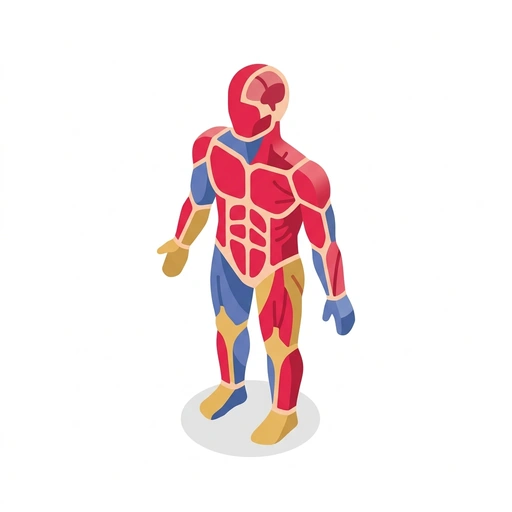
Mapping the Human Body
Like Duolingo, but for Mapping the Human Body. Tomo turns the whole topic into a game you play five minutes a day, until it actually sticks.
For the part of you with thirty open tabs that never became anything.
A short one: 12 levels across 2 sections, about 24 minutes end to end, roughly 5 days at five minutes a day. It moves through Navigating the Living Blueprint and Wiring and Internal Compartments. It starts from scratch.
Free forever · No credit card · iPhone & Android
Key ideas in Mapping the Human Body
- All anatomical descriptions assume a standard upright reference pose, regardless of actual posture
- The standard reference pose faces forward with palms out and feet parallel
- Standardizing to one pose stops body descriptions from shifting every time someone moves
- Proximal means closer to where the limb joins the trunk
- Distal means further away along the limb toward the fingers or toes
- Limb descriptions use proximal and distal instead of up or down to avoid confusion when arms or legs move
- A transverse cut slices horizontally into top and bottom halves
- A sagittal cut slices vertically into left and right sides
- A coronal cut slices vertically into front and back halves
- Left and right in medicine always belong to the patient's body, never the observer's
- Facing a patient creates a mirror image, so your right aligns with their left
- Superficial structures lie close to the skin surface
- Deep structures lie further down inside, past the protective skin and fat into muscle or organs
- A superficial injury stays in outer surface layers and has not breached the underlying protective tissue walls
- Arteries need thick, stretchy muscular walls to endure high pressure pumped directly from the heart
- Veins operate under low pressure and rely on one-way pocket valves to prevent blood from settling in lower limbs
You've tried the other tabs
Thirty open tabs. Four facts you actually kept.
You watched. You nodded. By Sunday it was gone.
One answer, then back to scrolling.
Eight weeks. You meant to finish. You didn't.
Tomo gives Mapping the Human Body the Duolingo treatment: levels, streaks, and quick quizzes that test what you just learned. That game loop is what the tabs above never had, so it's the one you actually finish.
Here's what playing it feels like
A real question from this course. Take your best guess.
How are the hands positioned in the standard anatomical reference pose?
Get it right to open this lesson and 11 more in the app.
Where Mapping the Human Body takes you
Learn to read human anatomy like a clinical map. Master universal body orientation, follow major blood and nerve pathways, and understand how internal structures interact in health and disease.
- 1
Navigating the Living Blueprint
- The Universal Body Map
- The Vascular Superhighways
- 2
Wiring and Internal Compartments
- The Nerve Grid
- Compartments and Clinical Relations
2 sections · 4 units · 12 levels. Built to play, not to enroll.
You pick the voice
Mapping the Human Body is taught in the The Professor style: clear, structured, thorough. Want a different feel? In the app you can spin up the same topic in any of Tomo's teaching styles. Same facts, totally different vibe.
More Health on Tomo
Thinking Like a Doctor
Step into the shoes of a medical student to learn how doctors gather clues, solve diagnostic puzzles, and treat the human body as a complex system.
Living with the Long Sleep
Move beyond basic tiredness to understand the heavy fog of hypersomnia. Learn to distinguish between a long night's sleep and a persistent neurological challenge that impacts your daily life.
Clinical Anatomy and Physiology
Bridge foundational human biology and medical practice. Connect gross anatomical architecture and systemic physiology directly to bedside physical diagnosis and clinical signs.

Living with Less Sugar
Take control of your energy and health by uncovering hidden sugars and retraining your palate for a lower-sugar lifestyle.
Clinical Anatomy: The Body in Action
Master the structural logic of the human body through the lens of clinical practice. Learn to visualize internal systems and speak the precise language used by medical professionals to describe health and injury.

GLP-1 Peptides and Weight Loss
Understand how GLP-1 medications alter hunger in the brain, how to navigate side effects and protect lean muscle, and how to build a realistic exit or maintenance plan.
Start Mapping the Human Body today.
Download Tomo, search Mapping the Human Body, and play your first lesson in under a minute.