
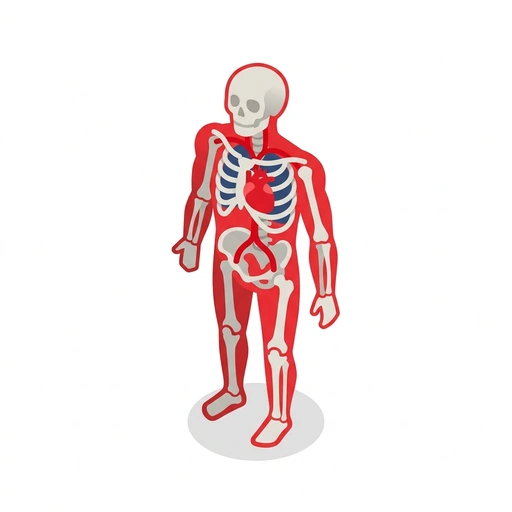
Modern Human Anatomical Terminology
Build a precise working vocabulary of the human body using the international standards of modern anatomy. Replace outdated historical eponyms with clear, descriptive terminology, navigate three-dimensional spatial relationships across imaging planes, and map continuous fascial and neurovascular networks with confidence.
Like Duolingo, but for Modern Human Anatomical Terminology. Tomo turns the whole topic into a game you play five minutes a day, until it actually sticks.
24 levels across 4 sections, about 48 minutes end to end, roughly 10 days at five minutes a day. It moves through Navigating the 3D Body with Modern Coordinates, Replacing Eponyms with Descriptive Structure, Mapping Fascial Continuities and Compartments, and Integrating Neurovascular Pathways. It assumes you already know the basics.
Free forever · No credit card · iPhone & Android
Key ideas in Modern Human Anatomical Terminology
- Standard anatomical position assumes upright posture, eyes forward, and palms turned forward (anterior)
- Anatomical terms never change based on whether a patient lies supine, prone, or rotates a limb
- When the forearm is pronated face down, its true anterior surface faces downward toward the bed
- Ipsilateral indicates structures or clinical signs occurring on the same side of the sagittal midline
- Contralateral indicates structures or manifestations on the opposite side of the body's midline
- These terms eliminate ambiguity when charting paired organs, neurological pathways, and bilateral limbs
- Proximal means closer to the trunk or origin point along a limb, vessel, or tubular structure.
- Distal designates points farther along a branching structure away from the point of attachment.
- Anatomical terms never change based on whether a patient lies supine, prone, or rotates a limb.
- The axilla sits most proximal at the shoulder girdle, followed by the elbow crease, then the wrist.
- The cephalic flexure bends the human central nervous system roughly 90 degrees at the midbrain.
- Rostral means toward the snout or frontal pole along the curved neuraxial pathway.
- Caudal means toward the tail or conus medullaris along both brainstem and spinal cord tracts.
- Superficial structures reside between the skin surface and the outer boundary of investing deep fascia.
- Deep structures lie internal to the deep fascia, including skeletal muscles, neurovascular bundles, and bone.
- Vessels like the great saphenous vein remain superficial because they travel in subcutaneous fat.
You've tried the other tabs
Thirty open tabs. Four facts you actually kept.
You watched. You nodded. By Sunday it was gone.
One answer, then back to scrolling.
Eight weeks. You meant to finish. You didn't.
Tomo gives Modern Human Anatomical Terminology the Duolingo treatment: levels, streaks, and quick quizzes that test what you just learned. That game loop is what the tabs above never had, so it's the one you actually finish.
Here's what playing it feels like
A real question from this course. Take your best guess.
What happens to anatomical directional terms when a patient lies down or shifts position?
Get it right to open this lesson and 23 more in the app.
Where Modern Human Anatomical Terminology takes you
- 1
Navigating the 3D Body with Modern Coordinates
- Mapping Relative Positions Beyond Everyday Directions
- Slicing and Reading Anatomical Reference Planes
- 2
Replacing Eponyms with Descriptive Structure
- De-Eponymizing the Musculoskeletal System
- Standardizing Visceral and Glandular Architecture
- 3
Mapping Fascial Continuities and Compartments
- Navigating the Global Fascial Network
- Defining Compartments and Interfascial Spaces
- 4
Integrating Neurovascular Pathways
- Tracing Neurovascular Bundles and Systemic Routes
- Standardizing the Central and Peripheral Neuraxis
4 sections · 8 units · 24 levels. Built to play, not to enroll.
Tomo is in ChatGPT
Tomo is also a ChatGPT plugin: the same playable courses, built and played inside your chat.
Add Tomo to ChatGPT- What to ask
- “Make me a Tomo course on black holes.” “Turn this chat into a Tomo course.”
- What you get
- Quick questions with instant feedback, hearts and stars, ready to play in about a minute.
- Where it goes
- No sign-up to start. Connect your Tomo account and your streak carries on in the app.
You pick the voice
Modern Human Anatomical Terminology is taught in the Professor style: clear, structured, thorough. Want a different feel? In the app you can spin up the same topic in any of Tomo's teaching styles. Same facts, totally different vibe.
More Health on Tomo
Mapping the Human Body
Learn to read your own body like a clinical map. Discover how surface landmarks reveal internal organs, how your chest and abdomen are organized, and how spinal nerve highways route sensation.
Human Anatomy for Nursing
Learn to read the human body through the eyes of a bedside clinician. Connect structural landmarks, vital organ positions, and anatomical pathways directly to daily patient assessment.
Clinical Anatomy and Physiology
Bridge foundational human biology and medical practice. Connect gross anatomical architecture and systemic physiology directly to bedside physical diagnosis and clinical signs.
Mapping the Human Body
Learn to read human anatomy like a clinical map. Master universal body orientation, follow major blood and nerve pathways, and understand how internal structures interact in health and disease.
Your Body's Living Defenses
Discover how your organs, tissues, and trillions of resident microbes work together to keep you alive. Learn the mechanics of physical barriers, internal immune responses, and the microscopic ecosystem running inside you.
Visual Anatomy for Plastic Surgery
Learn to interpret surgical photos, cross-sections, and anatomical diagrams like a surgeon. Recognize tissue planes, critical fascial layers, and vital danger zones across the face, abdomen, and breast.
Start Modern Human Anatomical Terminology today.
Download Tomo, search Modern Human Anatomical Terminology, and play your first lesson in under a minute.