
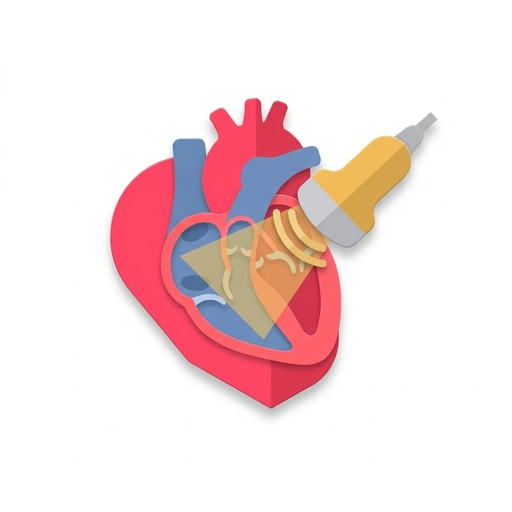
Reading Echocardiograms
Learn to interpret heart ultrasounds visually without getting bogged down in complex physics formulas. Master the standard acoustic views, assess pumping function by eye, and map blood flow through moving color patterns.
Like Duolingo, but for Reading Echocardiograms. Tomo turns the whole topic into a game you play five minutes a day, until it actually sticks.
A short one: 12 levels across 2 sections, about 24 minutes end to end, roughly 5 days at five minutes a day. It moves through Orienting Your Eyes to the Screen and Spotting Normal Motion and Flow. It starts from scratch.
Free forever · No credit card · iPhone & Android

Key ideas in Reading Echocardiograms
- Sound passes straight through blood pools without reflection, rendering fluid-filled chambers completely black
- Dense fibrous tissue like the pericardium strongly reflects sound waves back, rendering bright white
- Cardiac muscle reflects moderate amounts of ultrasound, appearing as shades of gray
- A standard ultrasound probe projects a flat, fan-shaped 2D slice through the heart
- A sonographer must mentally assemble full chamber volume by viewing multiple sequential cross-sections
- The physical notch or groove on the probe corresponds to a specific marker dot on the ultrasound monitor
- Aligning the probe marker with anatomical standard protocols ensures left and right cardiac structures are not displayed backwards
- True myocardial contraction requires the heart muscle wall to visibly thicken inward and shorten
- A damaged or dead segment of heart muscle can be dragged along by neighboring muscle, moving without actually thickening
- Bone reflects nearly all sound waves, casting a dark acoustic shadow that hides the heart behind ribs
- Air inside lung tissue scatters the ultrasound beam, creating useless white haze
- Sonographers must place the probe between ribs (intercostal spaces) to find clear acoustic windows
- The Parasternal Long Axis (PLAX) view slices through the heart vertically from base to apex
- PLAX directly visualizes the left ventricle, the mitral valve leaflets, and the aortic root/valve
- It does not display all four chambers simultaneously
- A 90-degree clockwise probe rotation transitions the view from long axis to short axis
You've tried the other tabs
Thirty open tabs. Four facts you actually kept.
You watched. You nodded. By Sunday it was gone.
One answer, then back to scrolling.
Eight weeks. You meant to finish. You didn't.
Tomo gives Reading Echocardiograms the Duolingo treatment: levels, streaks, and quick quizzes that test what you just learned. That game loop is what the tabs above never had, so it's the one you actually finish.
Here's what playing it feels like
A real question from this course. Take your best guess.
The tough sac around the heart, called the pericardium, bounces sound back strongly. How does it look on screen?
Get it right to open this lesson and 11 more in the app.
Where Reading Echocardiograms takes you
- 1
Orienting Your Eyes to the Screen
- Making Sense of the Ultrasound Screen
- Navigating the Standard Cardiac Views
- 2
Spotting Normal Motion and Flow
- Evaluating Heart Pump Function by Eye
- Reading Blood Flow with Color Doppler
2 sections · 4 units · 12 levels. Built to play, not to enroll.
Tomo is in ChatGPT
Tomo is also a ChatGPT plugin: the same playable courses, built and played inside your chat.
Add Tomo to ChatGPT- What to ask
- “Make me a Tomo course on black holes.” “Turn this chat into a Tomo course.”
- What you get
- Quick questions with instant feedback, hearts and stars, ready to play in about a minute.
- Where it goes
- No sign-up to start. Connect your Tomo account and your streak carries on in the app.
You pick the voice
Reading Echocardiograms is taught in the Explain Like I'm 5 style: no big words. promise.. Want a different feel? In the app you can spin up the same topic in any of Tomo's teaching styles. Same facts, totally different vibe.
More Health on Tomo
How Your Body Works
Decode the daily signals, glitches, and mechanics of the machine you live in. Learn what cramps, breath, and posture actually tell you so you can work with your biology instead of fighting it.
Understanding Pregnancy
Learn the essentials of human pregnancy from early bodily changes to labor and newborn recovery. Gain confidence in interpreting symptoms, understanding clinical milestones, and preparing for birth.
Thinking Like a Nurse
Step into the clinical mindset that spots invisible dangers, decodes subtle physical cues, and protects vulnerable patients. Learn how nurses read vital signs in context, communicate in high-stakes environments, and intervene before small shifts become critical emergencies.
Functional Anatomy of the Heart
Move beyond basic chambers and diagrams to understand how cardiac architecture drives pressure, flow, and electrical signaling. Learn to connect valve structure to heart sounds, ventricular geometry to pumping mechanics, and coronary maps to ischemia risks.
Clinical Laboratory Medicine
Bridge the gap between raw biological samples and diagnostic decisions. Learn to catch hidden specimen artifacts, interpret complex panel patterns, and navigate assay interferences.
Biostatistics in Practice
Cut through medical headlines, clinical trials, and epidemiological data with confidence. Learn how biostatisticians separate genuine health discoveries from random chance, confounding factors, and statistical noise.
Start Reading Echocardiograms today.
Download Tomo, search Reading Echocardiograms, and play your first lesson in under a minute.