
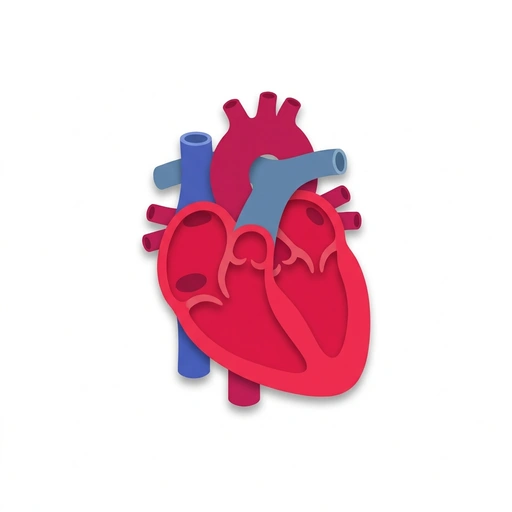
Functional Anatomy of the Heart
Move beyond basic chambers and diagrams to understand how cardiac architecture drives pressure, flow, and electrical signaling. Learn to connect valve structure to heart sounds, ventricular geometry to pumping mechanics, and coronary maps to ischemia risks.
Like Duolingo, but for Functional Anatomy of the Heart. Tomo turns the whole topic into a game you play five minutes a day, until it actually sticks.
A short one: 12 levels across 2 sections, about 24 minutes end to end, roughly 5 days at five minutes a day. It moves through Deciphering the Mechanical Pump and Tracing Conduction and Perfusion. It assumes you already know the basics.
Free forever · No credit card · iPhone & Android
Key ideas in Functional Anatomy of the Heart
- Closure sounds result from sudden deceleration of moving blood colliding with tensed valves.
- Vibrations in the valve leaflets and adjacent ventricular walls generate the audible sound wave.
- Atrioventricular valves rely on chordae tendineae and papillary muscles to avoid prolapse.
- Semilunar valves lack chordal tethers and seal purely through back-pressure filling their cusps.
- Ventricular pressure exceeding atrial pressure closes AV valves, initiating isovolumetric contraction.
- Aortic pressure exceeding ventricular pressure closes semilunar valves, beginning isovolumetric relaxation.
- Stenosis produces systolic ejection murmurs as stroke volume forces through a narrowed opening.
- Regurgitant murmurs arise when closed valves fail to seal against peak chamber pressure gradients.
- Turbulent acoustic vibrations propagate downstream along the directional trajectory of blood flow.
- Auscultation sites target downstream thoracic windows rather than surface valve anatomy.
- Subepicardial and subendocardial fibers spiral in opposite directions across the ventricular wall
- Opposing fiber directions produce a torsion or wringing motion that starts at the apex
- Apex-to-base wringing pulls the base down and expels blood upward toward the great arteries
- The left ventricle forms a thick cylinder that generates high pressures against systemic vascular resistance
- The right ventricle forms a thin crescent pocket designed to displace volume into low-resistance pulmonary vessels
- The right ventricle empties using a peristaltic, bellows-like contraction against the septum
You've tried the other tabs
Thirty open tabs. Four facts you actually kept.
You watched. You nodded. By Sunday it was gone.
One answer, then back to scrolling.
Eight weeks. You meant to finish. You didn't.
Tomo gives Functional Anatomy of the Heart the Duolingo treatment: levels, streaks, and quick quizzes that test what you just learned. That game loop is what the tabs above never had, so it's the one you actually finish.
Here's what playing it feels like
A real question from this course. Take your best guess.
When blood crashes against closed valves, what actually creates the sound wave a stethoscope picks up?
Get it right to open this lesson and 11 more in the app.
Where Functional Anatomy of the Heart takes you
- 1
Deciphering the Mechanical Pump
- Reading Heart Sounds Through Valve Mechanics
- Ventricular Architecture and Pressure Work
- 2
Tracing Conduction and Perfusion
- The Electrical Highway and Conduction Vectors
- Coronary Topography and Perfusion Vulnerability
2 sections · 4 units · 12 levels. Built to play, not to enroll.
Tomo is in ChatGPT
Tomo is also a ChatGPT plugin: the same playable courses, built and played inside your chat.
Add Tomo to ChatGPT- What to ask
- “Make me a Tomo course on black holes.” “Turn this chat into a Tomo course.”
- What you get
- Quick questions with instant feedback, hearts and stars, ready to play in about a minute.
- Where it goes
- No sign-up to start. Connect your Tomo account and your streak carries on in the app.
You pick the voice
Functional Anatomy of the Heart is taught in the Bestie style: your friend who just gets it. Want a different feel? In the app you can spin up the same topic in any of Tomo's teaching styles. Same facts, totally different vibe.
More Health on Tomo
Advanced Pathophysiology for Ontario PCPs
A mastery-level exploration of the physiological breakdowns in respiratory, cardiac, and neurological systems, tailored for the Ontario Primary Care Paramedic scope.
Applied Anatomy in Plastic Surgery
Navigate the fascial planes, neurovascular danger zones, and perforator territories essential for reconstructive and aesthetic procedures. Master structural landmarks from the SMAS to the hand compartments with surgical precision.
Anatomy and Physiology for Patient Care
Learn the physiological mechanics behind human vital signs, fluid balance, and organ systems. Connect physical bedside cues directly to internal biology so you understand what the body is doing and why. Designed specifically to build practical physiological intuition for clinical care.

The Human Body in Care Work
Understand how the human body functions, breaks down, and heals through the practical lens of caregiving. Learn to interpret vital signals, safeguard fragile skin, and support mobility with anatomical confidence.
Musculoskeletal Anatomy in Motion
Bridge the gap between memorizing bone names and understanding how the living body generates force and stabilizes joints. Explore the mechanical levers, dynamic force couples, and tissue adaptations that govern human movement and physical resilience.
Functional Anatomy for Physical Therapy
Understand how muscles, bones, nerves, and joints collaborate to produce healthy movement and recover from injury. Learn the essential anatomical structures and physiological healing principles that guide real-world rehabilitation exercises.
Start Functional Anatomy of the Heart today.
Download Tomo, search Functional Anatomy of the Heart, and play your first lesson in under a minute.