

Electrical Engineering from Zero
Build a working intuition for electrical circuits from your first closed loop to industrial power and automation. Learn how voltage, current, components, and three-phase systems interact to power modern hardware.
Like Duolingo, but for Electrical Engineering from Zero. Tomo turns the whole topic into a game you play five minutes a day, until it actually sticks.
26 levels across 4 sections, about 52 minutes end to end, roughly 10 days at five minutes a day. It moves through Building Working Circuits, Analyzing and Directing Current, Harnessing AC and Grid Power, and Automating Electrical Systems. It starts from scratch.
Free forever · No credit card · iPhone & Android

Key ideas in Electrical Engineering from Zero
- Voltage is the electrical push or pressure between two points, which can exist even when nothing is flowing
- Current is the actual movement of physical charge carriers through a closed circuit
- Without an electrical push (voltage), charge carriers will not drift in a continuous current
- Current requires a continuous, unbroken conductive loop from one terminal to the other
- An air gap anywhere in a simple series loop stops the flow of charge carriers across the entire path simultaneously
- Electricity does not pile up inside a disconnected component like water in an open hose
- Every conductor offers some resistance that naturally opposes the flow of electric charge
- Thicker conductive paths provide less resistance to moving electrons than thin paths of the same material and length
- Under a fixed voltage push, lowering resistance lets more current flow through the path
- A load is a circuit component that draws current to convert electrical energy into heat, light, sound, or physical motion
- Plain connecting wires are meant to conduct electricity with minimal loss, not act as working loads
- An open switch stops current entirely rather than converting energy
- A short circuit happens when an unintended conductive path bypasses the intended working load
- Because wire or metal clips have almost zero resistance, the voltage push drives an abnormally large current spike
- Large currents generate rapid, intense heat in conductors and batteries, creating fire hazards or component damage
- Ohm's Law states that Voltage = Current × Resistance (V = I × R)
You've tried the other tabs
Thirty open tabs. Four facts you actually kept.
You watched. You nodded. By Sunday it was gone.
One answer, then back to scrolling.
Eight weeks. You meant to finish. You didn't.
Tomo gives Electrical Engineering from Zero the Duolingo treatment: levels, streaks, and quick quizzes that test what you just learned. That game loop is what the tabs above never had, so it's the one you actually finish.
Here's what playing it feels like
A real question from this course. Take your best guess.
What is electrical current?
Get it right to open this lesson and 25 more in the app.
How to learn Electrical Engineering from Zero, step by step
Go in order. 26 short levels across 4 sections, about 52 minutes in all, five minutes a day.
- 1
Building Working Circuits
- Getting Current to Move
- Predicting Circuit Values with Ohm's Law
- Translating Schematics into Real Wiring
- 2
Analyzing and Directing Current
- Governing Loops and Junctions with Kirchhoff's Laws
- Shaping Signals with Capacitors, Inductors, and Diodes
- 3
Harnessing AC and Grid Power
- Managing Alternating Current and Impedance
- Distributing Industrial Three-Phase Power
- 4
Automating Electrical Systems
- Switching, Sensing, and Control Logic
4 sections · 8 units · 26 levels. Built to play, not to enroll.
Questions about Electrical Engineering from Zero
How do I learn Electrical Engineering from Zero?
Go in order: start with Building Working Circuits, then Analyzing and Directing Current, then Harnessing AC and Grid Power, then Automating Electrical Systems. On Tomo that's 26 short levels, about 52 minutes in all, played five minutes a day. Start free and play the first level in under a minute.
Is there a Duolingo-style app for Electrical Engineering from Zero?
Yes. Tomo works like Duolingo: short daily lessons, streaks and quick quizzes. Electrical Engineering from Zero is one of its free courses, and you can type any other topic to get a course of your own.
Is the Electrical Engineering from Zero course free?
Yes. Electrical Engineering from Zero is playable on Tomo's free plan, which doesn't expire. No credit card, no waitlist. Download the app and start your first lesson.
How long does it take to learn Electrical Engineering from Zero?
26 levels across 4 sections, about 52 minutes of play in total. It's built for five minutes a day, so you finish it a little at a time instead of all at once.
Do I need any background to start Electrical Engineering from Zero?
No. It's pitched at a beginner level, so it starts where you are and builds up. If you can tap a phone, you can start.
Tomo is in ChatGPT
Tomo is also a ChatGPT plugin: the same playable courses, built and played inside your chat.
Add Tomo to ChatGPT- What to ask
- “Make me a Tomo course on black holes.” “Turn this chat into a Tomo course.”
- What you get
- Quick questions with instant feedback, hearts and stars, ready to play in about a minute.
- Where it goes
- No sign-up to start. Connect your Tomo account and your streak carries on in the app.
You pick the voice
Electrical Engineering from Zero is taught in the Explain Like I'm 5 style: no big words. promise.. Want a different feel? In the app you can spin up the same topic in any of Tomo's teaching styles. Same facts, totally different vibe.
More Technology on Tomo
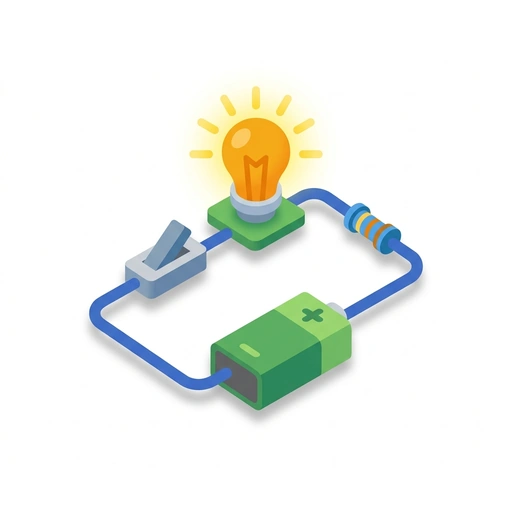
How Circuits Work
Understand the unseen flow of electricity by building real, working circuits. Learn to light components, route power on a breadboard, and automate behavior with switches and transistors.
Circuit Basics: Ohm's and Kirchhoff's Laws
Master the core rules that govern how electricity moves through wires, components, and junctions. Learn to calculate voltage, current, and resistance in simple circuits, and use those insights to troubleshoot real hardware issues. Gain the foundational intuition needed to build, analyze, and debug basic electronics.
Electricity and Practical Circuits
Move beyond basic textbook formulas to build a working intuition for real circuits. Learn how components behave under load, diagnose tricky faults, and master the forces shaping electrical systems.
Hands-On Electronics
Demystify how everyday gadgets work by building and understanding circuits from the ground up. Learn to direct electrical currents, wire components safely, and read circuit behaviors.
How Circuits Actually Work
Gain an intuitive grasp of voltage, current, and resistance by seeing how electricity actually moves through components. Learn to trace, design, and troubleshoot circuits from basic power loops to transistor-driven switches.
How Electrical Circuits Work
Demystify electricity by building, measuring, and troubleshooting real circuits. Learn how voltage, current, and resistance interact to power everyday devices safely.
Start Electrical Engineering from Zero today.
Download Tomo, search Electrical Engineering from Zero, and play your first lesson in under a minute.