
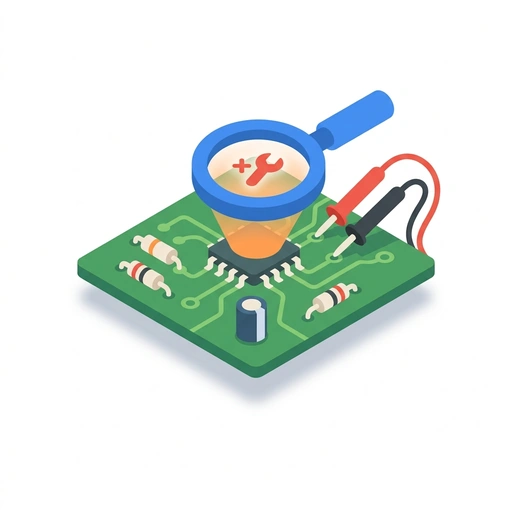
Electronic Circuit Troubleshooting
Move beyond basic multimeter readings to systematically diagnose and repair complex hardware failures. Learn to isolate faults, interpret signal noise, and reverse engineer circuits without a map.
Like Duolingo, but for Electronic Circuit Troubleshooting. Tomo turns the whole topic into a game you play five minutes a day, until it actually sticks.
A deep dive: 34 levels across 5 sections, about 68 minutes end to end, roughly 14 days at five minutes a day. It moves through The Diagnostic Mindset, Component-Level Forensics, Advanced Signal Diagnosis, Real-World Challenges, and The Physics of Failure. It assumes you already know the basics.
Free forever · No credit card · iPhone & Android

Key ideas in Electronic Circuit Troubleshooting
- Functional blocks process signals in a linear chain
- Probing the preamp output isolates the fault
- Half-Split method starts at the middle
- Half-Split downstream movement
- Binary search pattern efficiency
- Applying functional block isolation to a dead device
- Executing the Half-Split method on a long signal chain
- Known Good points are reliable nodes used to verify that specific subsystems are operational.
- Comparing a faulty board to a working 'golden' board helps identify abnormal voltage levels.
- A 'source' problem exists in the stage providing power, while a 'load' problem is a downstream short.
- Identifying Known Good baselines for comparison
- Disconnecting the load and re-testing the source reveals if the downstream circuit is pulling the voltage down.
- Thermal runaway sensory cues
- Electrolytic capacitor failure signs
- Distinguishing between source and load problems
- Discolored PCB traces
You've tried the other tabs
Thirty open tabs. Four facts you actually kept.
You watched. You nodded. By Sunday it was gone.
One answer, then back to scrolling.
Eight weeks. You meant to finish. You didn't.
Tomo gives Electronic Circuit Troubleshooting the Duolingo treatment: levels, streaks, and quick quizzes that test what you just learned. That game loop is what the tabs above never had, so it's the one you actually finish.
Here's what playing it feels like
A real question from this course. Take your best guess.
If an amplifier is powered on but silent, where should you probe to quickly determine if the fault is in the control stage or the power stage?
Get it right to open this lesson and 33 more in the app.
Where Electronic Circuit Troubleshooting takes you
- 1
The Diagnostic Mindset
- The Divide and Conquer Strategy
- Systematic Power Rail Analysis
- 2
Component-Level Forensics
- Testing Passives In-Circuit
- Semiconductor Junction Testing
- Integrated Circuit (IC) Health Checks
- 3
Advanced Signal Diagnosis
- Oscilloscope Mastery for Noise
- Logic and Protocol Debugging
- 4
Real-World Challenges
- Reverse Engineering Without a Schematic
- Intermittent Faults and Stress Testing
- 5
The Physics of Failure
- Parasitics and High-Frequency Behavior
- Component Aging and Wear
5 sections · 11 units · 34 levels. Built to play, not to enroll.
Tomo is in ChatGPT
Tomo is also a ChatGPT plugin: the same playable courses, built and played inside your chat.
Add Tomo to ChatGPT- What to ask
- “Make me a Tomo course on black holes.” “Turn this chat into a Tomo course.”
- What you get
- Quick questions with instant feedback, hearts and stars, ready to play in about a minute.
- Where it goes
- No sign-up to start. Connect your Tomo account and your streak carries on in the app.
You pick the voice
Electronic Circuit Troubleshooting is taught in the The Professor style: clear, structured, thorough. Want a different feel? In the app you can spin up the same topic in any of Tomo's teaching styles. Same facts, totally different vibe.
More Technology on Tomo
Heavy Machinery & Automotive Electronics Diagnostics
Move beyond basic multimeter checks and component swapping. Master loaded circuit analysis, oscilloscope waveform interpretation, J1939 CAN physical layer troubleshooting, and ECU driver stage diagnostics in complex machines.
Ohm's Law in Circuit Design
Bridge the gap between textbook formulas and reliable hardware. Learn how professional engineers apply Ohm's law to size real loads, account for parasitic resistance, troubleshoot ground drops, and manage thermal limits.
Real-World Circuit Design
Move past idealized textbook schematics into the physics of high-speed signals, control loop stability, and electromagnetic compliance. Master parasitic management, noise reduction, and robust power delivery.
Practical Circuit Design
Move beyond basic breadboard recipes to design reliable, real-world circuits. Learn to drive high-power loads, shape signals with op-amps, clean up noisy power rails, and debug circuits with confidence.
Mastering the Flow: Practical Electronics
Move beyond simple batteries and bulbs to design circuits that solve real problems. Master the math of power, troubleshoot like a pro, and understand how modern gadgets actually think.
Real-World Circuit Behavior
Bridge the gap between theoretical schematics and functioning physical hardware. Learn how to diagnose live signals on a scope, stabilize op-amp circuits, and eliminate insidious board noise.
Start Electronic Circuit Troubleshooting today.
Download Tomo, search Electronic Circuit Troubleshooting, and play your first lesson in under a minute.