
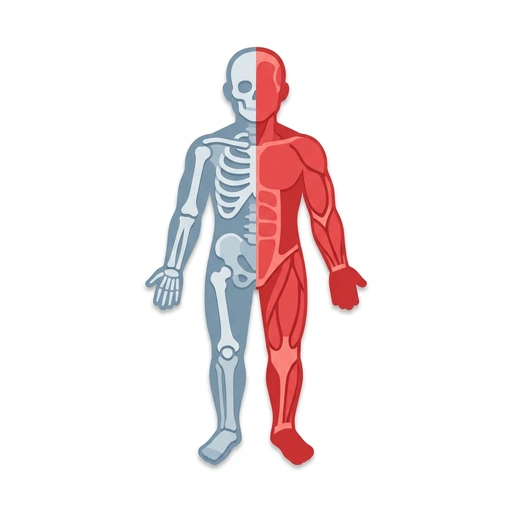
Musculoskeletal Anatomy in Motion
Bridge the gap between memorizing bone names and understanding how the living body generates force and stabilizes joints. Explore the mechanical levers, dynamic force couples, and tissue adaptations that govern human movement and physical resilience.
Like Duolingo, but for Musculoskeletal Anatomy in Motion. Tomo turns the whole topic into a game you play five minutes a day, until it actually sticks.
26 levels across 4 sections, about 52 minutes end to end, roughly 10 days at five minutes a day. It moves through Reading Movement as a Mechanical System, Joint Architecture and Stability Tradeoffs, Muscle Geometry and Elastic Networks, and Structural Adaptation and Mechanical Failure. It assumes you already know the basics.
Free forever · No credit card · iPhone & Android
Key ideas in Musculoskeletal Anatomy in Motion
- Skeletal muscle fibers can only generate tension by contracting and pulling on tendon attachments
- Pushing movements in human limbs are produced entirely by tensile pulling forces across joints
- The triceps straightens the elbow by pulling on the olecranon process behind the joint axis
- Third-class levers place muscle effort between the fulcrum joint and the load in the hand
- Operating with a mechanical disadvantage demands greater muscle force than the load itself
- Placing the effort near the fulcrum amplifies distal limb speed and total range of motion
- Spinal motor circuits automatically inhibit motor neurons of the antagonist muscle group
- Reciprocal inhibition prevents opposing muscle co-contraction from braking the prime mover
- Relaxation of the antagonist allows smooth, rapid limb movement driven by the agonist
- Prime movers create the primary rotational torque along the intended movement plane
- Synergists counteract secondary rotation or multi-planar deviation produced by the prime mover
- Fixators contract isometrically to immobilize the bone where the prime mover originates
- Multi-joint muscles cross two or more joints and shorten across all of them at once
- Maximum shortening overlaps sarcomere actin and myosin so much that cross-bridges cannot cycle
- Extending the hip while flexing the knee shortens the hamstrings at both ends, causing active insufficiency
- Alternating cervical/lumbar lordosis and thoracic kyphosis yield under axial loads to disperse energy
You've tried the other tabs
Thirty open tabs. Four facts you actually kept.
You watched. You nodded. By Sunday it was gone.
One answer, then back to scrolling.
Eight weeks. You meant to finish. You didn't.
Tomo gives Musculoskeletal Anatomy in Motion the Duolingo treatment: levels, streaks, and quick quizzes that test what you just learned. That game loop is what the tabs above never had, so it's the one you actually finish.
Here's what playing it feels like
A real question from this course. Take your best guess.
When you push someone away with your hands, what is mechanically happening inside your arm?
Get it right to open this lesson and 25 more in the app.
Where Musculoskeletal Anatomy in Motion takes you
- 1
Reading Movement as a Mechanical System
- Decoding Levers and Prime Movers
- Force Transfer Through the Pelvis and Spine
- 2
Joint Architecture and Stability Tradeoffs
- The Suspended Shoulder Complex
- The Lower Limb Kinetic Chain
- 3
Muscle Geometry and Elastic Networks
- Muscle Architecture and Vector Mechanics
- Fascial Tension and Elastic Recoil
- 4
Structural Adaptation and Mechanical Failure
- Bone Remodeling Under Mechanical Load
- Connective Tissue Mechanics and Joint Wear
4 sections · 8 units · 26 levels. Built to play, not to enroll.
Tomo is in ChatGPT
Tomo is also a ChatGPT plugin: the same playable courses, built and played inside your chat.
Add Tomo to ChatGPT- What to ask
- “Make me a Tomo course on black holes.” “Turn this chat into a Tomo course.”
- What you get
- Quick questions with instant feedback, hearts and stars, ready to play in about a minute.
- Where it goes
- No sign-up to start. Connect your Tomo account and your streak carries on in the app.
You pick the voice
Musculoskeletal Anatomy in Motion is taught in the Professor style: clear, structured, thorough. Want a different feel? In the app you can spin up the same topic in any of Tomo's teaching styles. Same facts, totally different vibe.
More Health on Tomo
Anatomy for Pilates Movement
Understand the functional anatomy behind classic Pilates exercises and cues. Learn how the deep core, spine, and joint stabilizers work together to guide safe, effective movement.
Human Movement and Vitality
Explore the intricate machinery of the human body, from the physics of a perfect squat to the cellular chemistry of the food you eat.
Clinical Musculoskeletal Anatomy
Build a working knowledge of functional musculoskeletal anatomy for movement assessment and rehabilitation. Learn how muscle lines of pull, force couples, and kinetic chains drive human motion and clinical decision-making.
Anatomy for Pilates Movement
Bridge the gap between textbook anatomy and movement instruction. Understand joint mechanics, muscular lines of pull, and functional compensations across the classic and contemporary Pilates repertoire.
Pilates Anatomy: The Body in Motion
Understand how your muscles and bones work together to create the strength and control that defines Pilates. Learn to move from your center and protect your spine with every breath.
Anatomy for Pilates Professionals
Bridge the gap between textbook anatomy and the moving body. Master the musculoskeletal relationships that drive core stability, spinal articulation, and efficient movement patterns in your clients.
Start Musculoskeletal Anatomy in Motion today.
Download Tomo, search Musculoskeletal Anatomy in Motion, and play your first lesson in under a minute.