
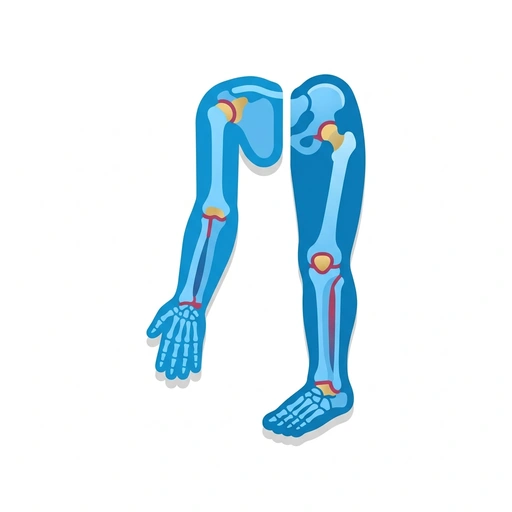
Gross Anatomy of the Limbs
Explore the structural architecture of the human upper and lower limbs through functional movement, muscle attachments, and real clinical cases. Learn how bones, joints, and tendons work together as mechanical levers and discover where nerves and blood vessels are most vulnerable to injury.
Like Duolingo, but for Gross Anatomy of the Limbs. Tomo turns the whole topic into a game you play five minutes a day, until it actually sticks.
25 levels across 3 sections, about 50 minutes end to end, roughly 10 days at five minutes a day. It moves through The Upper Limb: Reach, Grasp, and Mobility; The Lower Limb: Weight-Bearing, Propulsion, and Balance; and Clinical Fault Lines: Nerves, Vessels, and Compartments. It starts from scratch.
Free forever · No credit card · iPhone & Android
Key ideas in Gross Anatomy of the Limbs
- Bones that sit directly under the skin create permanent surface landmarks that do not change position with muscle movement
- Key nerves and blood vessels consistently travel adjacent to specific bony bumps
- Palpating prominent points like the clavicle, acromion, and medial epicondyle lets you pinpoint deeper, hidden structures
- The clavicle acts as an outward rigid brace (strut) keeping the shoulder joint spaced away from the ribcage
- Forces from a fall on an outstretched hand travel up the arm bones directly into the clavicle
- The junction between the clavicle's two curves (the middle third) is its thinnest mechanical weak point
- The shoulder socket is shallow and flat, resembling a golf ball resting on a small tee
- This lack of deep bony enclosure allows the arm its unmatched 360-degree range of motion
- Active dynamic muscle tension, rather than tight interlocking bone, holds the ball centered in the socket
- The large deltoid muscle lifts the arm outward, but its upward angle of pull tends to yank the humerus head straight up
- The rotator cuff muscles form a tight sleeve around the ball, actively pulling it inward and downward
- This downward stabilizing force centers the ball in the socket as the arm raises
- The supraspinatus tendon passes directly through a narrow bony tunnel under the acromion
- Lifting the arm out to mid-range tilts the arm bone, squeezing this tendon against the bony roof overhead
- Inflammation, swelling, or small bone spurs narrow this space further, causing pain specifically through the middle of the lift
- A tough wall of connective tissue (fascia) splits the upper arm into front and back compartments
You've tried the other tabs
Thirty open tabs. Four facts you actually kept.
You watched. You nodded. By Sunday it was gone.
One answer, then back to scrolling.
Eight weeks. You meant to finish. You didn't.
Tomo gives Gross Anatomy of the Limbs the Duolingo treatment: levels, streaks, and quick quizzes that test what you just learned. That game loop is what the tabs above never had, so it's the one you actually finish.
Here's what playing it feels like
A real question from this course. Take your best guess.
Why do healthcare providers check specific bony bumps to locate vital body structures?
Get it right to open this lesson and 24 more in the app.
How to learn Gross Anatomy of the Limbs, step by step
Go in order. 25 short levels across 3 sections, about 50 minutes in all, five minutes a day.
- 1
The Upper Limb: Reach, Grasp, and Mobility
- Surface Landmarks and the Shoulder Suspension
- Arm Levers and Forearm Rotation
- The Hand: Pulleys, Compartments, and Precision Grip
- 2
The Lower Limb: Weight-Bearing, Propulsion, and Balance
- The Hip and Pelvic Stabilizers
- The Knee: Ligament Crossbars and Shock Absorption
- The Ankle and Foot: Spring Arches and Push-Off
- 3
Clinical Fault Lines: Nerves, Vessels, and Compartments
- Brachial Plexus Pathways and Upper Limb Deficits
- Lower Limb Nerve Deficits and Compartment Crises
3 sections · 8 units · 25 levels. Built to play, not to enroll.
Questions about Gross Anatomy of the Limbs
How do I learn Gross Anatomy of the Limbs?
Go in order: start with The Upper Limb: Reach, Grasp, and Mobility, then The Lower Limb: Weight-Bearing, Propulsion, and Balance, then Clinical Fault Lines: Nerves, Vessels, and Compartments. On Tomo that's 25 short levels, about 50 minutes in all, played five minutes a day. Start free and play the first level in under a minute.
Is there a Duolingo-style app for Gross Anatomy of the Limbs?
Yes. Tomo works like Duolingo: short daily lessons, streaks and quick quizzes. Gross Anatomy of the Limbs is one of its free courses, and you can type any other topic to get a course of your own.
Is the Gross Anatomy of the Limbs course free?
Yes. Gross Anatomy of the Limbs is playable on Tomo's free plan, which doesn't expire. No credit card, no waitlist. Download the app and start your first lesson.
How long does it take to learn Gross Anatomy of the Limbs?
25 levels across 3 sections, about 50 minutes of play in total. It's built for five minutes a day, so you finish it a little at a time instead of all at once.
Do I need any background to start Gross Anatomy of the Limbs?
No. It's pitched at a beginner level, so it starts where you are and builds up. If you can tap a phone, you can start.
Tomo is in ChatGPT
Tomo is also a ChatGPT plugin: the same playable courses, built and played inside your chat.
Add Tomo to ChatGPT- What to ask
- “Make me a Tomo course on black holes.” “Turn this chat into a Tomo course.”
- What you get
- Quick questions with instant feedback, hearts and stars, ready to play in about a minute.
- Where it goes
- No sign-up to start. Connect your Tomo account and your streak carries on in the app.
You pick the voice
Gross Anatomy of the Limbs is taught in the Professor style: clear, structured, thorough. Want a different feel? In the app you can spin up the same topic in any of Tomo's teaching styles. Same facts, totally different vibe.
More Health on Tomo
Clinical Musculoskeletal Anatomy
Build a working knowledge of functional musculoskeletal anatomy for movement assessment and rehabilitation. Learn how muscle lines of pull, force couples, and kinetic chains drive human motion and clinical decision-making.
Anatomy for Pilates Professionals
Bridge the gap between textbook anatomy and the moving body. Master the musculoskeletal relationships that drive core stability, spinal articulation, and efficient movement patterns in your clients.
Anatomy for Pilates Movement
Bridge the gap between textbook anatomy and movement instruction. Understand joint mechanics, muscular lines of pull, and functional compensations across the classic and contemporary Pilates repertoire.
Anatomy for Pilates Movement
Understand the functional anatomy behind classic Pilates exercises and cues. Learn how the deep core, spine, and joint stabilizers work together to guide safe, effective movement.
Surgical Orthopedic Anatomy
Examine high-yield surgical intervals, capsuloligamentous joint restraints, and vulnerable vascular corridors essential for orthopedic procedures. Master the structural mechanics and anatomical danger zones encountered in operative practice.
Mapping the Human Body
Learn to read your own body like a clinical map. Discover how surface landmarks reveal internal organs, how your chest and abdomen are organized, and how spinal nerve highways route sensation.
Start Gross Anatomy of the Limbs today.
Download Tomo, search Gross Anatomy of the Limbs, and play your first lesson in under a minute.