
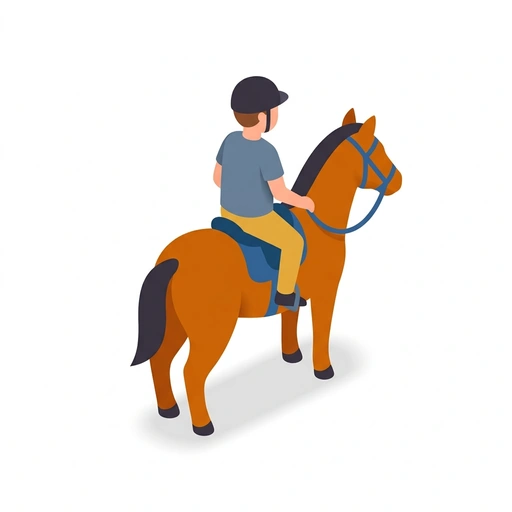
Horseback Riding Basics
Discover the fundamentals of balanced riding, compare classic English and Western styles, and see how the versatile American Quarter Horse brings both disciplines to life.
Like Duolingo, but for Horseback Riding Basics. Tomo turns the whole topic into a game you play five minutes a day, until it actually sticks.
A short one: 11 levels across 2 sections, about 22 minutes end to end, roughly 4 days at five minutes a day. It moves through First Steps in the Saddle and English, Western, and the Quarter Horse. It starts from scratch.
Free forever · No credit card · iPhone & Android
Key ideas in Horseback Riding Basics
- A straight vertical alignment stacks the rider's weight over the horse's center of gravity
- Stacking ear, shoulder, hip, and heel lets gravity support balance without exhausting muscular effort
- Letting heels drift forward or leaning shoulders back breaks the line and causes the rider to tip backward
- Pinching with the knees acts like a pivot point that levers the rider's seat bones up out of the saddle
- A deep, secure seat relies on relaxed, long legs wrapped softly around the horse's barrel rather than gripping knees
- Tension in the knees prevents the rider's weight from dropping down into the stirrups and heels
- The rider's pelvis acts as a flexible shock absorber, subtly oscillating with the horse's back movements
- Bracing the hips rigidly causes the horse's upward strides to toss the rider upward into a harsh bounce
- Allowing the lower back and hips to stay fluid keeps the seat glued to the saddle leather
- Looking where you want to go rotates the rider's shoulders and subtly shifts weight into the direction of the turn
- Looking down at the horse's ears causes the rider's upper body to collapse forward and unbalance the horse
- Horses are highly sensitive to subtle shifts in the rider's seat bones caused by head turning
- A rider's seat, legs, hands, and balance are called natural aids and must coordinate together
- Riders never use the hands in isolation; legs create movement while the seat sets pace
- Horses respond to the combined balance of your entire body, not separate isolated tugs
- Calf pressure applied with a relaxed squeeze asks the horse to step forward
You've tried the other tabs
Thirty open tabs. Four facts you actually kept.
You watched. You nodded. By Sunday it was gone.
One answer, then back to scrolling.
Eight weeks. You meant to finish. You didn't.
Tomo gives Horseback Riding Basics the Duolingo treatment: levels, streaks, and quick quizzes that test what you just learned. That game loop is what the tabs above never had, so it's the one you actually finish.
Here's what playing it feels like
A real question from this course. Take your best guess.
Why do riders aim to keep their ear, shoulder, hip, and heel lined up in a straight stack?
Get it right to open this lesson and 10 more in the app.
Where Horseback Riding Basics takes you
- 1
First Steps in the Saddle
- Finding Your Balance in Motion
- Speaking Horse with Your Body
- 2
English, Western, and the Quarter Horse
- English vs. Western Styles
- The American Quarter Horse in Practice
2 sections · 4 units · 11 levels. Built to play, not to enroll.
Tomo is in ChatGPT
Tomo is also a ChatGPT plugin: the same playable courses, built and played inside your chat.
Add Tomo to ChatGPT- What to ask
- “Make me a Tomo course on black holes.” “Turn this chat into a Tomo course.”
- What you get
- Quick questions with instant feedback, hearts and stars, ready to play in about a minute.
- Where it goes
- No sign-up to start. Connect your Tomo account and your streak carries on in the app.
You pick the voice
Horseback Riding Basics is taught in the The Bestie style: your friend who just gets it. Want a different feel? In the app you can spin up the same topic in any of Tomo's teaching styles. Same facts, totally different vibe.
More Sports on Tomo
Western Saddle Fitting: The Balanced Tree
Go beyond the basics of cinching up to understand the complex geometry of the western tree, equine anatomy, and how to ensure your horse's long-term soundness through a perfect fit.
Calisthenics: Strength with Your Own Weight
Learn to master your own bodyweight using simple, effective movements that build real-world strength without a gym membership.
Fishing for the First Time
Go from holding a rod to landing your first catch. This course covers the essential gear, casting techniques, and 'fish logic' needed for a successful day at the water.
Kitesurfing Somabay's Flat Waters
Learn to kitesurf in Egypt's premier flat-water haven. Master kite setup, launch safety, waterstarts, and bay navigation tailored to Somabay's unique Red Sea winds and sandbars.
Functional Anatomy in Sport
Decode the biomechanical language used by athletic trainers, physical therapists, and sports medicine pros. Learn how joints, planes, and kinetic chains work under real athletic loads.
Lower Body Mechanics
Upgrade your squats, hinges, and lunges by understanding joint angles, pelvic control, and ground contact. Eliminate lower back strain and knee pain by fixing the subtle power leaks in your stance.
Start Horseback Riding Basics today.
Download Tomo, search Horseback Riding Basics, and play your first lesson in under a minute.