
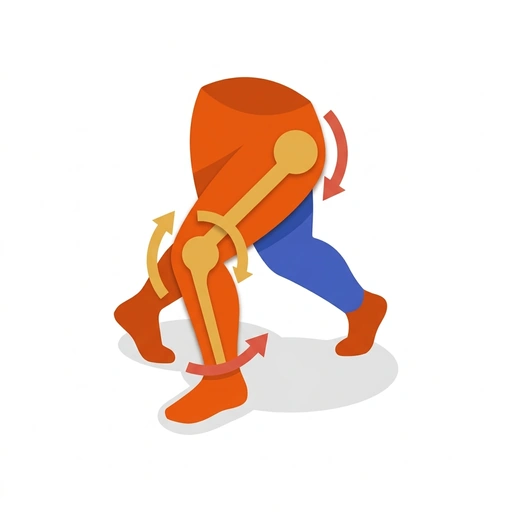
Lower Body Mechanics
Upgrade your squats, hinges, and lunges by understanding joint angles, pelvic control, and ground contact. Eliminate lower back strain and knee pain by fixing the subtle power leaks in your stance.
Like Duolingo, but for Lower Body Mechanics. Tomo turns the whole topic into a game you play five minutes a day, until it actually sticks.
A short one: 12 levels across 2 sections, about 24 minutes end to end, roughly 5 days at five minutes a day. It moves through Dialing Stance and Joint Alignment and Eliminating Imbalances and Power Leaks. It assumes you already know the basics.
Free forever · No credit card · iPhone & Android
Key ideas in Lower Body Mechanics
- Weight must distribute evenly between the heel and both the first and fifth metatarsal heads.
- Grounding these three contact points actively elevates the medial longitudinal arch.
- Losing pressure at the first metatarsal head collapses the foot inward and destabilizes the chain.
- Torquing the feet outward into the floor recruits the gluteus medius and deep hip rotators.
- External rotation torque must be created without letting the feet physically spin or slide.
- Active hip external rotation directly prevents inward knee valgus during heavy descent.
- Ankle dorsiflexion determines how far the shin can travel over the foot before balance fails
- Insufficient forward tibial travel forces the lifter to pitch the torso forward to stay balanced
- Weight must distribute evenly between the heel and both the first and fifth metatarsal heads
- Forcing an upright chest when ankles cannot bend forces the heels to peel off the floor
- Torquing the feet outward into the floor recruits the gluteus medius and deep hip rotators
- Heel wedges reduce the dorsiflexion demand required to reach full squat depth
- If squat depth and posture instantly improve on wedges, ankle mobility is the limiting factor
- Bony hip impingement continues to block depth regardless of whether heels are elevated
- Forward knee travel lengthens the moment arm at the knee, increasing quadriceps demand.
- Letting the shins incline forward keeps the torso more upright, decreasing lumbar shear stress.
You've tried the other tabs
Thirty open tabs. Four facts you actually kept.
You watched. You nodded. By Sunday it was gone.
One answer, then back to scrolling.
Eight weeks. You meant to finish. You didn't.
Tomo gives Lower Body Mechanics the Duolingo treatment: levels, streaks, and quick quizzes that test what you just learned. That game loop is what the tabs above never had, so it's the one you actually finish.
Here's what playing it feels like
A real question from this course. Take your best guess.
Picture yourself stepping under a heavy barbell. To form a rock-solid foot tripod, where should your weight balance?
Get it right to open this lesson and 11 more in the app.
Where Lower Body Mechanics takes you
- 1
Dialing Stance and Joint Alignment
- Grounding the Feet and Guiding the Knees
- Squat Geometry and Pelvic Position
- 2
Eliminating Imbalances and Power Leaks
- Loading the Posterior Chain Cleanly
- Unilateral Balance and Pelvic Leveling
2 sections · 4 units · 12 levels. Built to play, not to enroll.
You pick the voice
Lower Body Mechanics is taught in the The Storyteller style: every lesson is a story. Want a different feel? In the app you can spin up the same topic in any of Tomo's teaching styles. Same facts, totally different vibe.
More Sports on Tomo
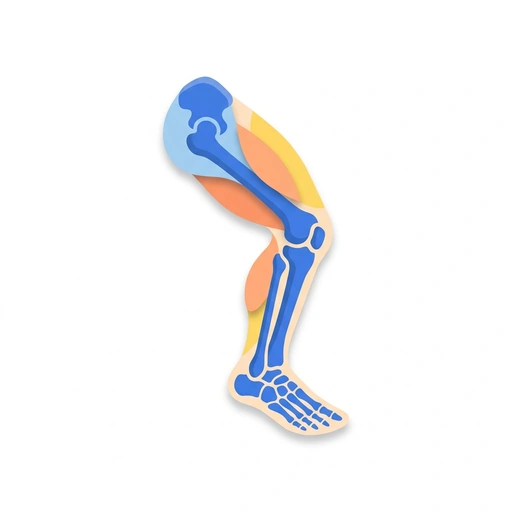
Anatomy for Athletic Movement
Bridge the gap between textbook anatomy and high-performance sport. Learn the functional terminology of planes, muscular roles, connective tissue mechanics, and kinetic chains to talk and train like a sports clinician.
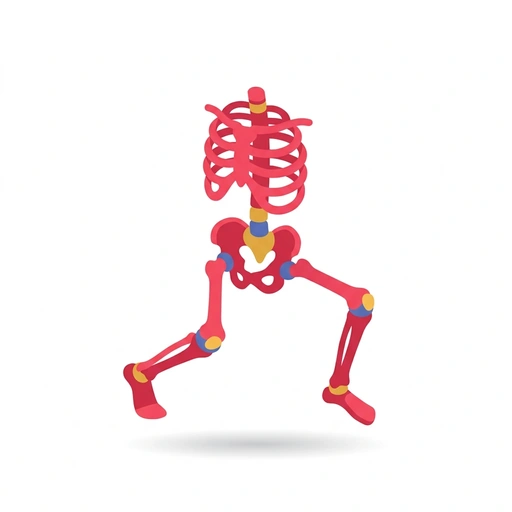
Functional Anatomy in Sport
Decode the biomechanical language used by athletic trainers, physical therapists, and sports medicine pros. Learn how joints, planes, and kinetic chains work under real athletic loads.
Kitesurfing Somabay's Flat Waters
Learn to kitesurf in Egypt's premier flat-water haven. Master kite setup, launch safety, waterstarts, and bay navigation tailored to Somabay's unique Red Sea winds and sandbars.
Horseback Riding Basics
Discover the fundamentals of balanced riding, compare classic English and Western styles, and see how the versatile American Quarter Horse brings both disciplines to life.
Volleyball: The Art of the Serve
Transform your serve from a simple restart into a lethal first attack. Learn to manipulate ball flight, target defensive gaps, and maintain composure under pressure.
Stronger Steps: Gym for Dancers
Stop struggling with shaky balances and soft knees. Master the gym routines that turn wobbly movements into powerful, sharp performances with better stamina.
Start Lower Body Mechanics today.
Download Tomo, search Lower Body Mechanics, and play your first lesson in under a minute.