
How Brain Neurons Work
Discover how billions of tiny brain cells generate your thoughts, memories, and actions. Learn the electrical and chemical mechanics behind neural firing, circuit building, and everyday brain health.
Like Duolingo, but for How Brain Neurons Work. Tomo turns the whole topic into a game you play five minutes a day, until it actually sticks.
24 levels across 4 sections, about 48 minutes end to end, roughly 10 days at five minutes a day. It moves through Sending the Signal; Forming Circuits and Memories; Fueling and Protecting the System; and Adaptation, Damage, and Aging. It starts from scratch.
Free forever · No credit card · iPhone & Android
Key ideas in How Brain Neurons Work
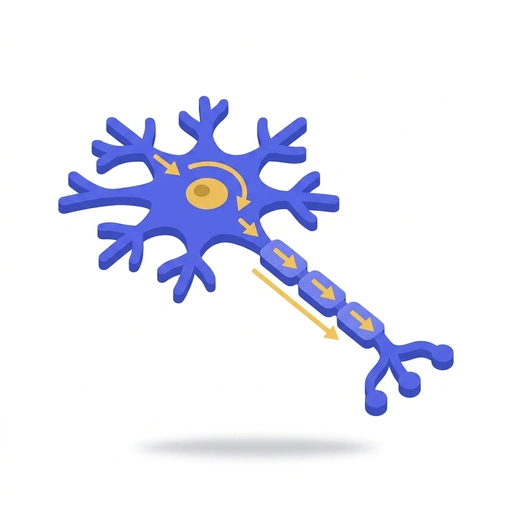
- A neuron receives incoming chemical or electrical cues primarily along its branched dendrites
- The cell body processes incoming cues and maintains the living cell
- A single axon carries outgoing electrical signals away from the cell body toward target cells
- Signals travel along an axon as brief, discrete electrical spikes called action potentials
- Neurons do not pass electricity as a continuous, smooth current like household wiring
- Each action potential maintains its full spike size as it travels down the length of the axon
- A resting neuron constantly pumps charged mineral ions, like sodium and potassium, across its membrane
- Separating these charged ions creates a negative electrical charge inside relative to outside, storing potential energy like a primed battery
- This stored electrical voltage is released during firing when channels open and ions rush across
- Neurons fire on an all-or-nothing rule: once incoming stimulation crosses the trigger threshold, the spike reaches full power
- A stronger stimulus causes a neuron to fire more pulses per second, but does not increase the size or voltage of an individual spike
- Any stimulation below the threshold fails to trigger a spike at all
- Myelin acts as fatty insulation wrapped around the axon
- Insulation forces the electrical impulse to jump rapidly between exposed gaps rather than creeping slowly along every millimeter
- Stripping away myelin slows impulses down dramatically or leaks charge, preventing signals from reaching their destination
- Neurons do not physically touch each other; they are separated by a microscopic fluid-filled gap called a synapse
You've tried the other tabs
Thirty open tabs. Four facts you actually kept.
You watched. You nodded. By Sunday it was gone.
One answer, then back to scrolling.
Eight weeks. You meant to finish. You didn't.
Tomo gives How Brain Neurons Work the Duolingo treatment: levels, streaks, and quick quizzes that test what you just learned. That game loop is what the tabs above never had, so it's the one you actually finish.
Here's what playing it feels like
A real question from this course. Take your best guess.
What is the main job of the neuron's cell body?
Get it right to open this lesson and 23 more in the app.
How to learn How Brain Neurons Work, step by step
Go in order. 24 short levels across 4 sections, about 48 minutes in all, five minutes a day.
- 1
Sending the Signal
- How a Brain Cell Fires
- Crossing the Synaptic Divide
- 2
Forming Circuits and Memories
- Rewiring Connections Through Experience
- Wiring Neurons into Functional Networks
- 3
Fueling and Protecting the System
- The Essential Work of Glial Cells
- Energy Demands, Sleep, and Waste Removal
- 4
Adaptation, Damage, and Aging
- Neurogenesis and the Limits of Brain Repair
- When Brain Signals Go Wrong
4 sections · 8 units · 24 levels. Built to play, not to enroll.
Questions about How Brain Neurons Work
How do I learn How Brain Neurons Work?
Go in order: start with Sending the Signal, then Forming Circuits and Memories, then Fueling and Protecting the System, then Adaptation, Damage, and Aging. On Tomo that's 24 short levels, about 48 minutes in all, played five minutes a day. Start free and play the first level in under a minute.
Is there a Duolingo-style app for How Brain Neurons Work?
Yes. Tomo works like Duolingo: short daily lessons, streaks and quick quizzes. How Brain Neurons Work is one of its free courses, and you can type any other topic to get a course of your own.
Is the How Brain Neurons Work course free?
Yes. How Brain Neurons Work is playable on Tomo's free plan, which doesn't expire. No credit card, no waitlist. Download the app and start your first lesson.
How long does it take to learn How Brain Neurons Work?
24 levels across 4 sections, about 48 minutes of play in total. It's built for five minutes a day, so you finish it a little at a time instead of all at once.
Do I need any background to start How Brain Neurons Work?
No. It's pitched at a beginner level, so it starts where you are and builds up. If you can tap a phone, you can start.
Tomo is in ChatGPT
Tomo is also a ChatGPT plugin: the same playable courses, built and played inside your chat.
Add Tomo to ChatGPT- What to ask
- “Make me a Tomo course on black holes.” “Turn this chat into a Tomo course.”
- What you get
- Quick questions with instant feedback, hearts and stars, ready to play in about a minute.
- Where it goes
- No sign-up to start. Connect your Tomo account and your streak carries on in the app.
You pick the voice
How Brain Neurons Work is taught in the Professor style: clear, structured, thorough. Want a different feel? In the app you can spin up the same topic in any of Tomo's teaching styles. Same facts, totally different vibe.
More Science on Tomo
Forces, Chemistry, and Living Circuits
Discover how the universe operates across physical forces, chemical bonds, living cells, and silicon circuits. Learn the fundamental principles that connect energy, matter, and electronic signals in our everyday world.
How Electric Circuits Work
Move beyond basic wiring diagrams to understand how charge, voltage, and energy behave in real-world loops. Learn to diagnose DC loads, master reactive components, control switching, and tame noisy signals.
How Your Body Works
Ever wonder what's happening inside you right now? Discover how your heart pumps, how you breathe, and how your brain controls everything you do in this simple guide to the human body.
How the Human Body Works
Discover the incredible machinery running beneath your skin every second. Learn how your organs coordinate, why your body produces familiar everyday sensations, and what it takes to keep you moving, thinking, and alive.

How the Human Body Works
Explore how your body operates as an interconnected system of pumps, levers, sensors, and chemical messengers. Discover the real mechanics behind everyday sensations like fatigue, reflexes, and appetite. Build a working mental model of how your organs team up to keep you alive and moving.
How the Human Body Works
Discover how your body coordinates movement, fuels your cells, and keeps you alive. Learn the mechanics behind everyday sensations from your heartbeat to muscle fatigue.
Start How Brain Neurons Work today.
Download Tomo, search How Brain Neurons Work, and play your first lesson in under a minute.