
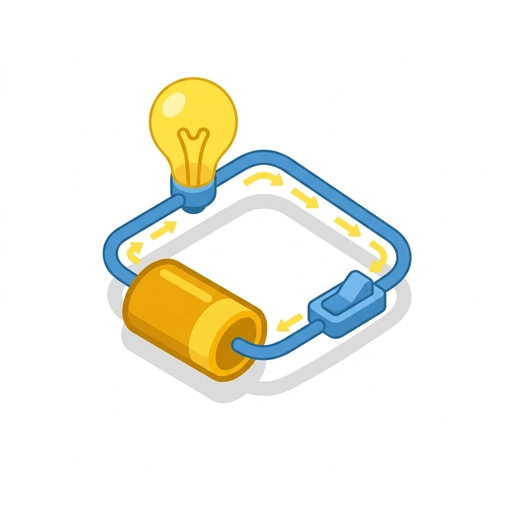
How Electric Circuits Work
Like Duolingo, but for How Electric Circuits Work. Tomo turns the whole topic into a game you play five minutes a day, until it actually sticks.
For the part of you with thirty open tabs that never became anything.
25 levels across 4 sections, about 50 minutes end to end, roughly 10 days at five minutes a day. It moves through Diagnosing and Predicting DC Loops, Energy Storage and Active Switching, Alternating Signals and Reactive Networks, and The Physical Reality Beneath Schematics. It assumes you already know the basics.
Free forever · No credit card · iPhone & Android

Key ideas in How Electric Circuits Work
- Junctions cannot store charge, so total inflow always equals total outflow.
- Subtracting known outflow branches from the incoming supply yields the remaining branch current.
- Charge never bottlenecks or vanishes at a circuit node.
- A closed loop returns to the same electrical potential, making the round-trip net voltage zero.
- Voltage rises provided by power sources must equal the sum of voltage drops across loads.
- Kirchhoff's voltage law holds true for any complete loop regardless of branch complexity.
- Components in a single unbranched path experience the exact same continuous current.
- Swapping series positions leaves total path resistance and component voltage drops unchanged.
- Current does not get used up sequentially before reaching downstream components.
- A voltmeter needs high internal resistance to probe across points without diverting flow.
- An ammeter must be inserted into an open wire so the full loop current passes through it.
- Measuring current across a powered component creates an accidental short circuit.
- Current diverts almost entirely through the near-zero-resistance bypass wire.
- Bypassed components experience near-zero voltage drop and shut down immediately.
- Overall circuit resistance collapses, drawing dangerously high current from the power supply.
- A divider relies on equal current flowing down both series resistors.
You've tried the other tabs
Thirty open tabs. Four facts you actually kept.
You watched. You nodded. By Sunday it was gone.
One answer, then back to scrolling.
Eight weeks. You meant to finish. You didn't.
Tomo gives How Electric Circuits Work the Duolingo treatment: levels, streaks, and quick quizzes that test what you just learned. That game loop is what the tabs above never had, so it's the one you actually finish.
Here's what playing it feels like
A real question from this course. Take your best guess.
If 5 amps enter a three-way junction, and two outgoing branches take 2 amps and 1 amp, how much is in the third branch?
Get it right to open this lesson and 24 more in the app.
Where How Electric Circuits Work takes you
Move beyond basic wiring diagrams to understand how charge, voltage, and energy behave in real-world loops. Learn to diagnose DC loads, master reactive components, control switching, and tame noisy signals.
- 1
Diagnosing and Predicting DC Loops
- Tracing Voltage and Current with Kirchhoff's Rules
- Managing Voltage Dividers and Load Effects
- 2
Energy Storage and Active Switching
- Capacitors in Transient and Filtering Circuits
- Inductors and Magnetic Transient Spikes
- Controlling Current with Diodes and Transistors
- 3
Alternating Signals and Reactive Networks
- Alternating Current and Complex Impedance
- Passive Filtering and Resonance
- 4
The Physical Reality Beneath Schematics
- Grounding, Parasitics, and Signal Return
4 sections · 8 units · 25 levels. Built to play, not to enroll.
You pick the voice
How Electric Circuits Work is taught in the Explain Like I'm 5 style: no big words. promise.. Want a different feel? In the app you can spin up the same topic in any of Tomo's teaching styles. Same facts, totally different vibe.
More Science on Tomo

Forces, Chemistry, and Living Circuits
Discover how the universe operates across physical forces, chemical bonds, living cells, and silicon circuits. Learn the fundamental principles that connect energy, matter, and electronic signals in our everyday world.

The Rules of the Physical World
Discover the invisible forces that govern everything from your morning walk to the stars above. Learn to see the world through the lens of motion, energy, and gravity.
How Electricity Works
Demystify the invisible force that powers modern life. Learn how circuits operate, what voltage and wattage actually measure, and how electricity safely runs your home.
The Body Electric: Signals and Systems
Discover how your body uses the laws of physics to move, think, and sense the world. Explore the hidden electrical circuits and wave patterns that keep your biological systems in sync.
Quantum Physics at Work
Learn the core formulas of quantum mechanics and see how wave-particle duality, tunneling, and superposition power the modern technologies in your pocket.
How the Physical World Works
Discover the hidden rules that govern everything from a falling apple to the stars in the sky. Learn to see the forces, energy, and waves that shape your daily life.
Start How Electric Circuits Work today.
Download Tomo, search How Electric Circuits Work, and play your first lesson in under a minute.