
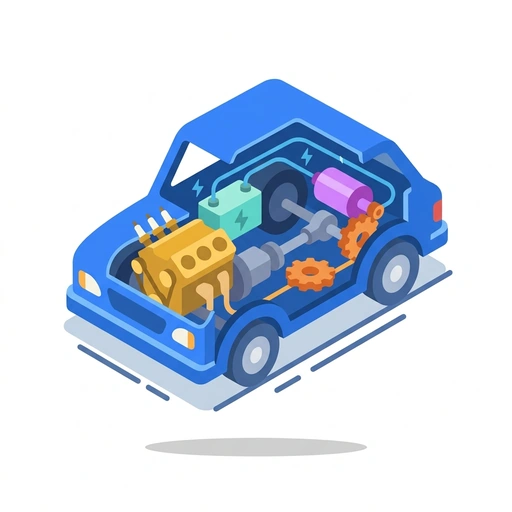
How Cars Work
Discover what happens beneath the metal when you press the pedal, turn the wheel, or charge up. Explore the mechanical gears, electric powertrains, and computer reflexes that move modern automobiles.
Like Duolingo, but for How Cars Work. Tomo turns the whole topic into a game you play five minutes a day, until it actually sticks.
A short one: 12 levels across 2 sections, about 24 minutes end to end, roughly 5 days at five minutes a day. It moves through The Powertrain: Turning Energy into Motion and Control Systems: Handling, Friction, and Onboard Computers. It starts from scratch.
Free forever · No credit card · iPhone & Android

Key ideas in How Cars Work
- Fresh air and fuel enter the cylinder during the intake stroke
- The piston squeezes the mixture on compression before a spark ignites it to force the piston down on power
- The exhaust stroke pushes the burned gases out so the cycle can repeat
- Pistons travel in a straight, reciprocating up-and-down path inside the cylinder
- The crankshaft has offset pins that translate that up-and-down push into smooth circular rotation
- This rotary motion is what ultimately turns the car's wheels
- A car engine only produces practical power across a relatively narrow range of spinning speeds
- Lower transmission gears trade engine speed for wheel-turning force to overcome inertia from a stop
- Higher gears let the car cruise at high speeds on the highway without the engine over-revving
- When turning a curve, the outside wheel travels a longer path than the inside wheel in the exact same amount of time
- If driven wheels were solidly joined on a single shaft, one or both tires would be forced to slip and scrub against the road
- A differential splits driving power between the driven wheels while letting them spin at unequal speeds
- Engine oil forms a pressurized barrier between moving metal parts so they slide smoothly without grinding or melting together
- Liquid coolant flows through channels around hot combustion chambers, carrying excess heat to the radiator where air cools it down
- Running out of either oil or coolant leads quickly to severe engine overheating and seized components
- A traditional gasoline engine relies on hundreds of moving parts like pistons, valves, camshafts, and belts that slide up and down or rotate against each other
You've tried the other tabs
Thirty open tabs. Four facts you actually kept.
You watched. You nodded. By Sunday it was gone.
One answer, then back to scrolling.
Eight weeks. You meant to finish. You didn't.
Tomo gives How Cars Work the Duolingo treatment: levels, streaks, and quick quizzes that test what you just learned. That game loop is what the tabs above never had, so it's the one you actually finish.
Here's what playing it feels like
A real question from this course. Take your best guess.
Picture the piston rising after intake. What happens to the fuel and air right before the spark fires?
Get it right to open this lesson and 11 more in the app.
How to learn How Cars Work, step by step
Go in order. 12 short levels across 2 sections, about 24 minutes in all, five minutes a day.
- 1
The Powertrain: Turning Energy into Motion
- Combustion Engines: Fuel, Fire, and Spinning Shafts
- Electric Drivetrains: Magnetic Pull and Instant Torque
- 2
Control Systems: Handling, Friction, and Onboard Computers
- Brakes and Suspension: Hydraulic Leverage and Tire Contact
- The Electronic Brain: Sensors, Networks, and Active Safety
2 sections · 4 units · 12 levels. Built to play, not to enroll.
Questions about How Cars Work
How do I learn How Cars Work?
Go in order: start with The Powertrain: Turning Energy into Motion, then Control Systems: Handling, Friction, and Onboard Computers. On Tomo that's 12 short levels, about 24 minutes in all, played five minutes a day. Start free and play the first level in under a minute.
Is there a Duolingo-style app for How Cars Work?
Yes. Tomo works like Duolingo: short daily lessons, streaks and quick quizzes. How Cars Work is one of its free courses, and you can type any other topic to get a course of your own.
Is the How Cars Work course free?
Yes. How Cars Work is playable on Tomo's free plan, which doesn't expire. No credit card, no waitlist. Download the app and start your first lesson.
How long does it take to learn How Cars Work?
12 levels across 2 sections, about 24 minutes of play in total. It's built for five minutes a day, so you finish it a little at a time instead of all at once.
Do I need any background to start How Cars Work?
No. It's pitched at a beginner level, so it starts where you are and builds up. If you can tap a phone, you can start.
Tomo is in ChatGPT
Tomo is also a ChatGPT plugin: the same playable courses, built and played inside your chat.
Add Tomo to ChatGPT- What to ask
- “Make me a Tomo course on black holes.” “Turn this chat into a Tomo course.”
- What you get
- Quick questions with instant feedback, hearts and stars, ready to play in about a minute.
- Where it goes
- No sign-up to start. Connect your Tomo account and your streak carries on in the app.
You pick the voice
How Cars Work is taught in the Storyteller style: every lesson is a story. Want a different feel? In the app you can spin up the same topic in any of Tomo's teaching styles. Same facts, totally different vibe.
More Technology on Tomo
How Cars Work
Demystify what happens beneath the hood and behind the dashboard. Learn how engines, transmissions, and brakes operate, how to spot warning signs before they become costly breakdowns, and how to make confident decisions as an owner.
How Your Car Works and Why It Breaks
Learn what happens under the hood and how to spot mechanical trouble before you get stranded. Diagnose common engine, brake, and electrical issues and make informed fixes with confidence.
How Car Engines and Turbos Work
Discover how tiny drops of gasoline create explosive forward motion. Trace the path from piston stroke to crankshaft spin, then see how a turbocharger harvests exhaust to unlock effortless speed.
Hands-On Auto Mechanics
Move beyond routine fluid changes into real-world diagnostic and mechanical repair. Learn to track down electrical gremlins, interpret live sensor data, and pinpoint chassis and engine faults before unbolting parts.
How Engines and Turbos Work
Discover how cars turn droplets of fuel and gulps of air into rotational wheel power. Follow the path of combustion through pistons and crankshafts, then see how turbochargers harvest waste exhaust to create effortless boost.
Everyday Car Mechanics
Demystify what happens under your car's hood with practical, hands-on knowledge. Learn how to check vital fluids, diagnose weird noises, understand core engine systems, and deal honestly with mechanics.
Start How Cars Work today.
Download Tomo, search How Cars Work, and play your first lesson in under a minute.