
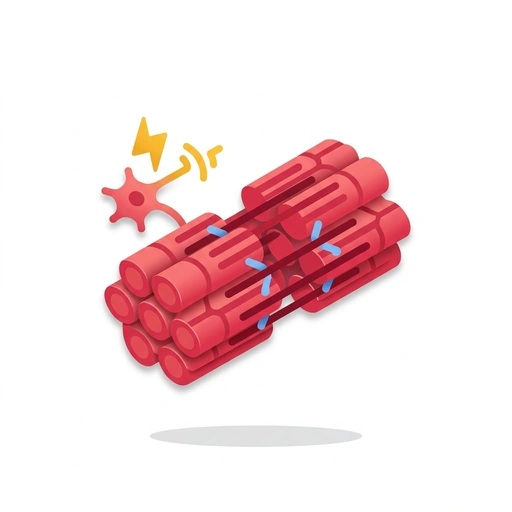
How Muscles Contract
Discover the microscopic machinery that converts nerve impulses into physical force. Learn how molecular ratchets slide, how calcium unlocks movement, and how the body calibrates tension in real time.
Like Duolingo, but for How Muscles Contract. Tomo turns the whole topic into a game you play five minutes a day, until it actually sticks.
A short one: 12 levels across 2 sections, about 24 minutes end to end, roughly 5 days at five minutes a day. It moves through The Nanoscale Engine and Controlling and Sustaining Force. It assumes you already know the basics.
Free forever · No credit card · iPhone & Android
Key ideas in How Muscles Contract
- Actin and myosin maintain constant physical lengths during contraction.
- Sarcomeres shorten entirely because thin filaments slide past thick filaments.
- Filament overlap increases as Z-discs are pulled toward the M-line.
- Binding of a fresh ATP molecule causes myosin to release actin.
- Without ATP, myosin remains locked to actin, resulting in rigor mortis.
- Cross-bridge detachment is an energy-dependent disengagement process.
- ATP binding breaks attachment before hydrolysis primes the head.
- Hydrolysis of ATP into ADP and Pi cocks the myosin head backward.
- The cocked head stores potential energy like a primed mechanical spring.
- The cocked myosin head binds to newly exposed sites on actin.
- Release of inorganic phosphate triggers the forceful neck pivot.
- Pivoting pulls the actin filament toward the sarcomere center.
- Asynchronous cycling ensures some heads maintain grip while others reset.
- Simultaneous detachment would allow thin filaments to slip backward under load.
- Out-of-phase binding produces smooth, continuous tension without jitter.
- Thick muscle fibers cannot rely on surface depolarization alone
You've tried the other tabs
Thirty open tabs. Four facts you actually kept.
You watched. You nodded. By Sunday it was gone.
One answer, then back to scrolling.
Eight weeks. You meant to finish. You didn't.
Tomo gives How Muscles Contract the Duolingo treatment: levels, streaks, and quick quizzes that test what you just learned. That game loop is what the tabs above never had, so it's the one you actually finish.
Here's what playing it feels like
A real question from this course. Take your best guess.
If the protein filaments don't shrink, why does the muscle sarcomere shorten when you contract?
Get it right to open this lesson and 11 more in the app.
Where How Muscles Contract takes you
- 1
The Nanoscale Engine
- The Cross-Bridge Power Stroke
- The Calcium Ignition
- 2
Controlling and Sustaining Force
- Tuning Tension and Recruitment
- Fueling the Pull and Muscle Fatigue
2 sections · 4 units · 12 levels. Built to play, not to enroll.
Tomo is in ChatGPT
Tomo is also a ChatGPT plugin: the same playable courses, built and played inside your chat.
Add Tomo to ChatGPT- What to ask
- “Make me a Tomo course on black holes.” “Turn this chat into a Tomo course.”
- What you get
- Quick questions with instant feedback, hearts and stars, ready to play in about a minute.
- Where it goes
- No sign-up to start. Connect your Tomo account and your streak carries on in the app.
You pick the voice
How Muscles Contract is taught in the Bestie style: your friend who just gets it. Want a different feel? In the app you can spin up the same topic in any of Tomo's teaching styles. Same facts, totally different vibe.
More Science on Tomo
How the Human Body Fits Together
Explore the elegant architecture of your own body from the inside out. Learn how your skeleton, muscles, circulation, and vital organs coordinate to keep you upright, moving, and alive.
Functional Anatomy: How the Body Handles Force
Move past rote memorization of muscle names and discover the biomechanical architecture of the human body. Learn how moment arms, two-joint muscle dynamics, core hydraulics, and elastic fascia manage force and movement.
How the Human Body Works
Discover how your body coordinates movement, fuels your cells, and keeps you alive. Learn the mechanics behind everyday sensations from your heartbeat to muscle fatigue.
Dragon Anatomy: Beyond the Basics
Move past simple myths to understand how a dragon's body actually functions. Explore the mechanics of flight, the chemistry of fire-breathing, and the specialized armor that protects these legendary beasts.
How the Human Body Works
Discover how your senses, muscles, brain, and heart collaborate as an extraordinary living machine. Learn how your body translates the world outside into thought, movement, and life on the inside.
Human Anatomy: Built to Move
Discover the mechanical genius beneath your skin. Learn how your bones, muscles, lungs, and heart coordinate to move you through the world.
Start How Muscles Contract today.
Download Tomo, search How Muscles Contract, and play your first lesson in under a minute.