
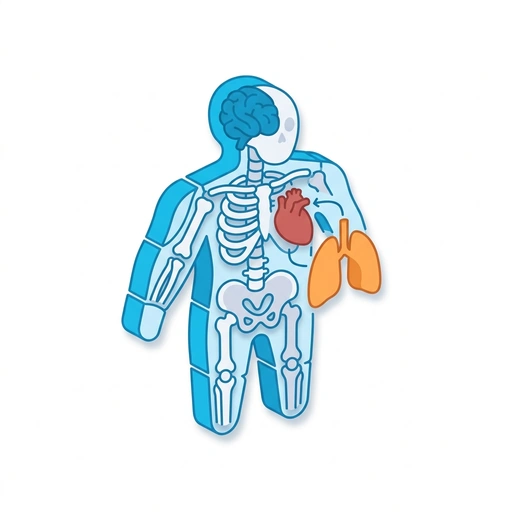
How the Human Body Fits Together
Understand your body's structural architecture through the bones, muscles, and organs you live with every day. Map where parts actually sit and see how your internal systems coordinate every breath and step.
Like Duolingo, but for How the Human Body Fits Together. Tomo turns the whole topic into a game you play five minutes a day, until it actually sticks.
A short one: 12 levels across 2 sections, about 24 minutes end to end, roughly 5 days at five minutes a day. It moves through The Moving Framework and The Internal Systems. It starts from scratch.
Free forever · No credit card · iPhone & Android
Key ideas in How the Human Body Fits Together
- Certain bones sit directly beneath the skin without thick muscle cover, making them easily felt
- Bones act as lever arms while the joints between them serve as fulcrums
- Body levers prioritize speed and distance over heavy lifting leverage
- A muscle anchored close to a joint needs to shorten only a tiny distance to swing the limb through a wide arc
- The collarbone (clavicle) spans the top of the chest to anchor the shoulder
- The hip crest marks where the torso ends and the pelvic basin begins
- The bony elbow point (olecranon) serves as the primary hinge marker for the arm
- Ball-and-socket joints like the shoulder and hip allow rotation in almost every direction
- Hinge joints like the elbow and knee lock movement into a single plane to provide stability
- Greater mobility in a joint inherently increases the risk of slipping out of place
- Bone is living tissue with blood vessels and active cells
- Impact and weight-bearing exercise stimulate bones to lay down extra mineral density where stress is highest
- Inactivity causes bone tissue to gradually thin and weaken
- Slick cartilage caps cushion the ends of touching bones so hard surfaces never collide
- Synovial fluid acts like biological oil inside the sealed joint capsule to eliminate friction
- Wear or loss of this protective cartilage layer leads to painful bone-on-bone friction
You've tried the other tabs
Thirty open tabs. Four facts you actually kept.
You watched. You nodded. By Sunday it was gone.
One answer, then back to scrolling.
Eight weeks. You meant to finish. You didn't.
Tomo gives How the Human Body Fits Together the Duolingo treatment: levels, streaks, and quick quizzes that test what you just learned. That game loop is what the tabs above never had, so it's the one you actually finish.
Here's what playing it feels like
A real question from this course. Take your best guess.
When your body moves, how do your bones and joints work together?
Get it right to open this lesson and 11 more in the app.
Where How the Human Body Fits Together takes you
- 1
The Moving Framework
- Locating Your Structural Landmarks
- Cables and Opposing Tension
- 2
The Internal Systems
- Pipes, Pumps, and Pressure
- The Core Floorplan
2 sections · 4 units · 12 levels. Built to play, not to enroll.
Tomo is in ChatGPT
Tomo is also a ChatGPT plugin: the same playable courses, built and played inside your chat.
Add Tomo to ChatGPT- What to ask
- “Make me a Tomo course on black holes.” “Turn this chat into a Tomo course.”
- What you get
- Quick questions with instant feedback, hearts and stars, ready to play in about a minute.
- Where it goes
- No sign-up to start. Connect your Tomo account and your streak carries on in the app.
You pick the voice
How the Human Body Fits Together is taught in the Explain Like I'm 5 style: no big words. promise.. Want a different feel? In the app you can spin up the same topic in any of Tomo's teaching styles. Same facts, totally different vibe.
More Science on Tomo
How the Human Body Fits Together
Explore the elegant architecture of your own body from the inside out. Learn how your skeleton, muscles, circulation, and vital organs coordinate to keep you upright, moving, and alive.
Anatomy of the Human Body
Discover how your bones, muscles, and internal systems coordinate every breath and step. Understand the physical machinery that powers daily movement, circulation, and sensation.
How the Human Body Is Built
Decode the architecture beneath your skin. Learn to identify major skeletal landmarks, trace how muscles pull against joints, and understand how internal organs are organized into working compartments.
Applied Human Anatomy
Bridge the gap between textbook organ lists and real human function. Learn how fascial planes, neurovascular pathways, and visceral architecture shape the living body.
Fluid Engineering in Practice
Bridge the gap between textbook fluid physics and working piping systems. Learn to calculate practical friction losses, match pumps to system resistance curves, and prevent catastrophic cavitation and water hammer.
Human Anatomy: Form and Function
Bridge the gap between basic body parts and true functional anatomy. Discover how bones, muscles, nerves, and organs mechanically coordinate to sustain motion, regulate pressure, and maintain life.
Start How the Human Body Fits Together today.
Download Tomo, search How the Human Body Fits Together, and play your first lesson in under a minute.