
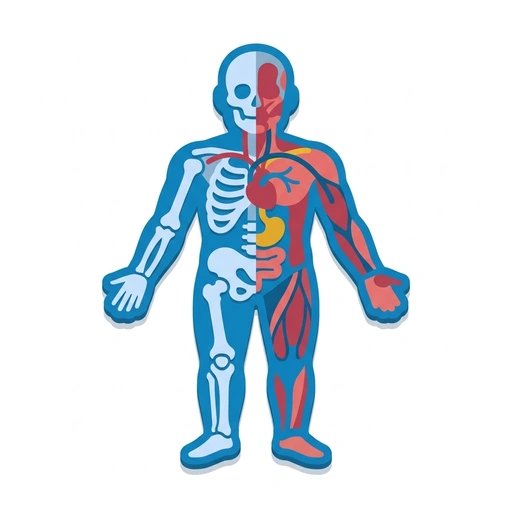
Human Anatomy: Form and Function
Bridge the gap between basic body parts and true functional anatomy. Discover how bones, muscles, nerves, and organs mechanically coordinate to sustain motion, regulate pressure, and maintain life.
Like Duolingo, but for Human Anatomy: Form and Function. Tomo turns the whole topic into a game you play five minutes a day, until it actually sticks.
20 levels across 3 sections, about 40 minutes end to end, roughly 8 days at five minutes a day. It moves through Mechanical Architecture and Movement; Internal Logistics and Fluid Dynamics; and Coordination, Regulation, and Defense. It assumes you already know the basics.
Free forever · No credit card · iPhone & Android

Key ideas in Human Anatomy: Form and Function
- The acromion provides a rigid landmark roughly 5 cm above the axillary nerve
- Tuffier's line spans both iliac crests to reliably identify the L4-L5 interspace
- The ulnar nerve runs directly posterior to the humerus's medial epicondyle
- The superficial back line links plantar fascia, Achilles tendon, and hamstrings
- Fascia transfers strain longitudinally across joints rather than absorbing it locally
- Tight hamstrings transmit tensile load downward into the plantar aponeurosis
- The sagittal plane governs flexion and extension, checking anteroposterior shear
- The frontal plane governs abduction/adduction, exposing collateral ankle ligaments
- The transverse plane governs rotation, with the dens providing the primary pivot
- Muscle spindle activation in the agonist stimulates Ia inhibitory interneurons
- Ia interneurons suppress alpha motor neurons supplying the antagonist muscle
- Failure of reciprocal inhibition produces co-contraction and limits joint excursion
- Spinal curves flex dynamically under load, converting vertical impact into distributed spring tension.
- A straight bony pillar concentrates axial shock straight into disc tissue instead of dampening it.
- Alternating cervical, thoracic, and lumbar curves balance gravity directly over the pelvis.
- Forward flexion compresses the anterior margins of adjacent vertebral bodies.
You've tried the other tabs
Thirty open tabs. Four facts you actually kept.
You watched. You nodded. By Sunday it was gone.
One answer, then back to scrolling.
Eight weeks. You meant to finish. You didn't.
Tomo gives Human Anatomy: Form and Function the Duolingo treatment: levels, streaks, and quick quizzes that test what you just learned. That game loop is what the tabs above never had, so it's the one you actually finish.
Here's what playing it feels like
A real question from this course. Take your best guess.
What anatomical landmark is pinpointed by drawing Tuffier's line across the tops of both iliac crests?
Get it right to open this lesson and 19 more in the app.
Where Human Anatomy: Form and Function takes you
- 1
Mechanical Architecture and Movement
- Mapping Surface Landmarks and Biomechanical Planes
- The Axial Core: Spinal Engineering and Load Transmission
- Appendicular Dynamics: Limbs, Girdles, and Kinetic Chains
- 2
Internal Logistics and Fluid Dynamics
- Cardiopulmonary Circulation and Pressure Gradients
- Visceral Architecture: The Abdominal Cavity and Gut
- 3
Coordination, Regulation, and Defense
- Peripheral Wiring and Somatosensory Pathways
- Fluid Balance, Endocrine Checkpoints, and Barrier Defense
3 sections · 7 units · 20 levels. Built to play, not to enroll.
You pick the voice
Human Anatomy: Form and Function is taught in the The Professor style: clear, structured, thorough. Want a different feel? In the app you can spin up the same topic in any of Tomo's teaching styles. Same facts, totally different vibe.
More Science on Tomo
How the Human Body Fits Together
Explore the elegant architecture of your own body from the inside out. Learn how your skeleton, muscles, circulation, and vital organs coordinate to keep you upright, moving, and alive.
Applied Human Anatomy
Decode the architectural logic of the human body through topographical relationships, fascial planes, and systemic structural design. Move beyond simple memorization to understand how form governs function across every major system.
Human Anatomy: Bones and Muscle
Move beyond memorizing muscle and bone names to understand how the human musculoskeletal system functions as an integrated mechanical machine. Learn how joints dictate movement, why muscles operate in coupled pairs, and how living tissue remodels under load.
Human Anatomy and Physiology in Practice
Go beyond basic diagrams to master the functional systems of the body. Learn how physiological mechanisms drive clinical diagnosis, natural healing, and peak human performance.
Human Anatomy and Physiology
Go beyond basic diagrams to master the complex mechanical and chemical interactions that sustain human life. This course bridges the gap between structural form and clinical function for a professional-grade understanding of the body.
Anatomy of the Human Body
Discover how your bones, muscles, and internal systems coordinate every breath and step. Understand the physical machinery that powers daily movement, circulation, and sensation.
Start Human Anatomy: Form and Function today.
Download Tomo, search Human Anatomy: Form and Function, and play your first lesson in under a minute.