
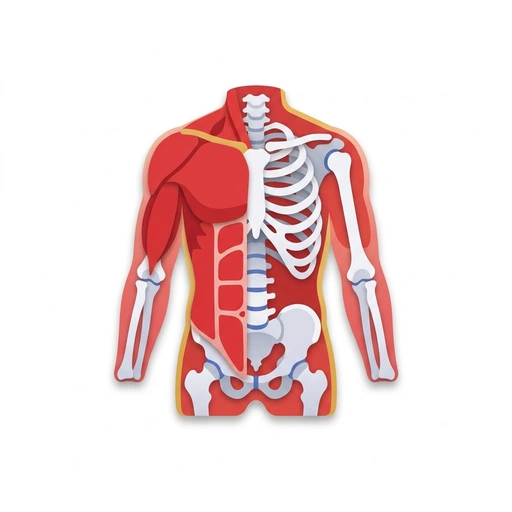
How the Human Body Works
Discover the mechanical and chemical systems that keep you alive, moving, and balanced every day. Explore how bones, muscles, blood, nerves, and organs collaborate seamlessly in real time.
Like Duolingo, but for How the Human Body Works. Tomo turns the whole topic into a game you play five minutes a day, until it actually sticks.
A short one: 11 levels across 2 sections, about 22 minutes end to end, roughly 4 days at five minutes a day. It moves through The Body in Motion and Control and Maintenance. It starts from scratch.
Free forever · No credit card · iPhone & Android
Key ideas in How the Human Body Works
- Bones act as rigid lever arms that amplify movement or force
- Joints act as the fixed pivot points (fulcrums) around which bones rotate
- Muscles provide the pulling effort while external weights or body parts act as the load
- Muscles can only pull by contracting; they cannot actively push
- Returning a joint to its original position requires an opposing muscle located on the other side of the joint
- In the arm, the biceps pulls to bend the elbow, while the triceps pulls to straighten it
- Tendons connect muscle to bone, transmitting the muscle's pulling force to create motion
- Ligaments connect bone to bone across a joint, holding the bones together and preventing abnormal twists or dislocations
- Neither tendons nor ligaments contract actively like muscles do
- Muscle fatigue happens when muscle cells deplete available chemical fuel and accumulate metabolic byproducts that hinder contraction
- Muscles do not simply run out of structural strength; their internal cellular machinery becomes temporarily unable to cycle
- Restoring blood flow and resting allows cells to clear waste and restock energy
- Standing upright is an active process requiring continuous, subtle micro-contractions across postural muscles in the back, core, and calves
- Joints do not passively lock rigid; without ongoing muscle pull to counteract gravity, the body would collapse
- The nervous system automatically fires tiny adjustments to keep your center of gravity balanced over your feet
- Distinguishing the connective roles of tendons and ligaments in stabilizing and moving a joint
You've tried the other tabs
Thirty open tabs. Four facts you actually kept.
You watched. You nodded. By Sunday it was gone.
One answer, then back to scrolling.
Eight weeks. You meant to finish. You didn't.
Tomo gives How the Human Body Works the Duolingo treatment: levels, streaks, and quick quizzes that test what you just learned. That game loop is what the tabs above never had, so it's the one you actually finish.
Here's what playing it feels like
A real question from this course. Take your best guess.
When your arm bends, what mechanical role does your elbow joint play?
Get it right to open this lesson and 10 more in the app.
How to learn How the Human Body Works, step by step
Go in order. 11 short levels across 2 sections, about 22 minutes in all, five minutes a day.
- 1
The Body in Motion
- Bones and Muscles as Mechanical Levers
- The Oxygen and Circulation Loop
- 2
Control and Maintenance
- Nerve Signals and Reflex Loops
- Fuel Processing and Waste Clearing
2 sections · 4 units · 11 levels. Built to play, not to enroll.
Questions about How the Human Body Works
How do I learn How the Human Body Works?
Go in order: start with The Body in Motion, then Control and Maintenance. On Tomo that's 11 short levels, about 22 minutes in all, played five minutes a day. Start free and play the first level in under a minute.
Is there a Duolingo-style app for How the Human Body Works?
Yes. Tomo works like Duolingo: short daily lessons, streaks and quick quizzes. How the Human Body Works is one of its free courses, and you can type any other topic to get a course of your own.
Is the How the Human Body Works course free?
Yes. How the Human Body Works is playable on Tomo's free plan, which doesn't expire. No credit card, no waitlist. Download the app and start your first lesson.
How long does it take to learn How the Human Body Works?
11 levels across 2 sections, about 22 minutes of play in total. It's built for five minutes a day, so you finish it a little at a time instead of all at once.
Do I need any background to start How the Human Body Works?
No. It's pitched at a beginner level, so it starts where you are and builds up. If you can tap a phone, you can start.
Tomo is in ChatGPT
Tomo is also a ChatGPT plugin: the same playable courses, built and played inside your chat.
Add Tomo to ChatGPT- What to ask
- “Make me a Tomo course on black holes.” “Turn this chat into a Tomo course.”
- What you get
- Quick questions with instant feedback, hearts and stars, ready to play in about a minute.
- Where it goes
- No sign-up to start. Connect your Tomo account and your streak carries on in the app.
You pick the voice
How the Human Body Works is taught in the Professor style: clear, structured, thorough. Want a different feel? In the app you can spin up the same topic in any of Tomo's teaching styles. Same facts, totally different vibe.
More Science on Tomo
How the Human Body Works
Discover the mechanical and chemical wonders powering your everyday life. Learn how muscles, organs, and nerves coordinate in real time to keep you moving, fueled, and alive.
How the Human Body Works
Discover the incredible machinery running beneath your skin every second. Learn how your organs coordinate, why your body produces familiar everyday sensations, and what it takes to keep you moving, thinking, and alive.
How the Human Body Works
Discover the mechanical and chemical principles that keep your body alive and moving. Learn how organs coordinate behind the scenes, how muscles generate force, and how your system automatically balances itself.
How the Human Body Works
Discover the mechanical and chemical systems keeping you alive every second. Learn how your heart, lungs, muscles, and nerves coordinate in real time to power movement and maintain vital balance.
How the Human Body Works
Discover how your body functions as an interconnected living machine. Explore the mechanics of bones and muscles, the heart and lungs' oxygen highway, digestive fuel conversion, and the nervous system's command center.
How the Human Body Works
Discover how your body coordinates movement, fuels your cells, and keeps you alive. Learn the mechanics behind everyday sensations from your heartbeat to muscle fatigue.
Start How the Human Body Works today.
Download Tomo, search How the Human Body Works, and play your first lesson in under a minute.