
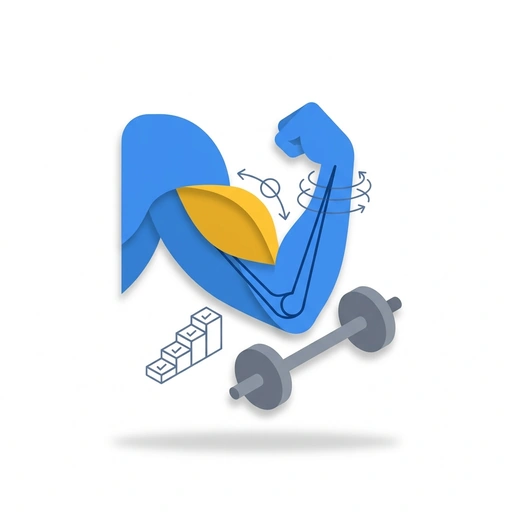
Hypertrophy Biomechanics and Program Design
Bridge the gap between exercise physiology and gym execution. Learn how to optimize joint stability, manipulate resistance profiles to match muscle anatomy, and program training volume for maximum muscular hypertrophy.
Like Duolingo, but for Hypertrophy Biomechanics and Program Design. Tomo turns the whole topic into a game you play five minutes a day, until it actually sticks.
24 levels across 3 sections, about 48 minutes end to end, roughly 10 days at five minutes a day. It moves through Joint Mechanics and Movement Execution, Resistance Architecture and Exercise Selection, and Evidence-Based Programming and Fatigue Management.
Free forever · No credit card · iPhone & Android

Key ideas in Hypertrophy Biomechanics and Program Design
- Unstable environments trigger protective neural inhibition and force the central nervous system to partition drive to small stabilizing muscles
- Rigid external contact points provide an opposing reaction force that eliminates balance-related motor output gating to the prime mover
- Higher output from the prime mover ensures high-threshold motor units are recruited earlier in the set
- Muscle fibers produce peak active tension when the external resistance directly opposes their anatomical pennation/fascicle trajectory
- The clavicular head runs roughly 30° to 45° upward from the humeral insertion toward the clavicle, meaning the opposing line of force must travel upward and inward
- Mismatched resistance vectors distribute tension onto secondary synergists and introduce non-productive joint shear
- Chest supports and backrests mechanically offload the spinal erectors, preventing spinal shear from becoming the limiting factor before target muscles reach failure
- Arm cradles isolate elbow flexors by preventing deltoid sway from dissipating mechanical tension
- Three-point or braced stances create stable reaction bases that allow full voluntary neural output without balance-limiting early termination
- Fixed straight bars lock the hands and wrists into a single plane, forcing the glenohumeral joint into an unnatural combination of internal rotation and horizontal abduction
- Independent handles and cables permit natural carrying angles and converging press arcs tailored to individual acromion morphology and ribcage shape
- Stimulus-to-fatigue ratio (SFR) evaluates local mechanical tension in the target muscle against total systemic, axial, and cardiovascular exhaustion
- Braced leg extensions with a lap belt eliminate axial loading and balance limits, directing virtually all motor effort into rectus femoris and vasti tension
- Front squats and pistol squats introduce massive spinal, core, and balancing demands that cause systemic or stability failure before the quads reach true local mechanical failure
- Internal moment arms are not static; a muscle's perpendicular distance to the joint center changes continuously as the bone rotates
- Supraspinatus possesses a relatively large internal moment arm at low abduction angles (0°–30°), whereas the lateral deltoid's line of pull has minimal perpendicular distance to the glenohumeral center until deeper into abduction (~60°+)
You've tried the other tabs
Thirty open tabs. Four facts you actually kept.
You watched. You nodded. By Sunday it was gone.
One answer, then back to scrolling.
Eight weeks. You meant to finish. You didn't.
Tomo gives Hypertrophy Biomechanics and Program Design the Duolingo treatment: levels, streaks, and quick quizzes that test what you just learned. That game loop is what the tabs above never had, so it's the one you actually finish.
Here's what playing it feels like
A real question from this course. Take your best guess.
Why does gripping a sturdy upright beam boost your strength during a single-arm lateral raise?
Get it right to open this lesson and 23 more in the app.
Where Hypertrophy Biomechanics and Program Design takes you
- 1
Joint Mechanics and Movement Execution
- Anchoring Stability and Line of Drive
- Active Range of Motion and Internal Moment Arms
- 2
Resistance Architecture and Exercise Selection
- Matching Resistance Curves to Strength Profiles
- Length-Tension Dynamics and Loaded Stretch
- Evaluating Stimulus-to-Fatigue Ratio (SFR) and Anatomy
- 3
Evidence-Based Programming and Fatigue Management
- Calibrating Proximity to Failure and Intensity
- Managing Connective Tissue, Systemic, and Axial Fatigue
- Volume Titration and Progressive Overload Architecture
3 sections · 8 units · 24 levels. Built to play, not to enroll.
Tomo is in ChatGPT
Tomo is also a ChatGPT plugin: the same playable courses, built and played inside your chat.
Add Tomo to ChatGPT- What to ask
- “Make me a Tomo course on black holes.” “Turn this chat into a Tomo course.”
- What you get
- Quick questions with instant feedback, hearts and stars, ready to play in about a minute.
- Where it goes
- No sign-up to start. Connect your Tomo account and your streak carries on in the app.
You pick the voice
Hypertrophy Biomechanics and Program Design is taught in the Bestie style: your friend who just gets it. Want a different feel? In the app you can spin up the same topic in any of Tomo's teaching styles. Same facts, totally different vibe.
More Sports on Tomo
Weight Lifting Biomechanics
Upgrade your lifting from generic form cues to applied biomechanics. Learn how your unique skeletal levers, muscle fiber lines of pull, and resistance profiles dictate optimal exercise selection and hypertrophy.
Gym Science: Muscle, Mind, and Fuel
Unlock the real mechanics behind muscle growth, training psychology, and performance nutrition. Bridge the gap between gym-floor intuition and exercise physiology to make every rep and meal count.
Anatomy for Athletic Movement
Bridge the gap between textbook anatomy and high-performance sport. Learn the functional terminology of planes, muscular roles, connective tissue mechanics, and kinetic chains to talk and train like a sports clinician.
Functional Anatomy in Sport
Decode the biomechanical language used by athletic trainers, physical therapists, and sports medicine pros. Learn how joints, planes, and kinetic chains work under real athletic loads.
Whole-Body EMS with Miha Bodytec
Bridge clinical neuromuscular physiology and advanced WB-EMS programming. Learn precise current parameter manipulation, motor unit recruitment mechanics, and rigorous safety protocols for high-intensity training.

Slopitch Strategy and Advanced Mechanics
Elevate your game beyond the basics with elite hitting techniques, defensive positioning theory, and the high-level strategy required for competitive tournament play.
Start Hypertrophy Biomechanics and Program Design today.
Download Tomo, search Hypertrophy Biomechanics and Program Design, and play your first lesson in under a minute.