
Mapping the Human Body
Learn the precise names and locations of your body's major structures, from everyday outer landmarks to subtle joints and core internal organs. Build the vocabulary you need to describe how your body moves, feels, and hurts with clarity and confidence.
Like Duolingo, but for Mapping the Human Body. Tomo turns the whole topic into a game you play five minutes a day, until it actually sticks.
A short one: 11 levels across 2 sections, about 22 minutes end to end, roughly 4 days at five minutes a day. It moves through Finding Your External Landmarks and Pinpointing Features and Internal Zones. It starts from scratch.
Free forever · No credit card · iPhone & Android
Key ideas in Mapping the Human Body
- The torso, or trunk, refers to the main central block of the body, excluding the head and limbs
- It includes the chest, back, and belly (abdomen), protecting vital organs like the heart and lungs
- Arms, legs, and the head attach to the torso rather than forming part of it
- The shoulder attaches the limb to the torso
- The upper arm sits above the elbow, and the forearm spans between the elbow and wrist
- The wrist connects the forearm directly to the hand at the outer end
- The lower limb structurally mirrors the upper limb: hip corresponds to shoulder as the ball anchor
- The hinge joint in the middle of the arm (elbow) mirrors the hinge in the leg (knee)
- The transition joint (wrist) mirrors the ankle, leading to the terminal contact point (hand to foot)
- Bilateral symmetry means the left and right halves of the outside of the body form approximate mirror images across a vertical midline
- Limbs, eyes, ears, and cheeks come in mirrored pairs on opposite sides
- Central features like the nose, mouth, and navel (belly button) lie directly on the line of symmetry
- The collarbone (clavicle) runs horizontally across the front of the upper chest to connect the breastbone to the shoulder
- The shoulder blade (scapula) floats against the back of the ribcage, moving whenever the arm reaches or lifts
- Together, the collarbone and shoulder blade form the mobile frame that anchors the entire arm to the ribcage
- The elbow bends and straightens the arm between the upper arm and forearm
You've tried the other tabs
Thirty open tabs. Four facts you actually kept.
You watched. You nodded. By Sunday it was gone.
One answer, then back to scrolling.
Eight weeks. You meant to finish. You didn't.
Tomo gives Mapping the Human Body the Duolingo treatment: levels, streaks, and quick quizzes that test what you just learned. That game loop is what the tabs above never had, so it's the one you actually finish.
Here's what playing it feels like
A real question from this course. Take your best guess.
Which parts belong to your torso and help guard important organs like your heart and lungs?
Get it right to open this lesson and 10 more in the app.
Where Mapping the Human Body takes you
- 1
Finding Your External Landmarks
- Mapping the Core and Limbs
- Locating Overlooked Joints and Connectors
- 2
Pinpointing Features and Internal Zones
- Navigating the Head and Face
- Locating Internal Organs and Cavities
2 sections · 4 units · 11 levels. Built to play, not to enroll.
Tomo is in ChatGPT
Tomo is also a ChatGPT plugin: the same playable courses, built and played inside your chat.
Add Tomo to ChatGPT- What to ask
- “Make me a Tomo course on black holes.” “Turn this chat into a Tomo course.”
- What you get
- Quick questions with instant feedback, hearts and stars, ready to play in about a minute.
- Where it goes
- No sign-up to start. Connect your Tomo account and your streak carries on in the app.
You pick the voice
Mapping the Human Body is taught in the Explain Like I'm 5 style: no big words. promise.. Want a different feel? In the app you can spin up the same topic in any of Tomo's teaching styles. Same facts, totally different vibe.
More Health on Tomo
Mapping the Human Body
Learn to read your own body like a clinical map. Discover how surface landmarks reveal internal organs, how your chest and abdomen are organized, and how spinal nerve highways route sensation.
Mapping the Human Body
Learn to read human anatomy like a clinical map. Master universal body orientation, follow major blood and nerve pathways, and understand how internal structures interact in health and disease.
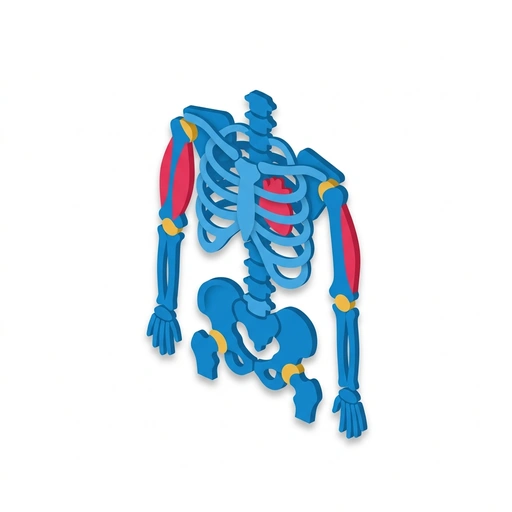
Human Anatomy for Nursing
Learn to read the human body through the eyes of a bedside clinician. Connect structural landmarks, vital organ positions, and anatomical pathways directly to daily patient assessment.
Human Anatomy for Patient Care
Learn the essential structures and functional systems of the human body through a practical clinical lens. Understand how organs interact, where vital landmarks sit, and why anatomical knowledge forms the foundation of frontline healthcare.
Visual Anatomy for Plastic Surgery
Learn to interpret surgical photos, cross-sections, and anatomical diagrams like a surgeon. Recognize tissue planes, critical fascial layers, and vital danger zones across the face, abdomen, and breast.
Your Body's Living Defenses
Discover how your organs, tissues, and trillions of resident microbes work together to keep you alive. Learn the mechanics of physical barriers, internal immune responses, and the microscopic ecosystem running inside you.
Start Mapping the Human Body today.
Download Tomo, search Mapping the Human Body, and play your first lesson in under a minute.