
Reading Architectural Tectonics
Like Duolingo, but for Reading Architectural Tectonics. Tomo turns the whole topic into a game you play five minutes a day, until it actually sticks.
For the part of you with thirty open tabs that never became anything.
A short one: 11 levels across 2 sections, about 22 minutes end to end, roughly 4 days at five minutes a day. It moves through Decoding Structural Envelope and Joint and Sectional Logic and Material Longevity.
Free forever · No credit card · iPhone & Android

Key ideas in Reading Architectural Tectonics
- Open-joint outer panel intercepts kinetic rain energy while venting cavity pressure
- Ventilated air gap allows drainage, upward convective drying, and pressure equalization
- Continuous mineral wool insulation sits outboard of the air-and-water barrier to eliminate thermal flanking
- Continuous vapor and air-impermeable barrier adhered directly to the exterior face of the structural backup wall forms the definitive environmental line
- Extruded aluminum expands and contracts significantly faster under diurnal cycles than Portland cement concrete
- Shadow reveals conceal the required clearance depth and backer-rod geometry needed to accommodate shear movement
- Rigid flush transitions force internal thermal stress into either mechanical fasteners or joint sealant tears
- Bearing masonry requires visible jamb depth to house wall thickness and lintel bearing surfaces
- Suspended curtain walls place the glazing line flush or nearly flush with the exterior skin outboard of structural slabs
- Precast sandwich panels produce distinctive deep chamfered panel joints and medium reveals that reflect two concrete wythes framing rigid insulation
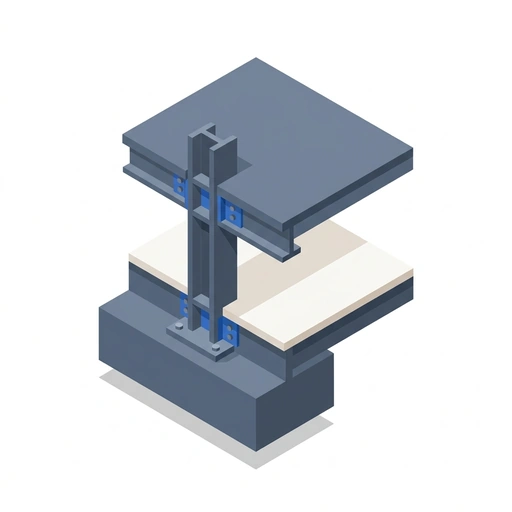
- Engineered structural thermal breaks use high-density rigid insulation penetrated by stainless steel rebar and compression pads to maintain structural continuity across the slab edge rupture
- Supporting the balcony via an independent exterior self-supporting steel or timber frame pinned laterally to the facade eliminates the need for slab penetrations
- Full-slab continuous monolithic pours create massive uninsulated thermal fins that radiate interior energy outward and trigger condensation risk indoors
- True pinned bases taper to a point to allow rotational freedom, reducing the apparent visual footprint at the foundation line
- Moment-resisting bases require deep haunches, embedded base plates, or heavy bolt clusters that visually root the column into the ground
- Releasing moment at the column base transfers lateral resistance demands entirely onto diagonal bracing or an interior stiffening core
You've tried the other tabs
Thirty open tabs. Four facts you actually kept.
You watched. You nodded. By Sunday it was gone.
One answer, then back to scrolling.
Eight weeks. You meant to finish. You didn't.
Tomo gives Reading Architectural Tectonics the Duolingo treatment: levels, streaks, and quick quizzes that test what you just learned. That game loop is what the tabs above never had, so it's the one you actually finish.
Here's what playing it feels like
A real question from this course. Take your best guess.
What primary purpose does the ventilated air gap serve directly behind the rainscreen cladding?
Get it right to open this lesson and 10 more in the app.
Where Reading Architectural Tectonics takes you
Move beyond facade aesthetics by decoding the engineering and spatial logics that drive contemporary buildings. Analyze how load transfers, envelope detailing, and sectional cuts convert practical structural constraints into compelling spatial experiences. Develop an expert eye for structural joints, environmental envelopes, and material palimpsests.
- 1
Decoding Structural Envelope and Joint
- Decoupling Structure and Cladding
- Articulating the Structural Joint
- 2
Sectional Logic and Material Longevity
- Sectional Volumetrics and Environmental Flow
- Adaptive Envelopes and Material Stratigraphy
2 sections · 4 units · 11 levels. Built to play, not to enroll.
You pick the voice
Reading Architectural Tectonics is taught in the The Professor style: clear, structured, thorough. Want a different feel? In the app you can spin up the same topic in any of Tomo's teaching styles. Same facts, totally different vibe.
More Arts on Tomo
Fabric Arts: Structure and Style
Move beyond basic stitches to understand the engineering and chemistry of textiles. Learn to manipulate drape, reinforce structures, and hack patterns for professional results.

The Architect's Eye
Stop just looking at buildings and start reading them. Learn to decode the hidden logic of facades, sections, and structural choices that define our built world.

How to Read Buildings
Transform everyday walks into explorations by decoding the clues hidden in facades and floor plans. Discover how structures balance weight, guide your movement, and shape how you feel inside them.

The Grammar of Architecture
Move beyond looking at buildings to actually reading them. Learn the visual logic of rhythm, proportion, and structure that architects use to communicate meaning and emotion.

The Language of Architecture
Move beyond naming styles to understanding the logic of the built world. Learn how architects manipulate space, light, and materials to shape human experience.

Cricut Explore 4: From Box to Build
Unlock the power of your cutting machine to create custom stickers, home decor, and personalized gifts. This course takes you from your very first cut to mastering complex multi-layered projects.
Start Reading Architectural Tectonics today.
Download Tomo, search Reading Architectural Tectonics, and play your first lesson in under a minute.