
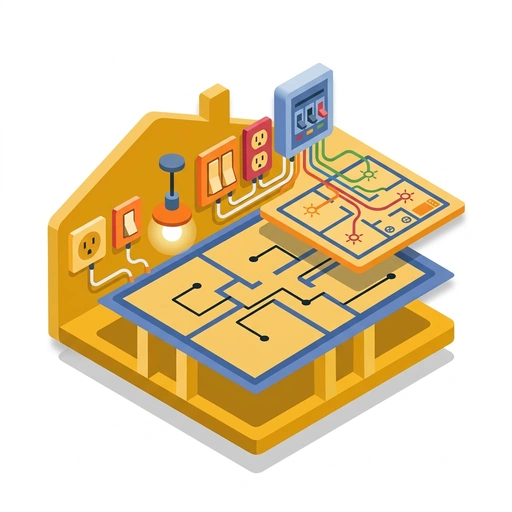
Residential Electrical Plans
Learn to read, evaluate, and draft residential electrical plans. Move beyond basic symbols into switch-leg topology, code-compliant outlet layouts, and panel load schedules.
Like Duolingo, but for Residential Electrical Plans. Tomo turns the whole topic into a game you play five minutes a day, until it actually sticks.
A short one: 11 levels across 2 sections, about 22 minutes end to end, roughly 4 days at five minutes a day. It moves through Decoding Room Layouts and Switching Logic and Circuit Routing and Panel Schedules. It assumes you already know the basics.
Free forever · No credit card · iPhone & Android

Key ideas in Residential Electrical Plans
- Curved or dashed switch lines indicate functional switching control rather than physical wire runs.
- Physical cables must run square along building framing members like studs and joists on the job site.
- Using curved lines on plans prevents installers from confusing control connections with straight structural walls.
- Matching lowercase subscripts link specific switches to their designated fixture sets across open spaces.
- Multiple letters on a switch symbol indicate a multi-gang box with independent toggles for each group.
- Shared subscript letters at different door locations indicate multi-way switching of the same fixture group.
- The abbreviation AFF defines rough-in measurements taken above finished floor level.
- Floor finish thickness like tile or hardwood must be factored into AFF rough-in box layout.
- Specific AFF callouts override general sheet notes for standard wall outlet heights.
- A half-shaded receptacle circle indicates a half-hot outlet where one socket is switched and one stays live.
- GFCI or AFCI text notations next to a receptacle symbol mandate integrated circuit interruption devices.
- Double sets of slash marks or quad symbols signify double-duplex boxes sharing a yoke or circuit, not four runs.
- The six-foot rule ensures a standard six-foot appliance cord can reach a receptacle from any point.
- The first outlet must sit within 6 feet of a door or opening along an unbroken wall line.
- Maximum spacing between consecutive wall receptacles is 12 feet along continuous wall space.
- Kitchen counters require small-appliance circuits with outlets spaced at maximum 4-foot intervals.
You've tried the other tabs
Thirty open tabs. Four facts you actually kept.
You watched. You nodded. By Sunday it was gone.
One answer, then back to scrolling.
Eight weeks. You meant to finish. You didn't.
Tomo gives Residential Electrical Plans the Duolingo treatment: levels, streaks, and quick quizzes that test what you just learned. That game loop is what the tabs above never had, so it's the one you actually finish.
Here's what playing it feels like
A real question from this course. Take your best guess.
How must an electrician actually route physical cables through a house?
Get it right to open this lesson and 10 more in the app.
How to learn Residential Electrical Plans, step by step
Go in order. 11 short levels across 2 sections, about 22 minutes in all, five minutes a day.
- 1
Decoding Room Layouts and Switching Logic
- Reading Room Plans: Symbols, Arcs, and Switch Legs
- Code Spacing and Wet-Location Layouts
- 2
Circuit Routing and Panel Schedules
- Multi-Way Switching and Conductor Tick Marks
- Panel Schedules and Load Coordination
2 sections · 4 units · 11 levels. Built to play, not to enroll.
Questions about Residential Electrical Plans
How do I learn Residential Electrical Plans?
Go in order: start with Decoding Room Layouts and Switching Logic, then Circuit Routing and Panel Schedules. On Tomo that's 11 short levels, about 22 minutes in all, played five minutes a day. Start free and play the first level in under a minute.
Is there a Duolingo-style app for Residential Electrical Plans?
Yes. Tomo works like Duolingo: short daily lessons, streaks and quick quizzes. Residential Electrical Plans is one of its free courses, and you can type any other topic to get a course of your own.
Is the Residential Electrical Plans course free?
Yes. Residential Electrical Plans is playable on Tomo's free plan, which doesn't expire. No credit card, no waitlist. Download the app and start your first lesson.
How long does it take to learn Residential Electrical Plans?
11 levels across 2 sections, about 22 minutes of play in total. It's built for five minutes a day, so you finish it a little at a time instead of all at once.
Do I need any background to start Residential Electrical Plans?
No. It's pitched at an intermediate level, so it starts where you are and builds up. If you can tap a phone, you can start.
Tomo is in ChatGPT
Tomo is also a ChatGPT plugin: the same playable courses, built and played inside your chat.
Add Tomo to ChatGPT- What to ask
- “Make me a Tomo course on black holes.” “Turn this chat into a Tomo course.”
- What you get
- Quick questions with instant feedback, hearts and stars, ready to play in about a minute.
- Where it goes
- No sign-up to start. Connect your Tomo account and your streak carries on in the app.
You pick the voice
Residential Electrical Plans is taught in the Professor style: clear, structured, thorough. Want a different feel? In the app you can spin up the same topic in any of Tomo's teaching styles. Same facts, totally different vibe.
More Technology on Tomo
Reading the Tape for Low-Voltage Installs
Crack the code of tape measure lines, master field fraction math, and lay out low-voltage brackets and cable runs with professional accuracy.
Tape Measure Precision
Move beyond slow tick-counting and eliminate measuring errors. Learn to read blade graduations at a glance, exploit built-in tape mechanics, and decode trade layout markings.
How to Read a Tape Measure
Crack the code of fractional tick marks, mysterious diamond symbols, and the loose metal hook. Learn how the blade works so you can measure accurately down to the sixteenth of an inch.

Python for Excel Users
Stop wrestling with crashing workbooks and fragile formulas. Learn how to use lightweight Python scripts to clean, combine, and automate your everyday spreadsheet workflows in minutes.

Resilient Excel Spreadsheets
Upgrade from fragile, manual spreadsheets to modern, dynamic workbooks. Learn to replace nested IFs, retire brittle lookups with XLOOKUP, and build self-updating models using dynamic arrays and structured tables.
Commercial Electrical Systems & Math
Bridge the gap between roughing-in conduit and passing commercial certification. Master three-phase power, precision voltage calculations, transformer connections, and motor circuit sizing.
Start Residential Electrical Plans today.
Download Tomo, search Residential Electrical Plans, and play your first lesson in under a minute.