
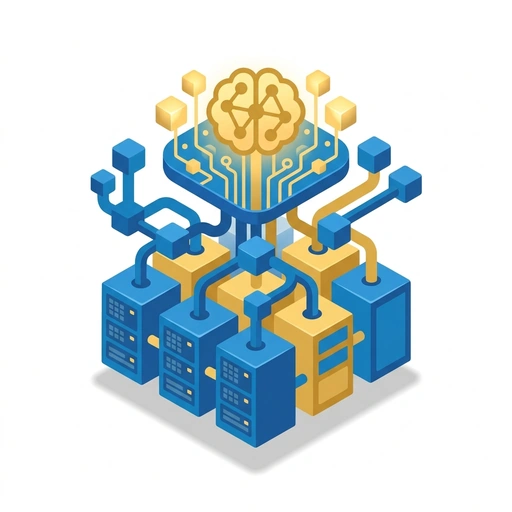
The Physical Engine Behind AI
Every prompt you send travels through subsea fiber, warehouse-scale supercomputers, and gigawatt power grids. Discover the astonishing physical infrastructure and futuristic engineering keeping modern artificial intelligence alive.
Like Duolingo, but for The Physical Engine Behind AI. Tomo turns the whole topic into a game you play five minutes a day, until it actually sticks.
A short one: 11 levels across 2 sections, about 22 minutes end to end, roughly 4 days at five minutes a day. It moves through From Keyboard to the Server Floor and The Heat, Power, and Futuristic Fixes. It starts from scratch.
Free forever · No credit card · iPhone & Android

Key ideas in The Physical Engine Behind AI
- A text prompt is chopped into tiny digital packets sent first over local Wi-Fi or cellular connections
- Packets cross long distances and oceans as pulses of light through physical fiber-optic glass cables
- The packets reassemble only once they reach the physical servers running the AI model
- Data travels as light through glass cables, which has a hard physical speed limit
- Even with the fastest computers, traveling thousands of miles introduces noticeable lag
- Tech companies build data centers close to major cities so signals have less physical distance to cover
- Everyday internet tasks like streaming or browsing treat each user's data independently, like separate cars on a road
- AI workloads divide giant calculations across thousands of networked processors that must synchronize their results
- If a single packet of AI calculation data gets delayed in the data center, the entire cluster must pause and wait for it
- Bandwidth is capacity (how wide the pipe is), while latency is delay (how fast a signal arrives)
- Chatbot prompts and token replies contain very little data, so they need very little bandwidth
- Traditional data centers host many unrelated tasks across isolated servers, but an AI data center links thousands of servers into a single shared machine
- Training a modern AI model requires thousands of racks working together on the same massive problem at once
- Standard processors (CPUs) excel at stepping through general-purpose tasks one instruction at a time
- The perceived wait time before an AI starts replying is almost entirely down to round-trip latency
- AI chips (such as GPUs or TPUs) contain thousands of smaller cores designed to calculate matrix math in parallel
You've tried the other tabs
Thirty open tabs. Four facts you actually kept.
You watched. You nodded. By Sunday it was gone.
One answer, then back to scrolling.
Eight weeks. You meant to finish. You didn't.
Tomo gives The Physical Engine Behind AI the Duolingo treatment: levels, streaks, and quick quizzes that test what you just learned. That game loop is what the tabs above never had, so it's the one you actually finish.
Here's what playing it feels like
A real question from this course. Take your best guess.
Imagine you tap 'send' on a question to an AI chatbot. What happens to your words first?
Get it right to open this lesson and 10 more in the app.
Where The Physical Engine Behind AI takes you
- 1
From Keyboard to the Server Floor
- Following a Prompt Down the Wire
- Inside the AI Server Warehouse
- 2
The Heat, Power, and Futuristic Fixes
- Power, Heat, and the Industrial Bottlenecks
- The Next Generation of AI Plumbing
2 sections · 4 units · 11 levels. Built to play, not to enroll.
Tomo is in ChatGPT
Tomo is also a ChatGPT plugin: the same playable courses, built and played inside your chat.
Add Tomo to ChatGPT- What to ask
- “Make me a Tomo course on black holes.” “Turn this chat into a Tomo course.”
- What you get
- Quick questions with instant feedback, hearts and stars, ready to play in about a minute.
- Where it goes
- No sign-up to start. Connect your Tomo account and your streak carries on in the app.
You pick the voice
The Physical Engine Behind AI is taught in the Storyteller style: every lesson is a story. Want a different feel? In the app you can spin up the same topic in any of Tomo's teaching styles. Same facts, totally different vibe.
More Technology on Tomo
How Electric Cars Work
Discover what really happens beneath the floorboards of an electric vehicle. Learn how battery packs, electric motors, and smart electronics replace centuries of traditional engine mechanics.
Car Mechanics and Everyday Upgrades
Understand how cars work from the engine bay to the wheels, and learn the essential logic behind modifying them for speed, sound, and handling.
Working with Modern AI
Understand how contemporary artificial intelligence models actually process, reason, and generate information. Learn to steer models via structured outputs, ground them with retrieval systems, and navigate the architectural trade-offs powering modern AI applications.
How Cars Work
Demystify what happens beneath the hood and behind the dashboard. Learn how engines, transmissions, and brakes operate, how to spot warning signs before they become costly breakdowns, and how to make confident decisions as an owner.
Industrial Networking in Practice
Design resilient shop-floor networks and bridge operational systems to enterprise IT safely. Learn how to handle determinism, industrial protocols, physical zoning, and passive monitoring without bringing down live production lines.
SQL Server Engine Tuning
Pinpoint SQL Server bottlenecks under high concurrency by profiling wait statistics, eliminating memory grant spills, resolving latch contention, and stabilizing query optimizer regressions.
Start The Physical Engine Behind AI today.
Download Tomo, search The Physical Engine Behind AI, and play your first lesson in under a minute.